
Choosing the right channel strip for voiceover can make a simple mic chain sound more polished, controlled, and ready for clients. The best options help you shape tone, manage dynamics, and keep noise low without slowing down your workflow.
Below, we focus on 10 standout picks for voice talent, from straightforward budget-friendly processors to high-end studio channel strips built for premium vocal detail.
Best 10 Channel Strip for Voiceover Picks for 2026
Studio Voice Strip
dbx 286s Channel Strip for Voiceover

- Compression, de-esser, enhancer, and gate in one rack unit
- Classic dbx compression helps vocals stay clear and present
- XLR mic input plus 1/4" TRS line input adds flexibility
Best For: Solo voiceover setups needing simple, hardware vocal processing
Tube Tracking Channel

- Tube preamp with compressor, expander, de-esser, and gate
- Digital outputs include ADAT, AES/EBU, S/PDIF, and TOSLink
- USB direct-connect supports computer or laptop use
Best For: Voiceover setups that want tube tone and digital output flexibility
Podcast Control Hub

- 10-channel mixer/interface with dual combo inputs
- Gain, EQ/tone, noise cancellation, and reverb onboard
- USB, Bluetooth, AUX, and OTG connectivity
Best For: Voiceover and podcast setups needing live mixer control and device flexibility
Tube EQ Strip
PreSonus StudioChannel Voice Processor

- Class A tube preamp with VCA compression
- 3-band EQ offers variable-q mid and shelving/peak shaping
- Mic, line, and instrument inputs in a 1U rack unit
Best For: Voiceover studios wanting tube tone, EQ shaping, and compression
Tube Channel Strip Pick

- Mono tube channel strip
- Opto/FET compression voicings
- 4-band semi-parametric EQ
Best For: Voiceover users wanting tube character and flexible control
Compact 500-Series Pick
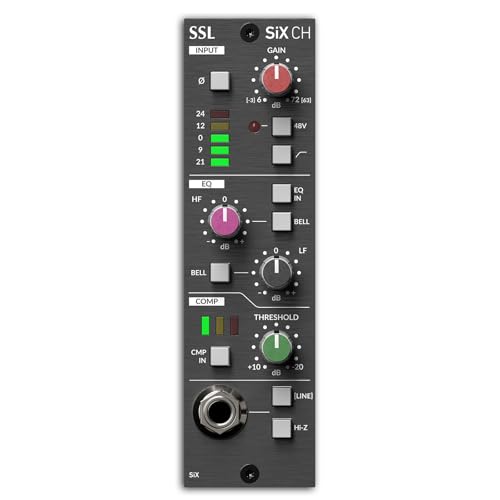
- 500 Series mic pre, EQ, and compressor
- Single knob compressor with variable threshold
- Front-panel TRS input and Hi-Z switch
Best For: Compact voiceover chains in a 500 Series rack
Transformer Color Pick

- Class A mic/line preamp
- Custom transformer outputs with Silk enhancement
- 8-segment LED meters
Best For: Voiceover recording with analog color and level monitoring
Tube Voice Chain

- Vacuum tube mic/instrument/line preamp
- Includes EQ and optical compressor
- Single-channel XLR channel strip
Best For: Voiceover artists wanting tube warmth and simple all-in-one processing
Premium Mono Strip

- Discrete mono channel strip
- Lundahl transformers with preamp
- Compressor, transient designer, and tube saturation
Best For: Single-voice setups needing detailed analog shaping
Dual-Mode Control
SSL Super 9000 Analogue Channel Strip

- Selectable SuperAnalogue or VHD preamp
- THAT 2181A VCA compressor
- 4-band EQ with parametric mid-bands
Best For: Engineers wanting flexible preamp tone and precise analog control
Studio Voice Strip – dbx 286s Channel Strip for Voiceover
If you want a practical channel strip for voiceover, the dbx 286s is built around the basics that matter most: clean mic preamp gain, compression, de-essing, and simple tone shaping. It also adds an expander/gate and loop-out, so you can tighten up spoken-word recordings and patch in extra processing when needed.
Best For: Solo voiceover setups that need straightforward mic control, sibilance reduction, and rack-mounted convenience.
Pros:
- Includes compression, de-esser, enhancer, and expander/gate in one 1U unit.
- Classic dbx compression is designed to help vocals stand out with more clarity and presence.
- Floating balanced XLR mic input and additional 1/4″ TRS line input add flexibility.
- Status LEDs make level and processor monitoring easy at a glance.
Cons:
- Single-channel design, so it is geared to one source at a time.
- Rack mount format may be less convenient for ultra-portable voiceover rigs.
Overall, this is a focused channel strip for voiceover work where you want core vocal processing without extra complexity. It is a strong fit if you prefer a hardware unit that handles preamp and dynamics duties in one place.
Tube Tracking Channel – ART VoiceChannel Tube Strip
The ART VoiceChannel is a channel strip for voiceover users who want tube preamp character plus onboard dynamics control in a single recording chain. Its tube preamp, compressor, expander, de-esser, and gate are paired with flexible digital outputs, so it works well when you want to move from analog tracking to digital capture cleanly.
Best For: Voiceover recording chains that need tube warmth, onboard dynamics, and digital output options.
Pros:
- Proven ART tube preamp design adds warmth and definition.
- Includes compressor, expander, de-esser, and gate for vocal control.
- Flexible digital connectivity includes ADAT Lite-pipe, AES/EBU, S/PDIF, and TOSLink.
- USB direct-connect support adds an easy path to a computer or laptop.
Cons:
- More connectivity options can make setup less straightforward than simpler strips.
- Single-channel design limits it to one voice or source at a time.
This is a strong option if you want a more full-featured hardware chain for spoken voice and are interested in both tube coloration and digital routing. It favors flexibility over simplicity, which can be useful in a serious voiceover studio.
Podcast Control Hub – AMIX40U Mixer Interface
While it is not a traditional channel strip, the AMIX40U offers several controls voiceover creators often want in one compact unit, including gain, EQ/tone modes, noise cancellation, reverb, and input monitoring. For a channel strip for voiceover-style work that also needs podcast, streaming, and multi-device connectivity, this mixer/interface can be a flexible all-in-one option.
Best For: Voiceover and podcast workflows that benefit from mixer-style control, multiple inputs, and live monitoring.
Pros:
- 10-channel control with dual XLR/6.35mm combo inputs.
- 48V phantom power supports compatible condenser microphones.
- Onboard gain, EQ/tone modes, noise cancellation, reverb, and monitoring controls.
- USB, Bluetooth, AUX, and OTG connectivity support a wide range of devices.
Cons:
- Not a dedicated channel strip, so processing is mixer-based rather than strip-based.
- Requires external USB-C power and is not rechargeable.
This is a versatile pick if your voiceover setup overlaps with streaming, podcasting, or computer-based recording. It offers broad connectivity and live control, but buyers seeking a classic one-channel vocal processor may want a more specialized strip.
Tube EQ Strip – PreSonus StudioChannel Voice Processor
The PreSonus StudioChannel is a more feature-rich channel strip for voiceover users who want tube preamp character, EQ shaping, and compression in one rack unit. With a Class A 12AX7 vacuum-tube preamp, 3-band EQ, and VCA compressor, it is designed for tracking voices and instruments with plenty of tonal control.
Best For: Voiceover studios that want tube coloration plus detailed EQ and compression in a rackmount strip.
Pros:
- High-voltage Class A 12AX7 tube preamp adds drive and character.
- Variable-q mid EQ and semi-parametric/shelving high-low bands provide detailed shaping.
- VCA compressor includes auto attack/release and soft/hard knee options.
- Mic, line, and instrument inputs make it flexible for different sources.
Cons:
- Racked 1U design is less portable than desktop gear.
- May be more feature-heavy than needed for simple voice-only setups.
For creators who want more hands-on control over vocal tone, this is a strong hardware option. It combines preamp coloration, EQ, and compression in a format that suits a dedicated studio workflow.
Tube Channel Strip Pick – ART Pro Channel III
If you want a channel strip for voiceover with a more flexible analog front end, the ART Pro Channel III gives you a mono tube path with switchable microphone impedance, selectable Opto/FET compression voicings, and a 4-band semi-parametric EQ. That combination makes it a practical option for shaping spoken-word recordings at the source.
Best For: Voiceover setups that need tube coloration, multiple compression options, and detailed EQ control.
Pros:
- Mono tube channel strip with switchable microphone impedance
- Selectable Opto/FET compression voicings for different control styles
- 4-band semi-parametric EQ for targeted tone shaping
Cons:
- Large chassis and heavier build may take more rack space
- More controls can mean a steeper setup curve than simpler strips
Overall, this is a versatile voiceover channel strip if you want one unit that can handle preamp, compression, and EQ duties without staying fixed to a single character.
Compact 500-Series Pick – SSL SiX Channel Strip
Solid State Logic SiX Channel Strip 500 Series | Mic-Pre, EQ, and Single Knob Compressor
Check Price On AmazonThe Solid State Logic SiX Channel Strip is a streamlined channel strip for voiceover when you want the essentials in a 500 Series format. It includes mic pre, EQ, a single knob compressor, +48V phantom power, a 75 Hz high-pass filter, and a front-panel TRS line input with 1MΩ Hi-Z switching.
Best For: Voiceover rigs that need a compact 500 Series channel strip with simple compression and practical front-panel connectivity.
Pros:
- 500 Series channel strip with mic pre, EQ, and compressor
- Single knob compressor with variable threshold for quick level control
- 75 Hz HPF and shelf-to-bell EQ switching add useful shaping options
- Front-panel TRS line input with 1MΩ Hi-Z switch
Cons:
- Single-channel design keeps the feature set focused rather than expansive
- Designed for 500 Series systems, so it is not a standalone unit
This is a clean, efficient choice if you want a straightforward voiceover channel strip that emphasizes speed, flexibility, and modular studio integration.
Transformer Color Pick – Newton Channel Strip
The Newton Channel Strip is built for voiceover users who want a mono channel strip with a Class A mic/line preamp, custom transformer outputs, Silk harmonic enhancement, and compressor control. Its 8-segment LED meters also make it easier to keep an eye on levels while tracking spoken word.
Best For: Voiceover recording that benefits from a Class A front end, transformer output stage, and harmonic enhancement.
Pros:
- Mono channel strip with Class A mic/line preamp
- Custom transformer outputs for added analog character
- Silk harmonic enhancement for tonal shaping
- 8-segment LED meters help with level monitoring
Cons:
- Heavier, larger unit may be less convenient for small setups
- Feature set is focused on analog processing rather than minimalism
For a voiceover chain that prioritizes character and monitoring, this channel strip offers a more polished analog workflow with useful built-in control.
Tube Voice Chain – Universal Audio LA-610 Mk II
If you want a channel strip for voiceover that leans into a classic tube character, the Universal Audio LA-610 Mk II gives you a mic/line/instrument preamp, EQ, and optical compression in one unit. It is a straightforward single-channel option for shaping vocal tone and controlling dynamics at the source.
Best For: Voiceover artists who want a tube-based all-in-one channel strip with preamp, EQ, and compression.
Pros:
- Vacuum tube preamp for adding tube color to voice recordings
- Built-in EQ and optical compressor simplify the vocal chain
- Single-channel design is focused on one voice source
- XLR input supports standard microphone connection
Cons:
- Heavier unit at 15.7 pounds
- Only one channel, so it is not meant for multi-voice setups
- More specialized if you want a very transparent vocal path
Overall, the LA-610 Mk II is a practical pick if your voiceover workflow benefits from a built-in tube preamp, EQ, and optical compression rather than separate rack pieces.
Premium Mono Strip – SPL Channel One MK3
The SPL Channel One MK3 is a mono channel strip for voiceover buyers who want a detailed front end with discrete preamp design, transformer-based I/O, and onboard dynamics tools. Its feature set combines a preamp, compressor, transient designer, and tube saturation in one mono unit.
Best For: Voiceover studios that want a flexible mono channel strip with transformer color and multiple shaping tools.
Pros:
- Discrete preamp with Lundahl I/O transformers
- Includes compressor, transient designer, and tube saturation
- Mono channel layout is well suited to single-voice recording
- Stainless steel construction suggests a robust build
Cons:
- Single-channel design limits it to one source at a time
- Heavier unit at 16.78 pounds
- May be more processing than some simple voiceover rigs need
As a channel strip for voiceover, the Channel One MK3 stands out when you want more control over tone and dynamics at the hardware stage without building a larger rack around it.
Dual-Mode Control – SSL Super 9000 Analogue Channel Strip
The SSL Super 9000 Analogue Channel Strip is aimed at voiceover users who want a flexible analog chain with selectable preamp character, a VCA compressor, and a fully parametric four-band EQ. It also includes input flip capability, which lets you move the VHD preamp from the mic path into the line input path for saturation or distortion processing at the mix stage.
Best For: Voiceover engineers who want selectable preamp flavors and detailed EQ/compression control in one strip.
Pros:
- Two mic-pre character options: SuperAnalogue and VHD
- VCA compressor section uses THAT 2181A circuitry
- 4-band EQ with fully parametric mid-bands for shaping vocals
- Input flip expands saturation/distortion routing options
Cons:
- Only one channel
- Warranty description is only 3 months
- Feature depth may be more than a basic voiceover chain requires
For voiceover work, the Super 9000 is a strong choice when you want precise tonal control and the option to move from clean capture to more colored processing with the same hardware.
How We Picked the Best Channel Strip for Voiceover
We focused on features that matter most in a Channel Strip for Voiceover: clean mic preamps, useful dynamics control, flexible EQ, low-noise operation, and a workflow that suits spoken-word recording. We also considered how well each unit fits different studio setups, from home booths to more advanced vocal chains.
Quick Comparison
Some units are best for fast, all-in-one voice processing, while others are better if you want a more transparent signal path or a more musical character. If you need simple control and dependable results, prioritize easy gain staging and basic compression. If you want a signature sound, look for tube coloration, premium analog sections, or more refined EQ behavior.
Key Buying Factors for a Channel Strip for Voiceover
Preamp Quality and Noise Floor
Voice recording exposes hiss, hum, and weak gain stages quickly. Look for enough clean gain for your microphone, especially if you use an SM7B-style dynamic mic or record at lower levels. A quiet preamp matters more than flashy extras.
Compression and De-Essing
For spoken voice, compression should tame peaks without making the delivery sound squashed. A de-esser can be just as valuable, since harsh sibilance often stands out in narration, podcasting, and commercial reads. Simple, predictable controls are usually easier to use than complex multi-stage processing.
EQ and Tone Shaping
A good channel strip should let you clean up rumble, tame boxiness, and add a little presence if needed. For voiceover, subtle EQ is usually better than aggressive shaping. Broad, musical EQ curves are often easier to manage than surgical controls.
Connectivity and Workflow
Check whether you need analog inserts, digital outs, USB integration, or 500-series compatibility. For many voiceover setups, straightforward front-panel control and fast recall matter more than advanced routing. If your booth setup changes often, a simple, reliable layout can save time.
Who Should Buy Which Channel Strip for Voiceover?
If you want an easy, all-purpose Channel Strip for Voiceover, choose a model with straightforward compression, de-essing, and clean preamp performance. If you want a warmer or more colored sound, tube-based options may be a better fit. If your priority is maximum studio control, a premium analog strip with stronger EQ and compression options may be worth the higher cost.
Beginners usually benefit most from units that are simple to dial in and hard to misuse. Experienced voice actors, producers, and engineers may prefer more detailed tools that reward careful setup and provide a more distinctive final sound.