
Choosing among OLED reference monitors for content creators means balancing color accuracy, resolution, HDR performance, connectivity, and workflow comfort. The right display can make grading, design, editing, and review work more reliable without sacrificing everyday usability.
This roundup compares 10 OLED and QD-OLED monitors across professional ProArt and ProDesigner models, large-format 4K displays, and high-refresh alternatives that may suit hybrid creative and gaming setups.
Best 10 OLED Reference Monitors for Content Creators Picks for 2026
Compact Color Accuracy Pick
Acer ProDesigner 26.5-inch OLED 4K
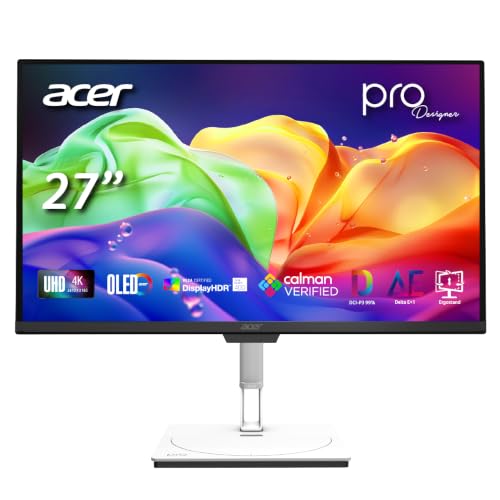
- 4K QD-OLED with 120Hz motion
- Delta E below 1 and 99% DCI-P3
- USB-C with 90W power delivery
Best For: Creators needing accurate color in a compact professional monitor
Mac-Friendly Workflow Pick

- 4K QD-OLED at 120Hz
- 99% DCI-P3 with Delta E below 1.5
- 96W USB-C and Auto KVM
Best For: Mac-centered creative workstations with multiple computers
Large-Canvas Color Pick
Acer ProDesigner 31.5-inch OLED 4K

- 31.5-inch 4K QD-OLED canvas
- AdobeRGB 97% and DCI-P3 99%
- DisplayHDR True Black 500
Best For: Editors and designers who need a spacious, wide-gamut workspace
High-Refresh Reference Pick
ASUS ProArt PA32UCDM 32-inch OLED

- 4K QD-OLED with 240Hz refresh
- Delta E below 1 and broad gamut support
- Dolby Vision, HLG, HDR10, and Thunderbolt 4
Best For: Professional creators prioritizing smooth previews and HDR versatility
Balanced QD-OLED Pick
Acer CE270K 27-inch 4K QD-OLED

- 4K QD-OLED with 99% DCI-P3 and Delta E<2
- 120Hz refresh and 0.03ms response time
- Adjustable stand with HDMI 2.1 and DisplayPort
Best For: Compact editing, office, and gaming setups
Professional Workflow Pick
ASUS ProArt PA329CDV 32-inch 4K QD-OLED

- Calman Verified with Delta E<1.5 color accuracy
- 99% DCI-P3 and 100% sRGB coverage
- USB-C with 96W Power Delivery and Auto KVM
Best For: Color-critical photo and video production
High-Refresh Hybrid Pick
Samsung Odyssey OLED G7 32-inch 4K

- 4K OLED with 165Hz refresh and 0.03ms response
- Dual mode switches to Full HD at 330Hz
- PANTONE Validated with G-Sync and FreeSync support
Best For: Gaming-focused creators and hybrid workstations
Balanced Creative Workstation

- 4K QD-OLED with 99% DCI-P3
- Dolby Vision and True Black 400 HDR
- USB-C supports up to 90W delivery
Best For: Color-conscious creators wanting a versatile 4K desktop monitor
High-Speed 4K Reference Display

- 4K QD-OLED with 140 PPI
- Pantone Validated and True Black 500 HDR
- 240Hz refresh with 0.03ms response
Best For: Hybrid creators who need 4K detail and fast motion performance
Compact QHD Creator Display

- 27-inch QD-OLED with QHD resolution
- Pantone Validated color and HDR10
- 240Hz refresh with OLED Safeguard
Best For: Space-conscious creators who value fast, colorful OLED performance
Compact Color Accuracy Pick – Acer ProDesigner 26.5-inch OLED 4K
For creators seeking OLED reference monitors for content creators without taking over the desk, this 26.5-inch Acer ProDesigner combines 4K resolution, QD-OLED contrast, and professional color features in a compact format. Calman verification, Delta E below 1, and 99% DCI-P3 coverage make it well suited to detailed photo, video, and design work.
Best For: Photographers, video editors, and designers who want a compact 4K professional display with strong color accuracy and flexible connectivity.
Pros:
- 4K QD-OLED panel with 120Hz refresh rate and 0.03ms response time
- Calman Verified accuracy with Delta E below 1 and 99% DCI-P3 coverage
- USB-C supports data, DisplayPort, and up to 90W power delivery
- Adjustable stand, Creator Hub software, and eye-comfort features
Cons:
- Smaller 26.5-inch workspace may feel limiting for complex timelines or multitasking
- HDR is specified at DisplayHDR True Black 400
This is a practical choice when color precision and desk efficiency matter more than maximum screen size. Its ergonomic stand and Creator Hub controls add useful workflow flexibility.
Mac-Friendly Workflow Pick – ASUS ProArt 27-inch 4K OLED
The ASUS ProArt PA279CDV is one of the more workflow-focused OLED reference monitors for content creators, pairing 4K QD-OLED imagery with Mac-optimized color, extensive USB-C connectivity, and built-in Auto KVM. Its factory calibration and Calman verification are useful for creators who move between systems.
Best For: MacBook users, photographers, video editors, and designers who need one display for accurate color, laptop charging, and multi-device control.
Pros:
- 4K QD-OLED panel with 120Hz refresh and 0.1ms response time
- True 10-bit color, 99% DCI-P3, 100% sRGB, and Delta E below 1.5
- USB-C provides up to 96W power delivery, with a built-in USB hub
- Auto KVM, daisy-chain DisplayPort support, and fully ergonomic stand
Cons:
- HDR specification is VESA DisplayHDR True Black 400
- Its extensive workflow features may be unnecessary for basic display use
Choose this ProArt model if your setup includes a MacBook and multiple computers. Auto KVM and 96W USB-C charging can simplify a creator workstation while the factory-calibrated panel handles color-sensitive work.
Large-Canvas Color Pick – Acer ProDesigner 31.5-inch OLED 4K
For creators who need more room for panels, timelines, and high-resolution assets, the 31.5-inch Acer ProDesigner offers a spacious 4K QD-OLED canvas. It combines Calman verification, Delta E below 1, AdobeRGB coverage, and DCI-P3 coverage for demanding visual workflows.
Best For: Video editors, photographers, and designers who value a large 4K workspace and broad color-gamut coverage.
Pros:
- Large 31.5-inch 4K QD-OLED display with 120Hz refresh
- Delta E below 1, AdobeRGB 97%, and DCI-P3 99%
- DisplayHDR True Black 500 for high-contrast HDR viewing
- USB-C offers data, DisplayPort, and up to 90W power delivery
Cons:
- Larger footprint and higher weight require more desk space
- The 4K resolution is spread across a larger panel than the compact Acer model
This model makes sense when screen area is central to your workflow. It preserves strong color credentials while giving creative applications more room to breathe, and its adjustable stand helps manage the larger chassis.
High-Refresh Reference Pick – ASUS ProArt PA32UCDM 32-inch OLED
The ASUS ProArt PA32UCDM is built for creators who want a large 4K OLED display without compromising refresh rate. Its 240Hz QD-OLED panel, Delta E below 1 accuracy, broad gamut support, HDR format compatibility, and Thunderbolt 4 connectivity make it a high-performance option among OLED reference monitors for content creators.
Best For: Professional photo and video workflows that benefit from a large screen, exceptionally smooth previews, extensive HDR support, and fast device connectivity.
Pros:
- 31.5-inch 4K QD-OLED panel with a 240Hz refresh rate
- Delta E below 1, true 10-bit color, 99% DCI-P3, and BT.2020 coverage
- Supports Dolby Vision, HLG, and HDR10 formats
- Thunderbolt 4 connectivity and a five-year warranty with registration
Cons:
- Its advanced specifications may exceed the needs of basic editing setups
- Large 32-inch design and nearly 20-pound weight require a sturdy workspace
This is the performance-oriented choice in the group. The 240Hz refresh rate is especially useful for smooth motion previews, while hardware calibration support and broad HDR compatibility target demanding professional workflows.
Balanced QD-OLED Pick – Acer CE270K 27-inch 4K QD-OLED
The Acer CE270K is a practical option for content creators seeking OLED reference monitors for content creators that also handle fast-paced gaming. Its 27-inch 4K QD-OLED panel combines high pixel density, wide DCI-P3 coverage, and deep contrast in a compact, adjustable design.
Best For: Creators who want a sharp 4K OLED display for color-focused office, editing, and gaming workflows.
Pros:
- 4K QD-OLED panel with true 10-bit color, 99% DCI-P3 coverage, and Delta E<2.
- 120Hz refresh rate and 0.03ms response time support smooth motion.
- Height, tilt, swivel, and pivot adjustments make positioning flexible.
- HDMI 2.1, DisplayPort 1.4, HDR True Black 400, and adaptive sync provide useful connectivity and image features.
Cons:
- Its 27-inch size provides less workspace than larger professional displays.
- The supplied specifications emphasize HDR True Black 400 rather than the higher peak brightness offered by some professional alternatives.
The CE270K is a well-rounded choice when desk space, 4K sharpness, and responsive performance matter. Its factory-listed color specifications and ergonomic stand make it versatile, though creators needing a larger canvas or stronger professional connectivity may prefer a 32-inch model.
Professional Workflow Pick – ASUS ProArt PA329CDV 32-inch 4K QD-OLED
The ASUS ProArt PA329CDV is designed for creators who need OLED reference monitors for content creators with strong color credentials and workstation-friendly connectivity. Its 31.5-inch 4K QD-OLED panel is Calman Verified, factory-calibrated, and built around a broad professional feature set.
Best For: Photo, video, and design professionals who need calibrated color, USB-C power delivery, and a large 4K workspace.
Pros:
- Calman Verified and factory-calibrated with Delta E<1.5, 99% DCI-P3, and 100% sRGB coverage.
- 31.5-inch 4K QD-OLED display offers 120Hz operation, 0.1ms response time, and up to 1000-nit peak brightness.
- USB-C provides 96W Power Delivery, while the USB hub and Auto KVM support multi-device workflows.
- Includes a fully adjustable stand, anti-scratch panel film, and a five-year warranty with registration extension.
Cons:
- Its professional feature set may be more than casual users need.
- The display is larger and heavier than compact 27-inch alternatives.
The PA329CDV is the strongest fit here for color-critical production and connected creative workstations. Calibration credentials, Mac-focused tuning, USB-C power, and Auto KVM make it especially useful for creators moving between laptops or desktop systems.
High-Refresh Hybrid Pick – Samsung Odyssey OLED G7 32-inch 4K
The Samsung Odyssey OLED G7 is a gaming-first choice among OLED reference monitors for content creators, pairing 4K OLED contrast with unusually high refresh options. It can run at 4K and 165Hz or switch to Full HD at 330Hz, making it attractive for creators who also prioritize competitive gameplay.
Best For: Gaming-focused creators who want accurate-looking OLED imagery, fast response, and flexible refresh modes.
Pros:
- 32-inch 4K OLED panel delivers deep blacks and sharp 3840×2160 visuals.
- Dual mode supports 4K at 165Hz or Full HD at 330Hz.
- 0.03ms response time, G-Sync compatibility, and AMD FreeSync Premium support smooth gaming.
- PANTONE Validated color, HDR10+ Gaming, and HDR True Black 400 enhance supported content.
Cons:
- Its supplied specifications identify gaming as the primary use rather than professional color calibration.
- The listed brightness is 275 cd/m², which may be less compelling for very bright HDR work.
- Connectivity is comparatively simple, with one HDMI input and one DisplayPort input listed.
The Odyssey OLED G7 makes the most sense for creators whose monitor must serve as both an editing screen and a high-refresh gaming display. Its dual-mode performance is distinctive, but dedicated color professionals may prefer the ASUS ProArt’s calibration and workstation features.
Balanced Creative Workstation – Dell 32 Plus 4K QD-OLED
For content creators seeking OLED reference monitors for content creators, the Dell S3225QC combines a large 31.6-inch 4K QD-OLED panel with 99% DCI-P3 coverage, Dolby Vision, and VESA DisplayHDR True Black 400. Its USB-C connectivity and adjustable stand also make it practical for a flexible desktop workflow.
Best For: Creators who want detailed 4K imagery, wide-gamut color, and an all-in-one desktop monitor with built-in audio.
Pros:
- 4K QD-OLED resolution with 99% DCI-P3 color coverage.
- Dolby Vision and VESA DisplayHDR True Black 400 support.
- USB-C connectivity with up to 90W power delivery.
- Built-in five-speaker spatial audio and ComfortView Plus.
Cons:
- 120Hz refresh rate is lower than the 240Hz options in this roundup.
- Only one HDMI port is listed.
The Dell is the most workflow-oriented choice here, pairing strong image specifications with USB-C power delivery, ergonomic adjustments, and integrated speakers. It is a well-rounded option for creators who value both visual accuracy and desk convenience.
High-Speed 4K Reference Display – Samsung Odyssey OLED G8 G80SH
The Samsung Odyssey OLED G8 is a strong candidate among OLED reference monitors for content creators who also need fast motion performance. Its 32-inch 4K QD-OLED panel offers Pantone Validated color, DisplayHDR True Black 500, and a 240Hz refresh rate, while the matte Glare Free screen helps limit reflections.
Best For: Hybrid creators who edit high-resolution content and also want exceptionally smooth gaming or motion playback.
Pros:
- 32-inch 4K QD-OLED display with 140 PPI.
- Pantone Validated color reproduction and DisplayHDR True Black 500.
- 240Hz refresh rate with a 0.03ms response time.
- USB-C provides up to 98W power delivery.
Cons:
- Designed primarily for gaming rather than dedicated reference work.
- Its gaming-focused features may be more than some editing workflows require.
With 4K detail, HDR contrast, glare reduction, and a generous USB-C power budget, the G80SH bridges creative and gaming use effectively. Its 240Hz capability is especially appealing when smooth motion matters as much as resolution.
Compact QHD Creator Display – Samsung Odyssey OLED G6 G61SH
For smaller workspaces, the Samsung Odyssey OLED G6 offers a compact 27-inch QD-OLED panel with QHD resolution, HDR10, and a listed 99% color gamut. It is one of the OLED reference monitors for content creators that prioritizes high refresh performance while retaining wide color and OLED contrast.
Best For: Creators with limited desk space who want a high-refresh OLED display for editing, design, and gaming.
Pros:
- QD-OLED panel with QHD 2560 x 1440 resolution.
- Pantone Validated color reproduction with 2100+ colors and 110+ skin tones.
- 240Hz refresh rate and 0.03ms response time.
- Glare Free technology and OLED Safeguard burn-in support.
Cons:
- QHD resolution provides less workspace detail than the 4K models.
- Connectivity is limited to DisplayPort and HDMI in the supplied specifications.
- It is positioned primarily as a gaming monitor.
The G61SH makes sense when desk space and motion performance take priority over 4K resolution. Its QD-OLED contrast, Pantone validation, ergonomic stand, and glare-control features give it useful versatility for creators working at a smaller scale.
How We Picked These OLED Reference Monitors for Content Creators
We focused on OLED and QD-OLED displays with specifications relevant to creative production: 4K resolution where available, wide-gamut color coverage, HDR support, stated color accuracy, high refresh rates, and useful computer connectivity. We also considered screen size and intended workflow, since a compact 27-inch panel, a 32-inch editing display, and a fast gaming-oriented monitor serve different needs.
Professional features such as Calman verification, USB-C connectivity, factory color claims, and creator-focused ergonomics received extra weight. Gaming models are included for creators who want fast motion, strong contrast, and one display for both production and entertainment, but they may not offer the same calibration-oriented feature set as dedicated professional monitors.
Quick Comparison
- Best for color-critical 4K work: ASUS ProArt PA279CDV and PA32UCDM.
- Best for a larger canvas: Acer’s 31.5-inch ProDesigner model and ASUS ProArt PA329CDV.
- Best for fast creative workflows: ASUS ProArt PA32UCDM, with its 240Hz specification.
- Best hybrid work-and-play choices: Dell S3225QC and Samsung Odyssey OLED G7 or G8.
- Best compact QD-OLED option: Acer’s 26.5-inch 4K 120Hz monitor.
- Best for high-refresh gaming at a lower resolution: Samsung Odyssey OLED G6.
Key Buying Factors for OLED Reference Monitors for Content Creators
Resolution and Screen Size
4K is generally the most flexible choice for video editing, photography, motion graphics, and detailed design work. A 32-inch panel provides more workspace, while a 26.5- or 27-inch display offers higher pixel density and a smaller desk footprint. A QHD monitor can still make sense if gaming performance and cost matter more than maximum editing detail.
Color, HDR, and Calibration
Look for broad color-gamut coverage, credible accuracy measurements, and calibration support rather than relying on OLED contrast alone. HDR performance depends on more than panel technology: brightness behavior, tone mapping, and content compatibility all affect grading and review work. A Calman Verified display or a monitor with strong factory calibration can reduce setup time, but serious professionals may still want a hardware calibrator.
Connectivity and Workflow
USB-C with video and power delivery can simplify laptop-based production, while DisplayPort and HDMI flexibility helps accommodate desktops, cameras, and consoles. Check the exact port bandwidth, power-delivery rating, KVM functionality, and stand adjustment before buying.
OLED Maintenance and Comfort
OLED panels deliver excellent blacks and fast response, but static interface elements can increase image-retention risk over time. Use screen-saving features, vary desktop content, and follow the manufacturer’s maintenance guidance. For long sessions, prioritize a height-adjustable stand, suitable brightness, and a comfortable viewing size.
Who Should Buy Which OLED Reference Monitors for Content Creators?
Choose a professional ASUS ProArt or Acer ProDesigner model if color-managed design, editing, and HDR review are your main priorities. Pick a 32-inch option when timeline space and a larger preview matter. The 27-inch and 26.5-inch displays suit smaller desks or sharper pixel density. If you split your time between content creation and gaming, Dell’s 120Hz QD-OLED and Samsung’s Odyssey G7 or G8 offer a more entertainment-focused balance. Choose the Odyssey G6 when high refresh rate is the priority and QHD resolution is sufficient.