
The best OLED reference monitors for remote work combine accurate color, deep contrast, sharp resolution, and practical connectivity for demanding creative and professional workflows.
This roundup compares 10 strong options, from Calman-verified ProArt displays to ultrawide OLEDs and portable 4K screens, so you can match image quality and desk space to your work.
Best 10 OLED Reference Monitors for Remote Work Picks for 2026
Best All-Around Pro Pick
ASUS ProArt 27-inch 4K QD-OLED

- 4K QD-OLED with 99% DCI-P3 coverage
- Calman Verified with Delta E < 1.5
- 96W USB-C, Auto KVM, and ergonomic stand
Best For: Color-conscious professionals with laptop-based home offices
Best Ultrawide Multitasker
Samsung Odyssey OLED G9 49-inch

- 49-inch 5120 × 1440 Dual QHD workspace
- QD-OLED with deep blacks and vibrant color
- Picture-in-picture for flexible multitasking
Best For: Users replacing a dual-monitor setup with one ultrawide display
Best for Comfortable Desktop Work

- 4K QD-OLED with 99% DCI-P3 coverage
- 90W USB-C laptop charging
- Built-in spatial audio and ComfortView Plus
Best For: Remote workers wanting an all-in-one, low-clutter desk setup
Best High-Refresh 4K Alternative
Samsung Odyssey OLED G7 32-inch

- 4K OLED resolution with up to 165Hz
- Dual mode supports Full HD at 330Hz
- PANTONE Validated color and HDR10+
Best For: Remote workers who also prioritize high-refresh gaming
Ultrawide Smart Workspace

- 34-inch curved QHD ultrawide workspace
- Built-in webOS and cloud app access
- HDMI, USB, AirPlay 2, and screen sharing
Best For: Multitasking and smart home-office setups
Professional OLED Precision

- 31.5-inch 4K QD-OLED with 120Hz refresh
- Factory calibrated with Delta E<1.5
- USB-C with 96W Power Delivery and Auto KVM
Best For: Color-critical creative work and multi-device desks
Portable OLED Office

- 15.6-inch portable 4K OLED display
- 1.5-pound design with protective cover
- USB-C single-cable setup and dual-orientation stand
Best For: Traveling workers and laptop-based mobile offices
Best for Immersive Multitasking

- 45-inch 21:9 OLED with an 800R curve
- USB-C with 65W power delivery
- 240Hz refresh rate and 0.03ms response time
Best For: Remote workers wanting a massive ultrawide workspace with gaming capability
Best for Color-Critical Work

- 31.5-inch 4K QD-OLED panel
- Delta E less than 1 color performance
- Thunderbolt 4 and hardware calibration support
Best For: Creative professionals who prioritize accurate color and Mac-friendly connectivity
Best Compact 4K Workstation
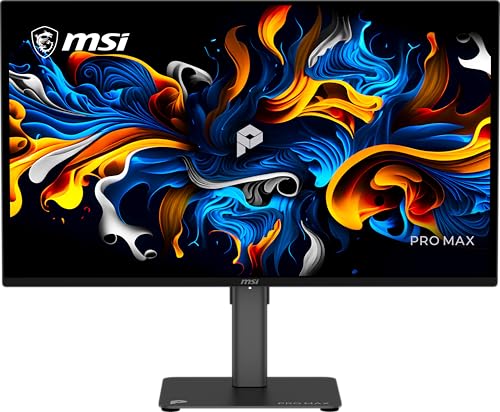
- 27-inch 4K QD-OLED display
- Delta E less than 2 color accuracy
- Height-adjustable stand and USB-C connectivity
Best For: Space-conscious remote workers seeking sharp 4K visuals and ergonomic flexibility
Best All-Around Pro Pick – ASUS ProArt 27-inch 4K QD-OLED
For remote workers who also edit photos or video, the ASUS ProArt PA279CDV is a well-rounded choice among OLED reference monitors for remote work. Its 4K QD-OLED panel, factory calibration, Mac-focused color tuning, and generous USB-C connectivity suit demanding desk setups.
Best For: Color-conscious professionals using a laptop-based home office, especially MacBook users.
Pros:
- 4K QD-OLED image with 100% sRGB and 99% DCI-P3 coverage.
- Calman Verified factory calibration with Delta E < 1.5.
- USB-C supports up to 96W Power Delivery, with Auto KVM and a USB hub.
- Height, swivel, tilt, and pivot adjustments support ergonomic positioning.
Cons:
- Its 27-inch workspace is less expansive than an ultrawide display.
- The professional feature set may be more than general office users need.
This is the strongest balance of accurate color, laptop connectivity, and ergonomic flexibility in the group. It is particularly compelling when one monitor needs to support both everyday remote work and color-sensitive creative tasks.
Best Ultrawide Multitasker – Samsung Odyssey OLED G9 49-inch
The Samsung Odyssey OLED G9 brings an expansive 32:9 workspace to remote work. As one of the OLED reference monitors for remote work, it can replace a dual-monitor arrangement while leaving room for documents, chat, and creative applications across its 49-inch Dual QHD screen.
Best For: Multitaskers who want one very wide curved display for several side-by-side applications.
Pros:
- 49-inch Dual QHD resolution provides a broad 5120 × 1440 workspace.
- QD-OLED delivers deep blacks, vibrant color, and a 1,000,000:1 contrast ratio.
- 144Hz refresh rate and 0.03ms response time provide smooth motion.
- Picture-in-picture supports simultaneous content sources.
Cons:
- The 32:9 format and 49-inch size require substantial desk space.
- Its gaming-focused design may be excessive for straightforward office work.
- It does not list USB-C Power Delivery for a single-cable laptop setup.
The G9 is a specialist choice: excellent when horizontal workspace matters more than compactness, but less convenient for a minimal laptop desk. Its built-in screen-saver and taskbar-detection features also address static-image concerns during extended use.
Best for Comfortable Desktop Work – Dell 32 Plus 4K QD-OLED
The Dell 32 Plus S3225QC combines a large 4K QD-OLED image with features aimed at comfortable home-office use. For remote workers comparing OLED reference monitors for remote work, its 90W USB-C connection, integrated speakers, and ComfortView Plus make it a practical all-in-one desk display.
Best For: Remote professionals who want strong image quality, built-in audio, and simple USB-C laptop connectivity.
Pros:
- 31.6-inch 4K QD-OLED panel with 99% DCI-P3 coverage.
- Dolby Vision and DisplayHDR True Black 400 support detailed HDR content.
- USB-C provides up to 90W Power Delivery for a cleaner laptop setup.
- Five 5W speakers offer AI-enhanced 3D spatial audio with head tracking.
Cons:
- Its one-year Advanced Exchange and Premium Panel Exchange warranty is shorter than some alternatives listed.
- The 32-inch footprint is less compact than a typical 27-inch monitor.
Among these options, Dell is the most office-oriented package: it pairs a high-resolution OLED panel with integrated sound and eye-comfort technology. It is a strong fit when reducing desk clutter matters as much as display performance.
Best High-Refresh 4K Alternative – Samsung Odyssey OLED G7 32-inch
The Samsung Odyssey OLED G7 G73SH is designed primarily for gaming, but its 32-inch 4K OLED panel and accurate color features can also serve a demanding remote-work setup. It stands out among OLED reference monitors for remote work when smooth motion and a flexible high-refresh mode are priorities.
Best For: Remote workers who divide their time between detailed 4K productivity and fast-paced gaming.
Pros:
- 4K OLED resolution provides a detailed 3840 × 2160 desktop.
- 4K mode reaches 165Hz, while dual mode supports Full HD at 330Hz.
- PANTONE Validated color and HDR10+ Gaming support color and contrast performance.
- Height, pivot, tilt, and swivel adjustments support flexible positioning.
Cons:
- It is positioned as a gaming monitor rather than a dedicated office display.
- Connectivity is limited to DisplayPort and HDMI in the supplied specifications.
- It does not list USB-C laptop charging or an integrated USB hub.
The G7 makes sense for a hybrid desk where gaming is a major use case. For remote work alone, the lack of USB-C convenience makes it less streamlined than the ASUS or Dell, but its 4K OLED image and high refresh rates are compelling.
Ultrawide Smart Workspace – LG 34SR60QC-W
For remote workers who want a wide desktop without adding a second display, the LG 34SR60QC-W is a practical alternative to OLED reference monitors for remote work. Its 34-inch curved QHD panel gives you extra horizontal space for documents and applications, while webOS adds built-in streaming and access to cloud productivity services.
Best For: Multitasking, video calls, cloud-based work, and entertainment in a home office.
Pros:
- 34-inch 3440×1440 ultrawide format provides a 21:9 workspace.
- webOS supports streaming apps, Microsoft 365, and Google applications without a connected PC.
- Includes two HDMI ports, three USB ports, AirPlay 2, and screen sharing.
- HDR10, up to 99% sRGB coverage, and a 100Hz refresh rate support vivid everyday viewing.
Cons:
- Uses a VA panel rather than OLED technology.
- Its 300-nit brightness and 5ms response time are less specialized for demanding reference or motion work.
The LG stands out when your priority is a spacious, flexible home-office screen with smart features. Choose it for convenient multitasking and media use rather than OLED-level contrast or professional color calibration.
Professional OLED Precision – ASUS ProArt PA329CDV
The ASUS ProArt Display PA329CDV is the most purpose-built choice here for shoppers comparing OLED reference monitors for remote work. Its 31.5-inch 4K QD-OLED panel combines high contrast with factory calibration, broad color coverage, USB-C laptop connectivity, and a stand designed for extended professional use.
Best For: Color-sensitive creative work, professional laptop setups, and users who switch between two computers.
Pros:
- 4K QD-OLED display offers a 1,500,000:1 contrast ratio, 120Hz refresh rate, and 0.1ms response time.
- Calman Verified factory calibration provides Delta E<1.5, with 99% DCI-P3 and 100% sRGB coverage.
- USB-C provides up to 96W Power Delivery, while Auto KVM supports switching between two PCs or laptops.
- Fully adjustable stand, ambient-light and proximity sensors, and a five-year warranty support long-term desk use.
Cons:
- Its professional feature set and 31.5-inch size may be more than needed for basic office tasks.
- It is a flat 16:9 display, so it offers less horizontal workspace than an ultrawide.
For remote work that includes photo, video, or other color-critical projects, this ASUS offers the strongest combination of OLED image quality, calibration, connectivity, and ergonomics in the group. Its Auto KVM and high-power USB-C connection are especially useful in a multi-device office.
Portable OLED Office – ViewSonic VX1655-4K-OLED
The ViewSonic VX1655-4K-OLED is a travel-friendly option for remote workers who need a second screen away from a permanent desk. Although compact, it delivers a 15.6-inch 4K OLED image, single-cable USB-C connectivity, and a built-in stand that works in portrait or landscape orientation.
Best For: Traveling professionals, mobile workstations, and laptop users who need a lightweight second display.
Pros:
- 4K OLED resolution delivers individually lit pixels, strong contrast, and vivid color in a portable format.
- At 0.6 inches thick and 1.5 pounds, it is easy to carry in a backpack or laptop case.
- USB-C supports a single-cable setup with 60W two-way power for compatible devices.
- Integrated kickstand supports portrait and landscape modes, and the included cover helps protect the screen.
Cons:
- Its 16-inch size and 60Hz refresh rate are less suitable as a primary desktop monitor.
- Connectivity is centered on USB-C and mini-HDMI, with a 400-nit brightness rating.
This ViewSonic is a strong fit when portability matters more than a large work area. It brings OLED contrast and 4K detail to a mobile setup, making it a useful companion screen for laptops, travel, and flexible remote offices.
Best for Immersive Multitasking – LG UltraGear 45GX900A-B OLED
For remote workers who want an expansive display, this 45-inch OLED reference monitor for remote work combines a 21:9 WQHD resolution with a dramatic 800R curve. Its matte finish, low-glare design, USB-C connectivity, and 65W power delivery make it practical for a streamlined desk, while the 240Hz refresh rate also suits gaming after hours.
Best For: Remote professionals who value a very wide, immersive workspace and also want high-end gaming performance.
Pros:
- Large 45-inch ultrawide panel provides substantial screen space for side-by-side windows.
- OLED contrast, up to 98.5% DCI-P3 coverage, and DisplayHDR True Black 400 support vivid images.
- USB-C supports up to 65W power delivery, while HDMI 2.1 and DisplayPort add connection flexibility.
- Low-glare, flicker-free, and low-blue-light features support focused viewing.
Cons:
- 3440 x 1440 resolution is lower than the 4K options in this roundup.
- The steep 800R curve and large footprint may not suit every office layout.
- Its 240Hz gaming features may be unnecessary for primarily office-focused work.
The LG is a specialized choice for users who want one huge, curved screen rather than maximum pixel density. It is especially compelling when remote work and gaming share the same desk.
Best for Color-Critical Work – ASUS ProArt PA32UCDM 4K OLED
The ASUS ProArt PA32UCDM is a strong pick among OLED reference monitors for remote work when accurate color matters. Its 31.5-inch 4K QD-OLED panel offers true 10-bit color, broad gamut coverage, hardware calibration support, and Thunderbolt 4 connectivity for creative and Mac-focused workflows.
Best For: Designers, photographers, video editors, and Mac users who need high-resolution, color-accurate display performance.
Pros:
- 4K UHD resolution delivers a sharp workspace on a 31.5-inch panel.
- True 10-bit color, 100% sRGB, 99% DCI-P3, and BT.2020 coverage support demanding creative work.
- Delta E less than 1 performance and ProArt hardware calibration prioritize color accuracy.
- Thunderbolt 4, Dolby Vision, HLG, and HDR10 support fit advanced professional workflows.
Cons:
- Its 240Hz refresh rate is more than most office tasks require.
- Professional features and calibration capabilities may be excessive for general productivity.
- The listing specifies one HDMI port, so users should plan their connection setup accordingly.
Among these options, the PA32UCDM is the most directly oriented toward reference-quality creative work. Its included color report, calibration support, and extended five-year warranty add reassurance for professionals.
Best Compact 4K Workstation – MSI PRO MAX 271UPX12G QD-OLED
The MSI PRO MAX 271UPX12G is a compact option for shoppers comparing OLED reference monitors for remote work. Its 27-inch 4K QD-OLED display offers sharp text and images, Delta E less than 2 color accuracy, USB-C connectivity, and an adjustable stand that fits smaller desks.
Best For: Remote workers who want a compact 4K OLED monitor with ergonomic adjustments and straightforward modern connectivity.
Pros:
- 27-inch 3840 x 2160 resolution provides high pixel density for a compact workspace.
- QD-OLED technology, Delta E less than 2 accuracy, and DisplayHDR True Black 400 support detailed visuals.
- USB-C, HDMI, and DisplayPort accommodate computers and other devices.
- Height adjustment, tilt, swivel, flicker-free viewing, and built-in speakers support daily office use.
Cons:
- USB-C power delivery is limited to 15W, which may not power or charge many laptops fully.
- The 27-inch screen offers less multitasking space than the larger displays here.
- Its 120Hz refresh rate is useful but not essential for standard office work.
The MSI balances sharp 4K output with a smaller footprint and practical ergonomics. It is a sensible choice when desk space matters more than having an ultrawide or larger professional panel.
How We Picked the Best OLED Reference Monitors for Remote Work
We focused on displays that can support color-sensitive work while remaining practical for a home office. Key considerations included OLED or QD-OLED panel quality, resolution, color-gamut coverage, HDR capability, refresh rate, connectivity, ergonomic flexibility, and the type of work each monitor suits. Professional models with factory calibration, Calman verification, wide-gamut coverage, and USB-C connectivity received particular attention, while gaming-focused screens were included when their image quality and specifications made them useful for creative or multitasking workflows.
OLED monitors deliver excellent contrast and fast response times, but buyers should still check warranty terms, brightness behavior, and burn-in coverage before committing to a daily-use display.
Quick Comparison
| Best For | Recommended Type | Why It Stands Out |
|---|---|---|
| Color-critical design | ASUS ProArt PA32UCDM or PA329CDV | Large 4K QD-OLED panels and professional-focused features |
| Compact professional setup | ASUS ProArt PA279CDV | 27-inch 4K format, USB-C, wide gamut, and factory accuracy |
| MacBook or laptop users | ASUS ProArt PA32UCDM or ViewSonic VX1655-4K-OLED | High-resolution options for desk or mobile workflows |
| Multitasking | Samsung Odyssey OLED G9 | Superwide workspace for multiple windows |
| Gaming and work | Samsung Odyssey OLED G7 or LG UltraGear 45GX900A-B | High refresh rates with OLED contrast and responsiveness |
Key Buying Factors for OLED Reference Monitors for Remote Work
Resolution and Screen Size
Choose 4K at 27 to 32 inches for crisp text, detailed photo work, and comfortable window layouts. Ultrawide models provide more horizontal space but may use lower vertical resolution. Portable 16-inch displays are useful as secondary screens rather than full-time reference monitors.
Color Accuracy and HDR
Look for wide DCI-P3 coverage, low Delta E measurements, factory calibration, and verification from organizations such as Calman when accurate color matters. HDR10 and DisplayHDR True Black support are useful for compatible video and image workflows, but actual HDR performance also depends on brightness and content.
Connectivity and Ergonomics
USB-C with video, power delivery, and a hub can simplify a laptop-based desk. Also check HDMI and DisplayPort compatibility, stand adjustment, VESA support, built-in speakers, and whether the monitor can switch easily between work devices.
Burn-In Protection and Daily Use
OLED panels can be vulnerable to image retention from static interface elements. Use pixel-shift, panel-refresh, screen-saver, and automatic dimming features, and avoid leaving fixed windows on screen for long periods. Review the manufacturer’s burn-in policy before purchase.
Who Should Buy Which OLED Reference Monitors for Remote Work?
Choose a ProArt display if color accuracy, calibration, and professional controls matter most. Pick the Samsung OLED G9 or LG ultrawide if your work depends on multiple timelines, documents, or applications side by side. The 32-inch Samsung OLED G7 and MSI QD-OLED are better fits for users who want a capable work monitor that also excels at gaming. Select the ViewSonic portable OLED for travel, hybrid work, or a flexible second-screen setup. For a balanced home-office upgrade, a 27- or 32-inch 4K QD-OLED with USB-C offers the strongest combination of clarity, contrast, and convenience.