
When it comes to producing high-quality films, the right HDMI splitter can make all the difference. You need a reliable device that can handle various resolutions and seamlessly connect your equipment. From the WARRKY HDMI Splitter to the avedio links 8K model, each option offers unique features tailored for film sets. Curious about how these splitters can elevate your production? Let’s explore the top picks and what to take into account for your setup.
WARRKY HDMI Splitter 1 in 4 Out (4K, USB-C Powered)

If you’re looking to enhance your film set with multiple display options, the WARRKY HDMI Splitter 1 in 4 Out is your best choice. This compact device mirrors 4K HDMI signals from a single source to four displays, perfect for multi-screen setups. It supports resolutions up to UHD 4K@30Hz and offers backward compatibility with various formats. Powered by USB-C, it connects easily to any USB-A device, ensuring stable performance without extra chargers. Its ultra-thin design and elegant space grey finish add sophistication to your setup. With five status indicators and reliable gold-plated connectors, you’ll enjoy seamless connectivity and stability.
Best For: Anyone looking to create a multi-screen setup for enhanced viewing experiences in film sets, presentations, or home entertainment.
Pros:
- Supports up to UHD 4K@30Hz resolution, ensuring high-quality video output.
- USB-C powered, simplifying connectivity without the need for additional chargers.
- Compact and ultra-thin design with an elegant space grey finish, making it easy to integrate into any setup.
Cons:
- Only supports mirror/duplicate mode, limiting flexibility in display options.
- Does not support CEC, HDR, or VRR, which may be a drawback for advanced users.
- The maximum distance for HDMI cable is 50 feet, which might not suffice for larger setups.
avedio links HDMI Splitter 1 in 2 Out

For filmmakers seeking a reliable solution to display the same HDMI input on multiple screens, the avedio links HDMI Splitter 1 in 2 Out stands out with its straightforward plug-and-play functionality. It duplicates one HDMI signal to two displays, making it perfect for presentations or film sets. Supporting resolutions up to 4K at 30Hz, it’s also backward compatible with 1080p and lower. The splitter works with HDMI v1.3/1.4 and supports various audio formats, ensuring excellent performance. Just connect a 5V power adapter, and you’re ready to go. Its compact size and lightweight design make it easy to transport and set up.
Best For: Filmmakers and presenters who need to display the same HDMI input on multiple screens seamlessly.
Pros:
- Plug-and-play functionality allows for easy setup without the need for external drivers.
- Supports high-resolution outputs up to 4K at 30Hz, ensuring quality visuals.
- Lightweight and compact design makes it highly portable for on-the-go usage.
Cons:
- Does not support extended displays; it simply duplicates the signal.
- Compatibility is limited to HDCP 1.4, which may not work with newer HDCP 2.2 devices.
- Requires an external 5V power adapter that is not included in the package.
avedio links 8K HDMI Splitter with 4ft HDMI Cable

The Avedio Links 8K HDMI Splitter is an excellent choice for filmmakers and content creators needing to connect one HDMI source to two displays simultaneously. Supporting resolutions up to 8K@60Hz and 4K@120Hz, it guarantees stunning visuals for your projects. This splitter is perfect for connecting devices like game consoles and Blu-Ray players to monitors or projectors. It comes with a 4ft HDMI cable and a power adapter, making setup a breeze. Just plug it in, and you’re ready to go. Remember, this splitter mirrors displays, so plan your setup accordingly for the best viewing experience.
Best For: Content creators and filmmakers looking for a reliable solution to connect one HDMI source to two displays for simultaneous viewing.
Pros:
- Supports high resolutions up to 8K@60Hz and 4K@120Hz for exceptional visual quality.
- Simple plug-and-play setup, allowing for quick installation and use.
- Includes a 4ft HDMI cable and power adapter for added convenience.
Cons:
- Only mirrors displays; does not support extended display functionality.
- Limited to HDMI connections, which may not suit all devices or setups.
- Requires specific HDMI cable types for optimal performance, which could necessitate additional purchases.
OREI HDMI Splitter 1 in 2 out – Ultra HD 4K @ 30Hz

Perfect for filmmakers and content creators, the OREI HDMI Splitter 1 in 2 out offers a reliable way to duplicate one HDMI signal into two identical outputs, guaranteeing seamless connectivity for your devices. Supporting resolutions up to 4K @ 30Hz, it works great with Xbox, PS4, Blu-ray players, and projectors. Keep in mind that it’s compatible with HDMI versions 1.2, 1.3, and 1.4, but it won’t bypass HDCP. For ideal performance, use high-quality HDMI cables no longer than 30 feet. With its heavy-duty metal enclosure, the splitter guarantees reliable operation, making it a solid addition to your film set.
Best For: Filmmakers and content creators looking for a reliable HDMI splitter to duplicate signals for seamless connectivity.
Pros:
- Supports high resolutions up to 4K @ 30Hz, ensuring excellent video quality.
- Heavy-duty metal enclosure enhances durability and heat dissipation for reliable operation.
- Compatible with various devices, including Xbox, PS4, and Blu-ray players.
Cons:
- Does not bypass HDCP, which may limit usage with certain content.
- Maximum HDMI cable length is limited to 30 feet for optimal performance.
- HDMI cables are not included in the package, requiring separate purchase.
GANA Aluminum Bidirectional HDMI Switcher (2 in 1 Out)
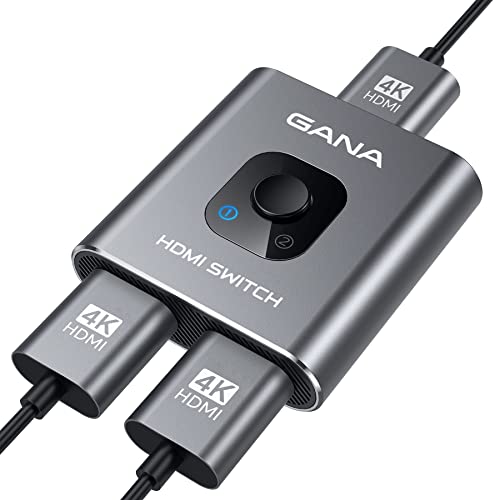
When you need a reliable solution for switching between multiple HDMI sources on set, the GANA Aluminum Bidirectional HDMI Switcher (2 in 1 Out) stands out. This compact device lets you connect two HDMI sources to one display or one source to toggle between two displays, ensuring only one display is active at a time. With support for 4K resolution at 60Hz, it delivers stunning visuals while maintaining compatibility with devices like Xbox and PS5. Plus, its simple button press makes switching inputs a breeze, and you’ll appreciate the lifetime technical support for any issues you might encounter.
Best For: Those who need an efficient way to switch between multiple HDMI devices, such as gamers or home theater enthusiasts.
Pros:
- Supports 4K resolution at 60Hz for high-quality visuals.
- Easy one-button switching between two HDMI sources or displays.
- Lifetime technical support ensures assistance for any issues.
Cons:
- Only one display can be active at a time, which may be limiting for some users.
- Requires a standard HDMI 2.0 cable (not included) for optimal performance.
- May not work optimally over longer cable lengths exceeding 3M.
UGREEN HDMI Switch 5 in 1 Out 4K@60Hz

If you’re juggling multiple gaming devices on a film set or at home, the UGREEN HDMI Switch 5 in 1 Out 4K@60Hz is an excellent solution. This switch connects up to five devices, like your PS5, Xbox, or laptop, to a single TV input, delivering stunning 4K@60Hz resolution. It features a USB-powered design for stable video transmission and comes with a remote control, letting you switch devices from up to 33 feet away. With LED indicators for active ports, it’s easy to keep track of your connections. Just remember to connect it to a power source for peak performance!
Best For: Gamers and multimedia enthusiasts who need to connect multiple devices to a single TV input without compromising on video quality.
Pros:
- Supports stunning 4K@60Hz resolution for an immersive gaming and viewing experience.
- Remote control functionality allows for convenient switching between devices from a distance.
- LED indicators help users easily identify which device is currently active.
Cons:
- Automatic switching is not supported, requiring manual selection of devices.
- Power adapter is not included, which may be an inconvenience for some users.
- No HDMI cables included, necessitating separate purchases for full setup.
MT-ViKI HDMI Splitter 1 in 4 Out

For filmmakers and content creators needing to display the same video feed across multiple monitors, the MT-ViKI HDMI Splitter 1 in 4 Out is an ideal solution. This device allows you to mirror one HDMI input to four HD output monitors simultaneously, supporting resolutions up to 4K@30Hz and Full HD 1080P. It’s compatible with various devices like computers, gaming consoles, and Blu-ray players. Plus, its plug-and-play functionality means no software is required. With cascade connection capabilities, you can link multiple splitters, extending HDMI signals effectively. Just remember, it duplicates signals, so it won’t extend screens across multiple displays.
Best For: Filmmakers and content creators needing to display the same video feed across multiple monitors simultaneously.
Pros:
- Supports high resolutions including 4K@30Hz and Full HD 1080P for clear, vibrant images.
- Plug-and-play functionality means easy setup without the need for additional software.
- Cascade connection capability allows linking multiple splitters to extend HDMI signals up to 100ft.
Cons:
- Only duplicates signals; it cannot extend screens across multiple displays.
- Limited to one input source, meaning you cannot connect multiple devices to one TV.
- Requires an external power source, as it is a powered device.
llano HDMI 2.1 Splitter (1 in 2 Out)
The llano HDMI 2.1 Splitter (1 in 2 Out) stands out as an excellent choice for gamers and content creators who demand high-resolution performance. Supporting 8K@60Hz and 4K@240Hz, it guarantees stunning visuals and smooth motion for gaming and video playback. While it’s designed for mirror mode only, this splitter is compatible with a range of devices, including PS5, Xbox, and laptops. You’ll appreciate its advanced 8K chip that assures stable signal transmission and ultra-low latency. Whether for home theaters or business settings, it adapts seamlessly, making it a versatile addition to your production toolkit.
Best For: Gamers and content creators who demand high-resolution performance and seamless signal transmission.
Pros:
- Supports high resolutions up to 8K@60Hz and 4K@240Hz for stunning visuals.
- Equipped with an advanced 8K chip for stable signal transmission and ultra-low latency.
- Versatile application for home theaters, retail displays, and business meetings.
Cons:
- Designed for mirror mode only; does not support extended desktop functionality.
- Output resolution is limited to the lowest supported by all connected devices.
- ARC/eARC function is not supported, which may limit audio options.
WARRKY HDMI Switch 2 in 1 Out 4K@60Hz
WARRKY HDMI Switch 2 in 1 Out 4K@60Hz is ideal for filmmakers who need seamless changes between multiple HDMI sources or displays. This versatile switch features two modes: switch between two sources or connect one source to two displays. With support for 4K@60Hz and backward compatibility, you won’t miss any detail in your visuals. The included 3.3ft HDMI cable minimizes clutter, while the aluminum casing enhances durability and heat dissipation. Plus, it’s compatible with popular devices like PS5, Xbox, and various displays. Enjoy flawless audio pass-thru, ensuring your production sounds as good as it looks.
Best For: Filmmakers and gamers who require seamless switching between multiple HDMI sources or displays.
Pros:
- Supports 4K@60Hz and backward compatibility with 2K and 1080P, providing high-quality visuals.
- Bidirectional functionality allows users to easily switch between two sources or displays.
- Includes a 3.3ft fixed HDMI cable to minimize clutter and simplify setup.
Cons:
- Limited to one display working at a time when using the switch display mode.
- Not compatible with ARC, which may limit functionality for some audio systems.
- Requires manual switching between sources or displays, which may not be as convenient as automatic options.
MT-VIKI 4K HDMI Splitter 1×8

When you need to display a single source across multiple monitors or HDTVs, the MT-VIKI 4K HDMI Splitter 1×8 stands out as an ideal solution. This splitter features one input and eight outputs, allowing you to share content from devices like computers, DVD players, or gaming consoles. It supports stunning resolutions up to 4K at 30Hz, ensuring exceptional picture quality. Plus, it’s HDCP compliant and works seamlessly with various devices, including projectors and Apple TVs. Installation is a breeze—just plug it in without needing any software. With the recommended cable length, you’ll enjoy superior performance every time.
Best For: Those who need to display content from a single source on multiple monitors or HDTVs, such as in presentations or gaming setups.
Pros:
- Supports high resolutions up to 4K at 30Hz for exceptional picture quality.
- Easy installation with plug and play setup, requiring no software.
- HDCP compliant, ensuring compatibility with various devices like projectors and Apple TVs.
Cons:
- Limited to mirroring only, so it cannot display different content on each output.
- Recommended cable length of no more than 49 feet may restrict setup options.
- Only supports HDMI 1.4b, which may not be suitable for newer devices requiring higher specifications.
Factors to Consider When Choosing an HDMI Splitter for Film Sets
When you’re choosing an HDMI splitter for your film set, you’ll want to take into account several key factors. Supported resolutions, refresh rates, and the number of outputs can greatly impact your setup. Don’t forget to check compatibility with your devices and the audio formats you need for ideal performance.
Supported Resolutions and Refresh Rates
Choosing the right HDMI splitter for your film set hinges on understanding supported resolutions and refresh rates. You’ll find options that support 4K resolutions (up to 3840×2160) at refresh rates like 30Hz or 60Hz, ideal for standard viewing. For high-definition video production, consider higher-end splitters that can handle up to 8K (7680×4320) at 60Hz. If you’re dealing with fast-paced content or gaming, look for options that offer refresh rates of 120Hz or even 240Hz for smooth playback. Don’t forget to check for HDR compatibility to enhance color depth and contrast. Finally, verify your splitter is backward compatible with lower resolutions, like 1080p or 720p, for versatile use across different display devices.
Number of Outputs Available
Understanding the number of outputs available in an HDMI splitter is essential to efficient content distribution on your film set. You’ll want a splitter that offers sufficient outputs, like 1 in 4 or 1 in 8 configurations, to guarantee every display receives the same signal simultaneously. This is vital for larger setups where multiple monitors are in play. Make sure the splitter supports the necessary resolution and refresh rates for all connected devices, as some are limited in this regard. Also, keep in mind the compatibility with your source device and the output displays—check for features like HDCP and 4K support. Finally, assess your physical layout, as longer HDMI runs require robust splitters to maintain signal integrity.
Compatibility With Devices
Selecting the right HDMI splitter for your film set hinges on compatibility with your devices. First, make certain the splitter matches the HDMI version of your equipment; older versions might not support high resolutions or features like HDR or VRR. Check for HDCP compliance, as many devices need HDCP 1.4 or higher for 4K content protection. Confirm that the splitter supports the maximum resolution and refresh rate required, such as 4K@60Hz or even 8K for top-tier productions. Don’t overlook audio formats—some setups may need advanced options like Dolby Atmos or DTS-HD for superior sound quality. Finally, verify that the splitter’s power requirements and connectivity options fit seamlessly into your current setup without extra adapters or complications.
Power Requirements and Stability
When it comes to power requirements and stability, ensuring your HDMI splitter operates reliably during film shoots is essential. Choose a splitter powered by a reliable source, like USB-C or an external power adapter, to maintain stable performance. Look for models that support long cable lengths, as this can impact signal integrity; some devices can maintain quality over distances up to 50 feet. Opt for splitters with low power consumption, usually around 5W, to prevent overheating during long sessions. A plug-and-play design is also vital, allowing for quick setups and minimizing downtime. Finally, make sure the splitter is compatible with the necessary HDMI version and HDCP compliance for high-definition video transmission.
Audio Format Support
Audio format support is a critical factor in choosing an HDMI splitter for film sets. You’ll want to check if the splitter can handle advanced formats like DTS-HD, Dolby True HD, and LPCM 7.1, as not all models support multi-channel audio. Compliance with HDCP standards is essential for smooth audio transmission and device compatibility. If you need separate audio outputs for professional sound systems or monitoring, look for splitters with audio extraction features. Additionally, verify the splitter supports high-definition audio formats like Dolby Atmos for an immersive sound experience. Finally, consider depth of color support and frame rates, as these aspects can greatly impact your overall audio-visual quality when working with high-resolution formats.
Cable Length Limitations
Although it might seem easy to overlook, cable length plays an essential role in the effectiveness of your HDMI splitter on film sets. For ideal 4K resolutions, keep your HDMI cable lengths between 16 to 30 feet to prevent signal degradation. If you’re working with 8K resolutions, aim for shorter cables—around 9.8 feet—especially when using HDMI 2.1 cables. To minimize signal loss over longer distances, opt for high-quality HDMI cables with an AWG of 26 or lower. While cascading multiple HDMI splitters can extend your signal reach, remember to adhere to the individual splitter specifications. Always consider the capabilities of both your HDMI splitter and cables to guarantee you achieve the best possible video and audio quality.
Installation Ease and Portability
Choosing the right HDMI splitter for your film set can greatly impact your setup efficiency and overall filming experience. Look for plug-and-play functionality to make installation a breeze—no need for extra software or drivers. Pay attention to the splitter’s size and weight; a lightweight, compact design makes transport and setup much easier. Confirm it has stable mounting options or non-slip rubber feet, keeping it secure during dynamic shoots. Evaluate power requirements, as USB-powered models can help reduce cable clutter, streamlining your setup. Finally, opt for splitters that support long cable runs to give you flexibility in positioning displays without sacrificing signal quality. These factors will enhance your filming workflow considerably.
Build Quality and Design
When selecting an HDMI splitter for your film set, the build quality and design are essential factors that can directly affect performance and usability. Look for splitters with robust metal enclosures that enhance heat absorption and dissipation, ensuring reliable operation. Compact designs with ultra-thin profiles are ideal for fitting into tight setups, saving valuable space during shoots. Stability features like non-slip rubber feet prevent unwanted movement, which is vital in dynamic filming environments. Gold-plated HDMI connectors are a must, as they maximize conductivity and minimize signal loss, improving overall performance. Finally, choose splitters with plug-and-play designs for a hassle-free setup, letting you focus on capturing the perfect shot without delays.