
The best audio cable testers help you find opens, shorts, miswired pins, and intermittent connections before they become troubleshooting problems. The right model can save time in studios, live-sound rigs, repair benches, and installation work.
We selected 10 testers across portable, multi-connector, speaker-cable, and advanced signal-testing categories so you can match features, durability, and budget to the cables you actually use.
Best 10 Audio Cable Testers for Accurate Measurements Picks for 2026
Rugged Field Tester

- Tests common live-sound and studio connectors
- Five-way switch and LED readout
- Battery-powered steel chassis with probes
Best For: Routine continuity checks across varied audio connectors
Signal & Phantom Power Tester
Xvive AT-1 Portable Audio Tester
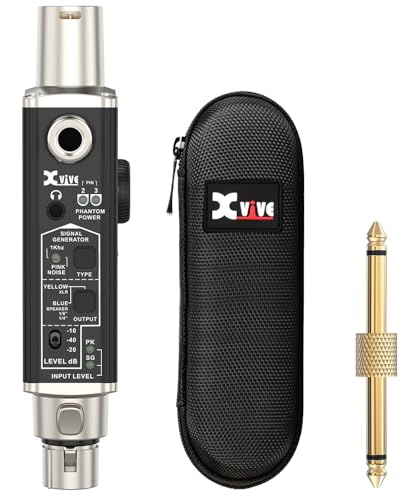
- Generates sine wave or pink-noise test signals
- Checks all three XLR pins
- Indicates phantom-power ranges
Best For: Portable XLR testing and live signal verification
Advanced Multi-Format Tester
dbx CT-3 Advanced Cable Tester

- Tests cables up to eight pins
- Supports audio, video, network, and control connectors
- Two-piece chassis tests installed cables
Best For: Broad connector coverage and installation troubleshooting
Broad-Format Cable Checker
Hosa CBT-500 Audio Cable Tester
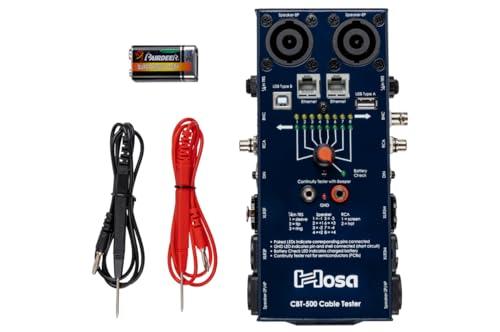
- Supports XLR, BNC, Ethernet, and SpeakON
- Battery-powered ohmmeter operation
- Listed UL specification and limited lifetime warranty
Best For: General cable checks across audio and related formats
Versatile Connector Coverage

- Tests seven listed connector types
- Ohmmeter-based measurement
- Corded-electric multifunction design
Best For: Broad audio connector coverage
LED Line-Finding Checks
MFL 15-Plug Audio Cable Tester

- LEDs show conductor connections
- Supports up to 13 cables
- Metal casing with 10-way switch
Best For: Recording and live-performance troubleshooting
Speaker-System Compatibility
Elite Core OSP CT-04C Cable Tester

- Supports 2-, 4-, and 8-pole Speakon
- Works as ohmmeter or continuity tester
- Includes audio, DMX, and RJ45 coverage
Best For: Speaker systems and mixed connector setups
Broad-Coverage Cable Checks
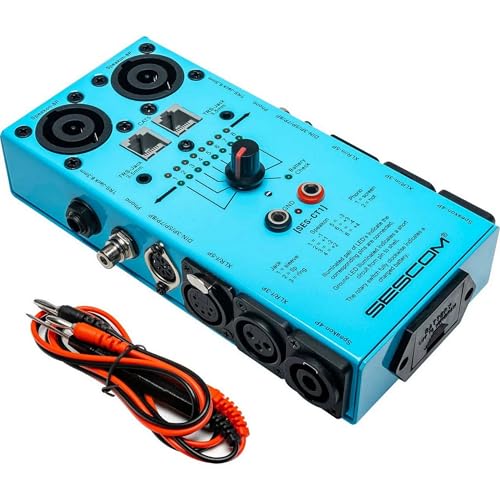
- Tests nine audio and Ethernet connection types
- Includes selector, battery check, and ground-status check
- Battery-powered ohmmeter with test probes
Best For: Multi-connector audio and Ethernet troubleshooting
Long-Run Signal Troubleshooting
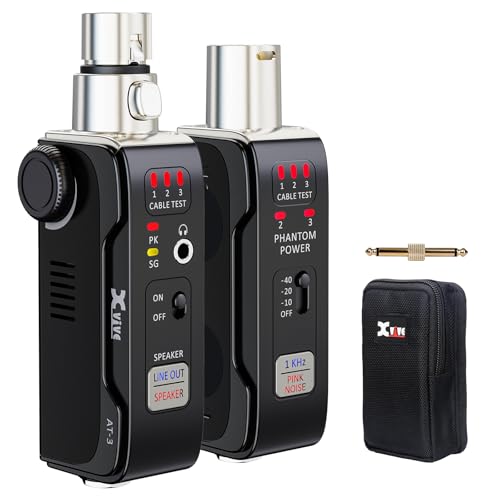
- Split design enables one-person end-to-end testing
- Generates sine or pink-noise test signals
- Checks phantom power and monitors input activity
Best For: Live-sound XLR and DMX troubleshooting
Multi-Interface LED Diagnostics
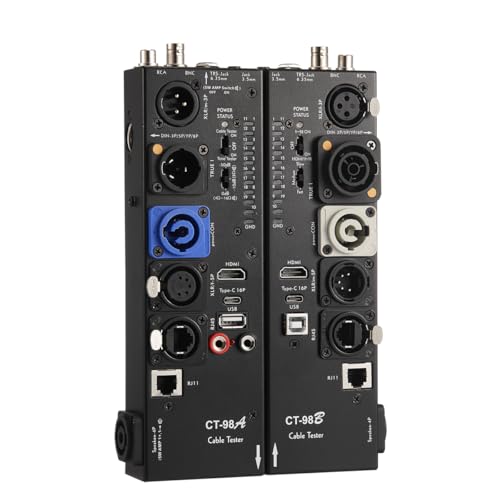
- Tests audio, video, USB, and network interfaces
- LEDs show connectivity and pin configuration
- Supports continuity, polarity, and voltage checks
Best For: Mixed-format cable repair benches
Rugged Field Tester – Mackie CT-MACKIE
The Mackie CT-MACKIE is a practical choice among audio cable testers for accurate measurements when you need to check common live-sound and studio connectors quickly. Its five-way switch, LED readout, and supplied probes support continuity checks across several cable formats.
Best For: Live-sound technicians and studio users testing TRS, TS, XLR, RCA, Speakon, 3.5mm TRS, MIDI, and banana-jack connections.
Pros:
- Tests many commonly used connector types.
- Five-way switch helps verify individual pins quickly.
- Battery-powered steel chassis with LED readout and signal probes.
Cons:
- Requires a separate 9V battery.
- Its listed measurement type is an ohmmeter, so it is focused on continuity rather than broader signal analysis.
Choose this model if rugged construction and straightforward connector checks matter more than advanced signal-generation features.
Signal & Phantom Power Tester – Xvive AT-1 Portable Audio Tester
The Xvive AT-1 stands out among audio cable testers for accurate measurements because it combines cable verification with signal generation and monitoring. It can produce a 1 kHz sine wave or pink noise, check three-pin XLR connectivity, and indicate phantom-power levels.
Best For: Audio professionals who need portable XLR testing, real-time signal monitoring, and phantom-power verification.
Pros:
- Generates 1 kHz sine waves or pink noise at selectable output levels.
- Checks connectivity across all three XLR pins.
- Provides visual indicators for 24–44V and 44–52V phantom power.
- Includes a carry case, belt clip, USB-C cable, and adapter.
Cons:
- Its stated cable compatibility centers on XLR cables.
- Maximum listed voltage is 52V DC, so it is not intended for higher-voltage testing.
This is the most function-rich option in the group for XLR-focused troubleshooting, especially when you want to verify both connectivity and an active audio signal.
Advanced Multi-Format Tester – dbx CT-3 Advanced Cable Tester
The dbx CT-3 is designed for broad cable-service needs, making it a strong option among audio cable testers for accurate measurements. It tests cables up to eight pins, supports numerous connector formats, and includes a tone generator for practical troubleshooting.
Best For: Installers, repair technicians, and production users working with audio, video, networking, and control cables.
Pros:
- Tests cables with up to eight pins.
- Supports BNC, DIN, DMX, MIDI, RCA, RJ11, RJ45, TRS, TS, XLR, banana, and speaker-twist connectors.
- Two-piece chassis can test installed cables.
- Includes a test-tone generator and supports different connector formats.
Cons:
- Uses corded electric power rather than battery operation.
- At 2.2 pounds, it is heavier than some portable testers.
- Its broad connector support may be more capability than needed for simple audio-only checks.
The CT-3 is a sensible pick when your work extends beyond standard audio cables and you need one tester for varied connector types and installed runs.
Broad-Format Cable Checker – Hosa CBT-500 Audio Cable Tester
The Hosa CBT-500 offers a straightforward way to evaluate a wide range of cable types, making it useful for audio cable testers for accurate measurements. Its listed compatibility includes XLR, 75-ohm BNC, Ethernet, and SpeakON connections, with battery-powered ohmmeter operation.
Best For: Users who need a general-purpose tester for audio, Ethernet, BNC, and SpeakON cables.
Pros:
- Supports XLR, 75-ohm BNC, Ethernet, and SpeakON cables.
- Battery-powered operation is convenient for bench or field checks.
- Listed UL specification and limited lifetime warranty.
Cons:
- The supplied notes do not specify a display, tone generator, or pin-selection controls.
- Its listed dimensions make it relatively large for a portable tester.
- Requires a 9V battery.
Consider the CBT-500 if connector variety is important and you want a simple, battery-powered continuity tester rather than a signal-analysis tool.
Versatile Connector Coverage – Whirlwind MCT7 Cable Tester
The Whirlwind MCT7 is a practical choice among audio cable testers for accurate measurements when your setup includes several connector types. Its ohmmeter-based design checks NL4, 5-pin DIN, BNC, XLR, TRS, RCA, and Mini connections in one multifunction tester.
Best For: Users who need one corded-electric tester for a broad range of audio and related connectors.
Pros:
- Supports NL4, 5-pin DIN, BNC, XLR, TRS, RCA, and Mini connectors.
- Uses ohmmeter testing for cable checks.
- Multifunction design consolidates several connector-testing needs.
Cons:
- Requires corded electric power rather than battery operation.
- Its listed connector coverage may not suit setups using other plug types.
The MCT7 stands out for connector variety. Choose it when broad compatibility matters more than a battery-powered format.
LED Line-Finding Checks – MFL 15-Plug Audio Cable Tester
The MFL 15-Plug Audio Cable Tester is designed for audio cable testers for accurate measurements with visual continuity feedback. LED indicators help identify conductor connections, while the unit can support testing for up to 13 cables and uses a 10-way switch to select connections.
Best For: Recording and live-performance setups that need broad cable compatibility and LED-assisted troubleshooting.
Pros:
- LED indicators help confirm conductor connections.
- Supports up to 13 cables during testing.
- Compatible with listed TRS, XLR, RCA, DIN, and Speakon cable types.
- Strong, compact metal casing is suited to regular use.
Cons:
- Battery powered, with the required battery not included.
- The 10-way switch requires manual connection selection.
With its visual indicators, wide cable support, and compact metal housing, this tester is a useful troubleshooting option for busy audio systems.
Speaker-System Compatibility – Elite Core OSP CT-04C Cable Tester
The Elite Core OSP CT-04C is a battery-powered option for audio cable testers for accurate measurements across speaker and signal connections. It functions as an ohmmeter or continuity tester and covers TRS, XLR, RCA, MIDI, DIN, Speakon, Mini Stereo, RJ45 CAT5e, and DMX connectors.
Best For: Speaker-focused users who also need to check common audio, network, and DMX connections.
Pros:
- Supports 2-, 4-, and 8-pole Speakon connections.
- Tests 1/4-inch TRS, male and female XLR, RCA, MIDI, and DIN connections.
- Also covers 1/8-inch Mini Stereo, RJ45 CAT5e, and 3- and 5-pin DMX.
- Offers both ohmmeter and continuity-testing functions.
Cons:
- Battery-powered operation requires an available battery.
- Its 1.8-pound, 8 x 5 x 3-inch format is less compact than some basic testers.
The CT-04C is especially compelling when Speakon testing is central to your workflow. Its additional connector coverage makes it suitable for more varied technical setups.
Broad-Coverage Cable Checks – Sescom SES-CT1
For shoppers comparing audio cable testers for accurate measurements, the Sescom SES-CT1 is a practical option when broad connector coverage matters. Its 9-way selector supports XLR, RCA, TRS, 3.5 mm, SpeakON, DIN, and RJ45 CAT5 testing, while the ohmmeter function, ground-status check, and included test probes help with basic cable troubleshooting.
Best For: Studios, installers, and audio technicians who need one battery-powered tester for multiple audio and Ethernet cable types.
Pros:
- Tests a wide range of XLR, audio, SpeakON, DIN, and RJ45 connections.
- Includes a 9-way connection selector and battery check.
- Provides ground-connection status checking and includes test probes plus a 9V battery.
Cons:
- Its measurement function is specified as an ohmmeter rather than a signal generator or input meter.
- Battery powered, with a minimum operating voltage of 9 volts.
The SES-CT1 stands out for connector versatility and straightforward continuity-oriented checks. Choose it when you want a compact, general-purpose tester rather than advanced live-sound signal monitoring.
Long-Run Signal Troubleshooting – XVIVE AT-3 Ultra
Among audio cable testers for accurate measurements, the XVIVE AT-3 Ultra is geared toward active troubleshooting rather than simple continuity checks. Its split send-and-monitor design lets one person test long XLR or DMX runs, while selectable test signals, pin-fault modes, phantom-power checking, and input metering add useful diagnostic detail.
Best For: Live sound crews, churches, DJs, rental teams, and touring rigs checking long XLR or DMX cables and connected audio equipment.
Pros:
- Split transmitter and receiver design supports one-person, two-end testing.
- Generates 1 kHz sine or pink noise at three output levels.
- Checks 48V phantom power and displays XLR input signal activity with LEDs.
- Offers headphone or built-in speaker monitoring and USB-C charging.
Cons:
- Its main cable-testing focus is XLR and DMX rather than a broad range of connector formats.
- Uses a nonstandard rechargeable battery included with the unit.
The AT-3 Ultra is the most feature-rich choice here for field diagnostics. Its signal generation and monitoring functions make it better suited to tracing faults in working systems than to basic passive cable verification alone.
Multi-Interface LED Diagnostics – MFL. MF-CT98 Cable Tester
If you need audio cable testers for accurate measurements across several connector families, the MFL. MF-CT98 offers unusually broad interface coverage. Its 10-way switch, LED indicators, detachable testing design, and continuity, polarity, and voltage measurement modes support visual checks for audio, video, and network cables.
Best For: Technicians who regularly troubleshoot mixed audio, video, USB, and network cabling with a single metal-housed tester.
Pros:
- Supports XLR, HDMI, USB, Type-C, RCA, BNC, TRS/jack, and RJ11 connections.
- Uses LED feedback to show connectivity and pin configuration status.
- Detachable design supports split testing in different locations.
- Measures continuity, polarity, and voltage within its stated operating range.
Cons:
- At 2.5 pounds and 10.5 inches long, it is less portable than smaller basic testers.
- The supplied notes specify a 9V minimum operating voltage and battery-powered/corded operation.
- The feature set is broader than a dedicated audio-only tester may require.
The MF-CT98 is a strong fit for mixed-format repair benches where LED pin-status feedback and interface variety are priorities. Its larger metal design favors workshop versatility over minimal carry weight.
How We Picked the Best Audio Cable Testers for Accurate Measurements
We focused on testers that provide clear, repeatable results for common audio-cable faults. Selection criteria included connector coverage, continuity and pinout visibility, portability, switch or probe design, build quality, power requirements, and usefulness in real studio or live-sound workflows. Advanced features such as phantom-power checking, signal generation, cable tracing, and Ethernet or video support were considered valuable when they added practical diagnostic capability.
Because “accurate” testing depends on the fault being investigated, no single tester is ideal for every cable. A simple continuity unit may be the fastest choice for routine patch-cable checks, while a professional tester with remote ends or a signal generator can provide more informative results on installed or long-distance lines.
Quick Comparison
| Best For | Look For | Typical Advantage |
|---|---|---|
| Studio patch cables | Clear LED pinout display | Fast checks for opens and shorts |
| Live-sound technicians | Rugged housing and broad connector support | Fewer adapters in the field |
| Speaker cables | SpeakON and high-current connector compatibility | Better coverage for PA systems |
| Installed or long cables | Remote unit, tone generator, or tracer | Easier fault location over distance |
| Mixed-format work | XLR, TRS, RCA, USB, HDMI, or network testing | One tool covers more equipment |
Key Buying Factors for Audio Cable Testers for Accurate Measurements
Connector Compatibility
Start with the connectors you test most often. Three- and five-pin XLR, ¼-inch TRS, 3.5 mm, RCA, DIN, SpeakON, and DMX connections are not interchangeable, so verify that the tester has the required sockets or supports suitable adapters.
Fault Visibility
LED indicators should make pin-by-pin continuity and wiring errors easy to interpret. A sequential switch can test individual conductors, while a remote receiver or cable tracer is more useful when both ends are separated or the cable is installed.
Testing Depth
Basic testers identify continuity, shorts, and reversed wiring. For more demanding work, consider signal generation, phantom-power detection, shielding checks, or the ability to test long XLR and DMX runs. These features can reveal problems that a simple continuity test may miss.
Portability and Power
Battery-powered testers are convenient for racks, stages, and service bags. Check battery access, automatic shutoff, switch durability, and whether the enclosure can withstand frequent transport. A compact design is helpful, but not if it limits connector coverage or readability.
Who Should Buy Which Audio Cable Testers for Accurate Measurements?
Choose a straightforward LED continuity tester if you mainly maintain short studio, rehearsal, or home-recording cables. Live-sound crews should prioritize rugged construction, broad connector support, and fast one-handed operation. Installers and repair technicians will benefit more from remote testing, cable tracing, or signal-generation functions. If you regularly handle speaker, DMX, Ethernet, USB, or video connections alongside audio, a multi-interface model may reduce the number of tools you carry.
Before buying, list your connectors and the faults you need to diagnose, then select the simplest tester that covers both. That approach keeps the tool affordable while ensuring your Audio Cable Testers for Accurate Measurements provide useful results when you need them.