
The right rack cabinet can turn a crowded studio into a cleaner, safer, and easier-to-use workspace. These 10 options cover compact setups, rolling open-frame designs, slanted mixing racks, and heavy-duty AV storage.
Use the comparison and buying advice below to match rack units, depth, mobility, construction, and load capacity to your equipment and workflow.
Best 10 Audio Rack Cabinets for Studios Picks for 2026
Best Mobile Workhorse

- 500-pound steel-frame capacity
- Open design for wiring access
- Lockable casters and top shelf
Best For: Mobile studios and flexible AV installations
Best Compact Wood Rack
Sound Town 8U Slanted Studio Rack

- Slanted face for easier operation
- Golden oak plywood construction
- Includes rails and rack screws
Best For: Small studios seeking a furniture-style rack
Best Heavy-Duty Open Frame

- 550-pound load capacity
- Durable 1.5 mm steel frame
- Lockable 3-inch caster wheels
Best For: Heavy studio, DJ, AV, and network setups
Best Large Wood Rack
Sound Town 16U Slanted Studio Rack

- Spacious 16U equipment capacity
- Slanted layout for easier control access
- Includes feet and four casters
Best For: Growing studios wanting capacity with a wood finish
Best Rolling Rack
RIVECO POMU 12U Network & Stereo Rack

- Adjustable front and rear rails
- Round and square mounting holes
- Up to 600 pounds with leveling feet
Best For: Mobile studio, AV, and home-lab installations
Best Furniture-Style Option
Sound Town DIY 12U Walnut Studio Rack

- Walnut laminate furniture-style finish
- Compact 15-inch rack depth
- Casters and rubber feet included
Best For: Home studios seeking attractive, movable storage
Best for Touring Gear

- Portable four-wheel rack case
- Two-tier 10U equipment layout
- Load capacity up to 661 pounds
Best For: DJs and mobile studio or performance setups
Best DIY Studio Rack

- 12U of 19-inch rack space
- Slanted design for easier operation
- Casters, rubber feet, and rails included
Best For: Home and recording studios wanting a portable wood rack
Best Open-Frame Rack
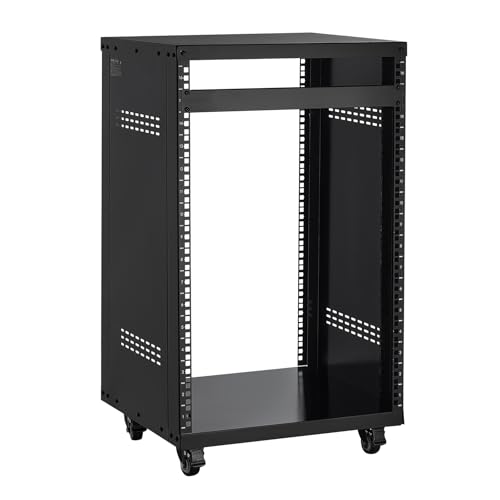
- 16U capacity with 18-inch depth
- Open front and back for easy access
- 200-pound steel-frame capacity
Best For: Expandable studio and AV equipment setups
Best Adjustable Rack
RIVECO 9U Rolling Studio Cabinet
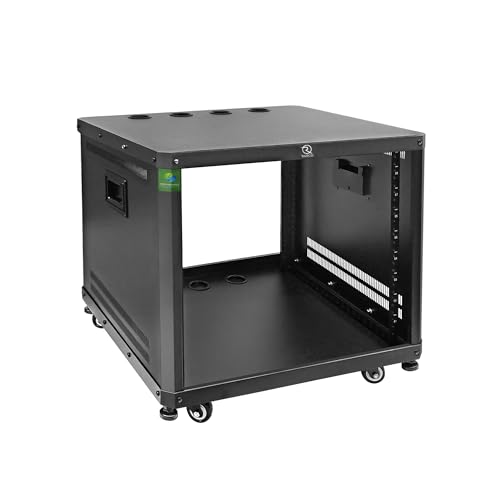
- Adjustable front and rear rails
- Up to 600 pounds with leveling feet
- Top and bottom cable-routing grommets
Best For: Mixed-depth equipment and flexible studio layouts
Best Mobile Workhorse – VEVOR 12U AV Rack Stand
For studios comparing audio rack cabinets for studios, the VEVOR 12U stand offers a practical open-frame setup with 18-inch depth, easy cable access, and mobility. Its steel construction and locking casters suit installations that may need to move or be reconfigured.
Best For: Mobile recording, AV, server, and media setups needing substantial capacity.
Pros:
- Q235 carbon-steel frame supports up to 500 pounds.
- Open front and back simplify wiring and maintenance.
- Lockable casters and a top shelf add flexibility.
Cons:
- Open-frame design provides less protection than an enclosed cabinet.
- Its 12U capacity may not suit larger collections.
This is a strong choice when accessibility, ventilation, and movement matter more than enclosure. The included screws, cage nuts, wrench, and casters help streamline setup.
Best Compact Wood Rack – Sound Town 8U Slanted Studio Rack
Sound Town DIY Solid Baltic Birch Plywood Slanted 8U Studio Rack, Golden Oak (SDRK-8T)
Check Price On AmazonAmong audio rack cabinets for studios, the Sound Town 8U rack stands out for its slanted layout and finished Baltic birch plywood construction. The angled face makes mounted equipment easier to operate while giving a small studio a furniture-style appearance.
Best For: Compact recording rooms and users who want an attractive DIY rack for essential gear.
Pros:
- Slanted design improves access to front-panel controls.
- Pre-cut plywood construction is designed for assembly.
- Includes installed 10/32 rack rails and rail screws.
Cons:
- Assembly is required.
- 8U capacity offers less expansion than larger racks.
- It is a floor-mounted design without listed casters.
Choose this model when presentation and convenient control access are priorities. Its 19-inch rack width supports standard equipment, while the golden oak finish adds a traditional studio look.
Best Heavy-Duty Open Frame – AxcessAbles 12U Network Rack
For buyers seeking audio rack cabinets for studios with serious load requirements, the AxcessAbles 12U open-frame rack combines 18-inch depth with a steel frame rated for up to 550 pounds. Its preinstalled locking wheels make repositioning a loaded setup more manageable.
Best For: Studios, DJ systems, and AV or network installations using heavy rack-mounted equipment.
Pros:
- Supports up to 550 pounds.
- 1.5 mm steel construction is built for durability.
- Includes lockable 3-inch casters and installation hardware.
Cons:
- Open-frame construction leaves equipment exposed.
- Assembly is implied by the included tool and hardware.
This rack is a sensible pick for dense equipment configurations where weight capacity and mobility are more important than a finished enclosed cabinet. Its universal 19-inch compatibility accommodates audio, video, IT, and networking gear.
Best Large Wood Rack – Sound Town 16U Slanted Studio Rack
The Sound Town 16U is a spacious option among audio rack cabinets for studios, pairing a slanted control-friendly design with Baltic birch plywood and a golden oak finish. Its included feet and casters let you choose between a stable stationary setup and easier movement.
Best For: Expanding studios that need 16U of rack space and a traditional wood finish.
Pros:
- 16U capacity provides room for substantial equipment.
- Slanted layout makes front controls easier to reach.
- Includes rubber feet and four rubberized casters, with two locking.
Cons:
- Assembly is required.
- Wood construction may not provide the same load profile as a steel rack.
- Only two of the included casters have lever brakes.
This model fits a growing studio that wants more rack space without giving up a furniture-like appearance. The dual mobility options are useful when the rack sometimes needs to stay planted and sometimes needs to move.
Best Rolling Rack – RIVECO POMU 12U Network & Stereo Rack
For studios that need flexible equipment storage and easy repositioning, the RIVECO POMU is one of the more adaptable audio rack cabinets for studios. Its 12U open frame accepts standard 19-inch gear, while adjustable rails, cable-routing openings, and included casters support varied installations.
Best For: Studios, home theaters, offices, and home labs that need a movable rack for amplifiers, AV equipment, recorders, or networking hardware.
Pros:
- Adjustable front and rear rails accommodate different equipment depths.
- Round and square rail holes support multiple mounting standards.
- Includes casters, leveling feet, mounting hardware, and assembly instructions.
- Supports up to 500 pounds with casters or 600 pounds with leveling feet.
Cons:
- Its 23.6-inch height and nearly 20-inch depth require substantial floor space.
- Open construction provides no enclosed-door protection for equipment.
- Assembly is required.
This is a practical choice when mobility, ventilation, and installation flexibility matter more than a finished furniture appearance. Use the leveling feet for the heaviest setups.
Best Furniture-Style Option – Sound Town DIY 12U Walnut Studio Rack
The Sound Town DIY 12U rack brings a warmer furniture-style look to audio rack cabinets for studios. Its walnut laminate finish and compact 15-inch depth suit home recording spaces, while the included casters make the open rack easier to move when needed.
Best For: Home and studio audio setups that prioritize a coordinated walnut appearance, compact depth, and straightforward equipment organization.
Pros:
- Furniture-grade walnut laminate offers a polished studio-friendly appearance.
- Pre-cut panels and installed rack rails simplify assembly.
- Includes rubber feet and four rubberized casters.
- Two casters include lever brakes for added stability.
Cons:
- The engineered-wood construction may be less suitable for very heavy equipment than a steel rack.
- Assembly is required.
- The 15-inch rack depth may limit compatibility with deeper devices.
Choose this model for a compact, presentable setup where appearance and portability are important. Check your equipment depth before buying, especially for larger amplifiers or processors.
Best for Touring Gear – 10U PA DJ Pro Audio Rack Case
For portable systems, this 10U PA DJ rack case offers a protective alternative among audio rack cabinets for studios. Its two-tier layout, four wheels, and compact case dimensions are aimed at moving mixers, amplifiers, effects units, and related equipment between sessions or performances.
Best For: DJs, gigging musicians, and studios that need transportable rack storage for compatible audio and network equipment.
Pros:
- Designed for EQs, amplifiers, mixers, effects units, and computer servers.
- Four wheels support portability for gigs and travel.
- Reported load capacity is up to 661 pounds.
- Compact external dimensions measure approximately 22 by 17.5 by 16 inches.
Cons:
- Its 10U capacity is smaller than the 12U alternatives in this roundup.
- Internal dimensions of approximately 19 by 12 by 14 inches may restrict larger equipment.
- The supplied notes do not specify wheel brakes or detailed rack-rail standards.
This case makes the most sense when transport and equipment protection are central concerns. Confirm both the internal dimensions and your required rack space before assembling a touring setup.
Best DIY Studio Rack – Slanted 12U Golden Oak Rack
For studios seeking audio rack cabinets for studios with a warm, furniture-style appearance, the Sound Town SDRK-12T combines 12U of 19-inch rack space with a practical slanted layout. Its plywood construction, included casters, and do-it-yourself assembly make it a flexible option for organizing rack equipment.
Best For: Home and recording studios that want a portable, slanted rack with a wood finish and straightforward assembly.
Pros:
- Provides 12U of 19-inch rack space.
- Slanted design makes mounted equipment easier to operate.
- Includes installed 10/32 rails, mounting screws, rubber feet, and four casters.
- Golden oak finish over Baltic birch plywood offers a studio-friendly appearance.
Cons:
- Assembly is required.
- Wood construction may be less suitable than steel for very heavy installations.
This rack is a strong fit when accessibility and appearance matter as much as equipment storage. The included locking casters add mobility, while the rubber feet provide a stable stationary setup.
Best Open-Frame Rack – 16U Rolling AV Studio Rack
The VEVOR 16U AV Rack is a practical choice among audio rack cabinets for studios when open access, cable maintenance, and equipment capacity are priorities. Its 18-inch depth, steel frame, top shelf, and rolling casters suit studio, AV, server, and commercial installations.
Best For: Studios and AV spaces needing an open, movable rack with substantial capacity and convenient equipment access.
Pros:
- Offers 16U of mounting space with an 18-inch depth.
- Open front and back simplify wiring and maintenance.
- Q235 carbon steel construction supports up to 200 pounds.
- Includes a top shelf, lockable casters, mounting hardware, cage nuts, and a blank panel.
Cons:
- Open-frame construction provides less enclosure than a closed cabinet.
- No manufacturer warranty is listed in the supplied details.
Choose this model when ventilation and quick access are more important than acoustic or dust enclosure. Its 16U capacity and 200-pound rating give it useful room for expanding studio or AV systems.
Best Adjustable Rack – RIVECO 9U Rolling Studio Cabinet
For audio rack cabinets for studios that need adjustable mounting depth and strong mobility, the RIVECO 9U rack offers front and rear rails, cable-routing openings, and interchangeable wheels or leveling feet. Its open design works across recording, home theater, office, and equipment-room setups.
Best For: Studios mounting mixed-depth 19-inch equipment and users who need either rolling mobility or higher stability with leveling feet.
Pros:
- Adjustable front and rear rails accommodate different equipment depths.
- Supports up to 500 pounds with casters or 600 pounds with leveling feet.
- Includes cable grommets on the top and bottom for cleaner routing.
- Ships with both casters and leveling feet, plus mounting hardware.
Cons:
- Only 9U of rack space, less than the other listed options.
- Assembly is required.
- Using leveling feet sacrifices the mobility provided by the casters.
This rack stands out for adaptable installation rather than maximum rack height. The adjustable rails and generous weight ratings make it a versatile choice for studios with varied equipment depths and changing layouts.
How We Picked These Audio Rack Cabinets for Studios
We focused on the practical features that matter in recording, production, DJ, broadcast, and home-studio environments: rack-unit capacity, 19-inch equipment compatibility, usable depth, mobility, construction, ventilation, access, and stated weight limits. The selection includes open-frame racks, enclosed or semi-enclosed cabinets, slanted studio racks, and road-style cases so different studio layouts and budgets are represented.
Because equipment dimensions vary, buyers should confirm each model’s internal depth, rail spacing, included hardware, and caster or foot configuration before ordering. Product names and advertised capacities are useful starting points, but the manufacturer’s specifications should be the final check.
Quick Comparison
| Best For | Rack Style | What to Look For |
|---|---|---|
| Compact studio systems | 9U–10U racks | Small footprint, adequate depth, stable wheels |
| Growing recording setups | 12U racks | Balanced capacity, cable access, flexible placement |
| Large equipment collections | 16U racks | Higher capacity, stronger frame, floor clearance |
| Mixing and hands-on control | Slanted studio racks | Angled rails, comfortable reach, secure feet or casters |
| Touring or transport | Road or ATA-style cases | Protection, handles, latches, and load rating |
Key Buying Factors for Audio Rack Cabinets for Studios
Rack Units and Future Expansion
One rack unit, or 1U, equals 1.75 inches of vertical equipment space. Count the rack-mounted gear you own, then reserve extra room for future interfaces, preamps, power conditioners, patch bays, or wireless systems. A nearly full rack can also make cable management and cooling more difficult.
Depth, Rails, and Compatibility
Check the cabinet’s usable front-to-back depth rather than relying only on the rack’s overall dimensions. Shallow units may suit processors and patch bays but not deeper amplifiers or servers. Adjustable rails are useful when equipment depths differ, while included screws and cage nuts can reduce setup time.
Mobility, Stability, and Access
Casters are valuable when the rack must move for rewiring or room changes, but lockable wheels or solid feet are preferable during operation. Removable side panels and open frames improve access, while enclosed designs offer more protection and a cleaner appearance. Confirm that the rack can fit through doors and leave enough clearance for cables.
Construction, Ventilation, and Load Capacity
Plywood and furniture-style finishes can blend well into a studio, while metal frames are often practical for network, AV, and utility equipment. Verify the stated load rating, especially when installing amplifiers or multiple power supplies. Leave ventilation space around heat-producing gear and avoid blocking vents with cable bundles.
Who Should Buy Which Audio Rack Cabinets for Studios?
Choose a 9U or 10U model if you have a compact setup and prioritize a smaller footprint or easier transport. A 12U rack is the most flexible choice for many home and project studios because it provides useful expansion without consuming excessive floor space. Select a 16U rack when you already own several rack units or want room to grow.
Slanted Baltic birch or walnut-finish racks suit producers who want front-panel controls positioned for comfortable access and a more furniture-like appearance. Open-frame rolling racks are better for flexible wiring, networking, and equipment that needs frequent access. For touring, mobile DJ work, or frequent transport, prioritize a road-style case with protective construction and a clearly stated load rating over appearance alone.