
Bookshelf speakers for electronic music need more than loud volume. The best models keep kick drums tight, synth layers clean, and bass controlled enough to stay enjoyable at both low and higher listening levels.
In this roundup, we focused on speakers that balance detail, low-end extension, connectivity, and value so you can find a pair that fits your desk, bedroom, or small listening room.
Best 10 Bookshelf Speakers for Electronic Music Picks for 2026
Reference-Grade Desktop Pick
Edifier MR3 Powered Studio Monitor Speakers

- Hi-Res certified with flat 52Hz-40kHz response
- Balanced TRS, RCA, AUX, Bluetooth, and headphone out
- Music, Monitor, and Custom modes with app EQ
Best For: accurate desktop listening and music creation
Flexibility With Subwoofer Support
Saiyin 40W*2 Bluetooth Bookshelf Speakers

- 40W x 2 with 4-inch woofers and silk dome tweeters
- Bluetooth, optical, aux, RCA, and sub out
- Remote control for easy source switching
Best For: easy setup with upgradeable bass
Classic Wired Value
Edifier R1280T Powered Bookshelf Speakers
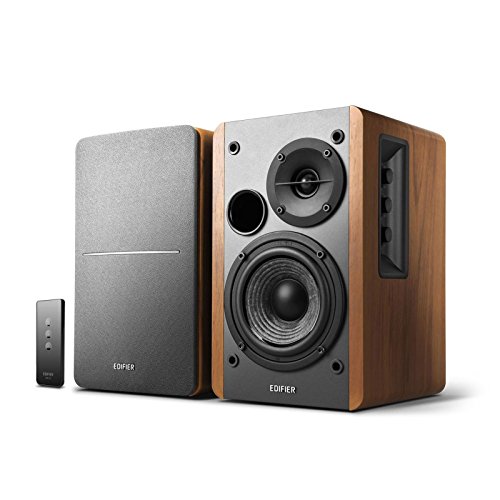
- 42W RMS with 4-inch driver and 13mm tweeter
- Dual AUX inputs for two-device convenience
- Bass and treble knobs on the powered speaker
Best For: simple wired listening with tone control
Compact Budget Wireless Option
Saiyin 30W*2 Bluetooth Bookshelf Speakers

- 30W x 2 in a compact 3.75-inch design
- Bluetooth, optical, coaxial, RCA, and 3.5mm inputs
- Remote control for volume and source selection
Best For: small spaces and budget-friendly versatility
Wood-Grain Desktop Upgrade
- Bluetooth 5.0 wireless streaming
- Optical, coaxial, and RCA inputs
- Sub out with built-in crossover
Best For: Flexible everyday listening with optional subwoofer expansion
Turntable-Friendly Stereo Pair

- Bluetooth 5.3 plus Optical and TV-ARC
- Dual 3-inch drivers with bass reflex port
- Remote control with 3 EQ presets
Best For: Compact turntable, TV, and PC listening
Near-Field Studio Option

- USB DAC with balanced TRS input
- 3.5-inch carbon fiber mid-bass driver
- Bluetooth 5.3 with RCA and AUX
Best For: Desktop monitoring and accurate music playback
Powered Compact Pick
RIOWOIS Powered Bookshelf Speakers

- No receiver or amplifier needed
- Bluetooth 5.3 with AUX, optical, and ARC
- Remote control with input switching
Best For: Easy all-in-one listening with turntables, TV, and streaming
Desktop Tuning Pick
Sanyun SW208 Active Bookshelf Speakers
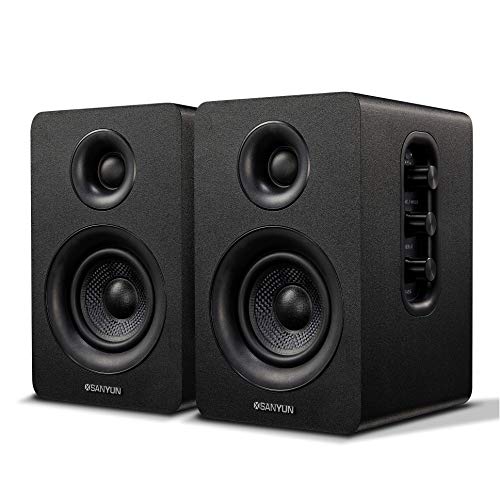
- 60W carbon fiber speaker unit
- USB input with built-in 24-bit DAC
- Bass and treble knobs for tuning
Best For: Desktop and PC listeners who want adjustable sound
Bass Control Pick
MEVOSTO Active Bookshelf Speakers

- 5-inch woofer with silk dome tweeters
- 10 levels of bass and treble control
- BT 5.4 plus USB, RCA, and AUX
Best For: Listeners who want stronger bass shaping and versatile inputs
Reference-Grade Desktop Pick – Edifier MR3 Powered Studio Monitor Speakers
If you want bookshelf speakers for electronic music that lean toward accuracy rather than hype, the Edifier MR3 is a strong desktop-friendly choice. Its Hi-Res Audio certification, flat response, and multiple input options make it easy to use for listening, producing, or editing without adding much coloration.
Best For: Listeners and creators who want a more accurate, versatile bookshelf speaker for electronic music on a desk or small studio setup.
Pros:
- Hi-Res Audio certified with a flat response from 52Hz to 40kHz.
- Balanced TRS, RCA, AUX, Bluetooth, and headphone output for flexible setups.
- Music, Monitor, and Custom modes plus EQ control in the EDIFIER ConneX app.
- MDF cabinet helps reduce distortion for cleaner playback.
Cons:
- 18W x 2 RMS is modest if you want bigger room-filling output.
- Best suited to near-field use rather than bass-heavy party listening.
The MR3 is a practical fit if you care about detail, input flexibility, and a more studio-like sound signature. For electronic music, that makes it especially useful when you want tight monitoring instead of extra bass boost.
Flexibility With Subwoofer Support – Saiyin 40W*2 Bluetooth Bookshelf Speakers
For bookshelf speakers for electronic music, this Saiyin pair focuses on easy connections and the option to add a subwoofer later. With Bluetooth, optical, RCA, auxiliary input, and a sub out, it suits users who want a simple all-in-one speaker setup for TV, PC, or a turntable with the right output.
Best For: Buyers who want versatile connectivity and the option to expand bass with a powered subwoofer.
Pros:
- 40W x 2 power with a 4-inch woofer and 0.5-inch silk dome tweeter.
- Bluetooth, optical, aux, RCA, and sub out for flexible hookups.
- Remote control makes input and volume changes easy.
- Can connect to a record player directly via LINE OUT, or to TV via optical.
Cons:
- Turntables need Bluetooth transmit output if you plan to use wireless pairing.
- Source must be set to PCM/Stereo/Non-surround to avoid noise issues.
- Large feature list may be more than you need for a simple desk setup.
This is a good pick if you want a straightforward powered speaker set with room to grow. For electronic music, the sub out is the key advantage when you want to add deeper low end later.
Classic Wired Value – Edifier R1280T Powered Bookshelf Speakers
If you are shopping for bookshelf speakers for electronic music and want a simple wired setup, the Edifier R1280T stays appealing. It offers dual AUX inputs, bass and treble controls, and a wooden enclosure, making it a practical option for desktop listening and casual home use.
Best For: Listeners who want a dependable wired bookshelf speaker with basic tone controls and dual-input convenience.
Pros:
- 42 watts RMS with a 4-inch full-range unit and 13mm silk dome tweeter.
- Two AUX inputs let you connect two devices without constant swapping.
- Side-panel bass and treble knobs make tuning easy.
- MDF wood build and classic finish suit home or desk setups.
Cons:
- No Bluetooth or optical input if you want modern wireless connectivity.
- Not the most feature-rich choice for users wanting a subwoofer output.
The R1280T is best seen as a straightforward, good-value powered speaker rather than a feature-packed system. For electronic music, it works well when you want clean wired playback and a bit of manual EQ control.
Compact Budget Wireless Option – Saiyin 30W*2 Bluetooth Bookshelf Speakers
For buyers seeking bookshelf speakers for electronic music in a smaller footprint, this Saiyin model is the compact option in the group. It still gives you Bluetooth, optical, coaxial, and RCA connectivity, plus a remote, so it can work as a flexible everyday speaker for a computer, TV, or turntable with the right output.
Best For: Shoppers who want a smaller powered bookshelf speaker with multiple inputs and simple remote control.
Pros:
- 30W x 2 output in a compact 3.75-inch woofer design.
- Bluetooth, optical, coaxial, RCA, and 3.5mm input options.
- Remote control supports volume and input switching.
- Can connect directly to a record player via LINE OUT.
Cons:
- Lower power and smaller drivers than the larger Saiyin model.
- Turntable Bluetooth use depends on the source having Bluetooth transmit/output.
- Source needs standard PCM/Stereo/Non-surround output to avoid issues.
This is the more compact, lower-power pick for people who want convenience first. For electronic music, it makes most sense in smaller spaces where you value versatility and a tidy setup over maximum output.
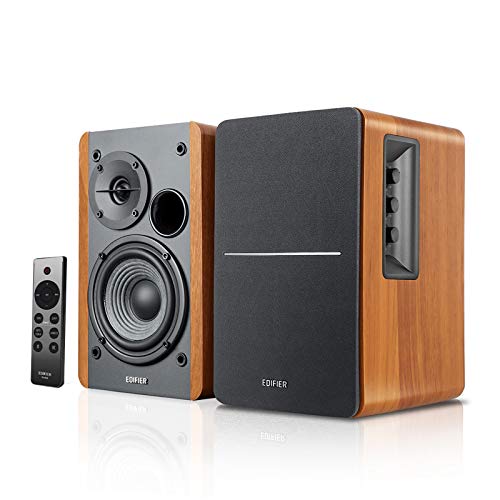
Wood-Grain Desktop Upgrade – Edifier R1280DBs
If you’re shopping for bookshelf speakers for electronic music, the Edifier R1280DBs is a practical pick for a compact setup. Its 42W output, 4-inch woofer, silk dome tweeter, and soundfield spatializer give it a balanced, room-filling presentation, while the sub out makes it easy to add more low-end weight later.
Best For: Listeners who want a flexible everyday speaker pair with wireless input and optional subwoofer expansion.
Pros:
- Bluetooth 5.0 lets you stream from phones, tablets, laptops, or Macs without cables.
- Optical and coaxial inputs support lossless connections to TVs and computers.
- Subwoofer output with built-in crossover adds upgrade room for stronger bass.
- Side-panel bass, treble, and volume knobs make quick EQ tweaks easy.
Cons:
- Only one speaker is powered, so placement is a little less flexible than fully separate active pairs.
- The 4-inch woofer is solid for nearfield use, but deep electronic bass may still benefit from a sub.
Overall, the R1280DBs is a versatile bookshelf option if you want clean connectivity and a warm, adjustable sound without overcomplicating your setup. It works especially well as a desktop or small-room speaker with room to grow.
Turntable-Friendly Stereo Pair – Saiyin DS6701DB3
For buyers comparing bookshelf speakers for electronic music and turntables, the Saiyin DS6701DB3 focuses on punchy stereo playback and easy source switching. Dual 3-inch drivers, a bass reflex port, and Bluetooth 5.3 are joined by Optical, TV-ARC, and AUX inputs, so it can handle a small entertainment setup without much fuss.
Best For: Users who want a compact powered pair for record players, TV, PC, and casual music playback.
Pros:
- Bluetooth 5.3, Optical, TV-ARC, and AUX give you plenty of connection options.
- Dual 3-inch drivers with sub-magnet enhancement are tuned for punchy low end.
- Remote control plus back-panel buttons make it easy to switch listening modes.
- Three EQ presets let you choose Movie, Music, or News settings from the couch.
Cons:
- The 3-inch driver size limits how much deep bass you can expect on its own.
- The setup depends on a wired link between the two speakers, even when streaming over Bluetooth.
This is a useful all-around powered bookshelf speaker set if you want simple control and broad compatibility. It is especially appealing if you care more about convenience and flexible inputs than maximum bass output.
Near-Field Studio Option – Ortizan C7
If you want bookshelf speakers for electronic music with a more studio-style approach, the Ortizan C7 is built around accurate near-field playback. It uses a 24-bit DAC over USB, a 3.5-inch carbon fiber mid-bass driver, a 0.75-inch silk dome tweeter, and balanced TRS input, making it a stronger fit for precise desktop listening and basic production work.
Best For: Near-field monitoring, desktop music production, and listeners who want a flatter, more accurate sound.
Pros:
- USB input with built-in 24-bit DAC reduces signal loss for digital playback.
- Balanced 6.35mm TRS input supports mixers, interfaces, and other pro gear.
- 3.5-inch carbon fiber driver and silk dome tweeter are tuned for clear detail.
- Bluetooth 5.3, RCA, AUX, and headphone output make it easy to connect multiple sources.
Cons:
- The 3.5-inch woofer size means it is more about clarity than big room-filling bass.
- Its accuracy-first tuning may feel less exciting if you want extra coloration or boosted low end.
As a compact studio monitor-style speaker pair, the C7 stands out for balanced output and connection versatility. It is a smart choice when you want detail and source accuracy more than club-style bass.
Powered Compact Pick – RIOWOIS Powered Bookshelf Speakers
If you want bookshelf speakers for electronic music without adding a receiver, the RIOWOIS powered pair is built for simple desktop or TV use. With Bluetooth 5.3, AUX, optical, and TV-ARC support, it gives you flexible ways to play bass-heavy tracks from a turntable, computer, phone, or TV.
Best For: Listeners who want a straightforward powered setup for turntables, TVs, and everyday streaming.
Pros:
- No receiver or amplifier required.
- Bluetooth 5.3 plus AUX, optical, and TV-ARC inputs.
- Remote control can switch inputs and sound effects.
- Reinforced MDF cabinet helps minimize crackling sounds.
Cons:
- Turntable Bluetooth use requires the turntable to have Bluetooth transmitter/output.
- Optical and ARC cables are not included.
- 2.75-inch woofer size may be limiting for very large rooms.
For electronic music fans who want a compact powered speaker with broad connectivity, this is a practical all-in-one option. It leans more toward convenience and input flexibility than deep customization, but the remote and multiple sound effects make it easy to tune for different sources.
Desktop Tuning Pick – Sanyun SW208 Active Bookshelf Speakers
For bookshelf speakers for electronic music on a desk or near a monitor, the Sanyun SW208 focuses on tunable stereo sound in a compact form. Its 60W carbon fiber speaker unit, Bluetooth 5.0, USB input, and built-in 24-bit DAC make it a solid match for PC listening where you want clear detail and adjustable sound.
Best For: PC and desktop listeners who want a small speaker pair with bass and treble controls.
Pros:
- 60W carbon fiber speaker unit for a fuller desktop sound.
- Built-in 24-bit DAC for USB playback.
- Separate bass and treble adjustment knobs.
- Bluetooth 5.0 and 3.5mm AUX support.
Cons:
- Smaller 3-inch design is not aimed at large-room output.
- Best suited to computer and desktop use rather than home-theater setups.
- Sound tuning depends on manual knob adjustments.
This model is a strong fit if you like dialing in electronic tracks to your taste, especially on a computer setup. The blend of USB DAC playback and onboard tone controls gives it more flexibility than basic budget speakers.
Bass Control Pick – MEVOSTO Active Bookshelf Speakers
If you’re shopping for bookshelf speakers for electronic music and want more control over the low end, the MEVOSTO pair is built around a 5-inch woofer, silk dome tweeters, and 10 levels of bass and treble adjustment. It also adds BT 5.4, USB digital audio, RCA, and AUX inputs, so it works across turntables, TVs, computers, and laptops.
Best For: Buyers who want bigger bass control and flexible wired/wireless connectivity.
Pros:
- 5-inch woofers plus silk dome tweeters for deeper bass and crisp highs.
- 10 levels of bass and treble adjustment.
- BT 5.4, USB, RCA, and AUX inputs.
- Remote, knobs, and voice prompts for easy control.
Cons:
- USB audio requires a compatible audio-output USB port.
- Does not support Dolby Audio.
- Requires the correct DC power setup for stable operation in some uses.
Among these options, this one stands out for listeners who want to shape electronic music playback more aggressively. The larger woofer and dedicated bass/treble control make it the most adjustment-friendly pick here.
How We Picked the Best Bookshelf Speakers for Electronic Music
We prioritized models that make sense for electronic music listening: clear treble for hi-hats and effects, enough bass authority for kick drums and sub-bass lines, and practical inputs for PC, turntable, TV, or streaming devices. We also weighed amplifier power, speaker size, and whether a model is better suited to near-field desktop use or a small room.
Quick Comparison
Some options lean more neutral and monitor-like, which is useful if you want cleaner mids and tighter timing. Others are more consumer-friendly with extra bass shaping or wireless convenience. If you want the most accurate presentation, look at the studio-monitor-style picks first. If you want easy setup and fuller sound without adding a sub, powered Bluetooth models with larger woofers are often the better fit.
Key Buying Factors for Bookshelf Speakers for Electronic Music
Bass Control
Electronic music depends on punchy mid-bass and clean low-end extension. A larger woofer can help, but enclosure design and tuning matter just as much. Look for speakers that stay composed instead of sounding boomy.
Treble Detail
Synth textures, percussion, and reverb tails can get smeared on cheaper speakers. A smooth tweeter with good separation helps preserve sparkle without becoming harsh during long listening sessions.
Power and Room Size
For a desk or small bedroom, modest power is often enough. For a larger room, choose a stronger powered pair or plan to add a subwoofer later. Overbuying size can lead to muddy sound in compact spaces.
Connectivity
USB, optical, RCA, and Bluetooth each solve different use cases. For a PC setup, USB or optical can be the cleanest route. For turntables, make sure the speaker pair matches your phono preamp situation. Bluetooth is convenient, but wired connections usually sound more consistent.
Who Should Buy Which Bookshelf Speakers for Electronic Music?
If you want the most balanced listening experience, choose the more studio-oriented models. If your priority is easy setup and everyday versatility, powered Bluetooth bookshelf speakers are a smart fit. If bass matters most, pick a model with a larger woofer and sub-out support so you can expand later. For compact desks or casual listening, smaller powered speakers can still deliver strong results without taking up much space.
Overall, the best Bookshelf Speakers for Electronic Music are the ones that match your room, your source gear, and how loud you actually listen. Focus on clean low-end, solid stereo imaging, and the connections you’ll use most.