
When you’re a musician on the go, having the right bus-powered audio interface can make all the difference in your recordings. You need something compact, reliable, and packed with features that won’t slow you down. From high-resolution options to versatile inputs, these devices cater to various needs. But which ones really stand out? Let’s explore the top contenders that can elevate your music experience.
Focusrite Scarlett Solo 3rd Gen USB Audio Interface

If you’re a guitarist, vocalist, podcaster, or producer looking for an easy-to-use audio interface, the Focusrite Scarlett Solo 3rd Gen USB Audio Interface is a top choice. This interface boasts high-performing mic pre-amps that enhance your recordings with a unique Air mode, adding clarity. With two high-headroom instrument inputs, you can capture guitar and bass tones without distortion. Experience studio-quality sound thanks to its 24-bit/192kHz converters. It also features low-noise balanced outputs for clean playback and a headphone output for private listening. Plus, it includes essential software and a three-year warranty for peace of mind.
Best For: Guitarists, vocalists, podcasters, and producers seeking an easy-to-use audio interface for studio-quality recordings.
Pros:
- High-performing mic pre-amps with switchable Air mode for enhanced clarity.
- Supports studio-quality recordings up to 24-bit/192kHz for optimal sound quality.
- Includes essential recording software and a three-year warranty for peace of mind.
Cons:
- Limited to two inputs, which may not be sufficient for larger recording setups.
- May require additional adapters or cables depending on your equipment.
- Some users may find the bundled software limited compared to more advanced options.
Focusrite Scarlett Solo 4th Gen USB Audio Interface

The Focusrite Scarlett Solo 4th Gen USB Audio Interface is perfect for guitarists and vocalists seeking high-fidelity, studio-quality recordings. With a dynamic range of 120dB and converters from Focusrite’s flagship interfaces, you’ll capture every nuance. The Air Mode enriches your vocals and guitars, adding harmonic depth. You’ll also appreciate the included recording toolkit featuring Pro Tools Intro+, Ableton Live Lite, and more, ensuring you have essential software at your fingertips. Compact and lightweight, it easily fits into your setup, while 24/7 customer support and a 3-year warranty offer peace of mind. Elevate your recordings wherever you go!
Best For: Guitarists, vocalists, and producers looking for high-fidelity, studio-quality recording solutions.
Pros:
- High dynamic range of 120dB for capturing detailed audio.
- Includes a comprehensive recording toolkit with popular software.
- Compact and lightweight design makes it easy to transport.
Cons:
- Limited to one audio input channel, which may not suit all users.
- May require additional software setup for optimal use.
- Some users may find the price point higher compared to basic models.
Mackie Onyx Producer 2X2 USB Audio Interface

For musicians on the go, the Mackie Onyx Producer 2X2 USB Audio Interface stands out with its bus-powered design, eliminating the need for an external power adapter. You’ll enjoy high-resolution 24-Bit/192kHz recording with two boutique-quality Onyx mic preamps, guaranteeing exceptional audio fidelity. The XLR/TRS combo inputs allow for versatile connectivity, accommodating mic, line, and Hi-Z instruments. Plus, with MIDI I/O and zero-latency direct monitoring, you can capture your sound effortlessly. Its durable build makes it perfect for mobile sessions, while USB 2.0 connectivity guarantees fast transfer speeds and low latency, keeping your workflow smooth wherever you are.
Best For: Musicians and podcasters seeking a portable audio interface for high-quality recordings on the go.
Pros:
- High-resolution 24-Bit/192kHz recording ensures exceptional audio fidelity.
- Versatile XLR/TRS combo inputs accommodate various sources, including microphones and instruments.
- Durable design makes it ideal for mobile recording sessions.
Cons:
- Limited to 2 in x 2 output, which may not suffice for larger recording setups.
- USB 2.0 connectivity may be slower compared to newer USB standards.
- No onboard effects processing, requiring reliance on external plugins or software.
Focusrite Clarett+ 2Pre USB-C Audio Interface

Musicians seeking a compact and versatile solution will find the Focusrite Clarett+ 2Pre USB-C Audio Interface to be an ideal choice. With two professional-quality Clarett⁺ preamps, it delivers high headroom and ultra-low noise for pristine recordings. The JFET instrument inputs preserve your guitar’s natural tone, while ADAT optical input allows for easy expansion. Its improved A-D and D-A converters guarantee accurate audio with low distortion and high dynamic range. Enjoy a transparent headphone output for peak mixing, and connect easily via USB-C to a variety of devices. Plus, you’ll get a software bundle to enhance your production capabilities.
Best For: Musicians and producers seeking a high-quality, compact audio interface for home recording and music production.
Pros:
- Professional-quality Clarett⁺ preamps provide high headroom and ultra-low noise for excellent sound quality.
- Versatile connectivity via USB-C allows compatibility with various devices and easy expansion with ADAT optical input.
- Included software bundle offers mixing plug-ins and virtual instruments, enhancing production capabilities.
Cons:
- Bus-powered design may limit usage if the USB-C port does not supply sufficient power.
- Limited number of inputs (2 preamps) may not be sufficient for larger recording sessions without expansion.
- Potential learning curve for users unfamiliar with Focusrite Control software and audio interface management.
Synido USB C Audio Interface for Music Recording and Streaming

Looking for a compact and versatile audio interface that seamlessly fits into your mobile recording setup? The Synido USB C Audio Interface is perfect for recording music, streaming, and podcasting. Its 2-channel design features XLR and line inputs, 24-bit depth, and a 48kHz sampling rate, ensuring high-fidelity sound. With professional 48V phantom power, you’ll enjoy reduced noise and latency. You can easily switch between monitoring modes for real-time mixing or post-editing. Plus, its lightweight design and plug-and-play functionality make it incredibly portable. Just grab your adapters, and you’re ready to create anywhere!
Best For: Musicians, podcasters, and streamers seeking a portable and high-quality audio interface for professional sound recording.
Pros:
- High-fidelity sound quality with 24-bit depth and 48kHz sampling rate for accurate audio detail.
- Multiple monitoring modes allow for flexibility in recording, mixing, and post-editing.
- Lightweight and compact design makes it easy to transport for on-the-go recording sessions.
Cons:
- Requires a third-party universal ASIO driver for optimal DAW compatibility.
- Limited to 2-channel input, which may not be sufficient for larger setups.
- Phantom power may not be necessary for all users, adding potential complexity for beginners.
Audio Interface 2X2 24-bit/192kHz for PC/Mac/iOS Recording

Designed for mobile creators and home recording enthusiasts, the 2X2 24-bit/192kHz audio interface offers exceptional sound quality without the hassle of bulky equipment. With plug-and-play USB C connectivity, you won’t need to deal with complicated drivers. Experience studio-grade recordings that capture every nuance, thanks to high-performance converters and a wide dynamic range. The built-in 48V phantom power supports demanding microphones, while zero-latency monitoring guarantees silent tracking. Its elegant design features illuminated control knobs, making it easy to use in low light. Perfect for vocals or guitars, this versatile interface meets all your recording needs on PC, Mac, or iOS.
Best For: Musicians and content creators seeking high-quality audio solutions for home recording or mobile use.
Pros:
- Plug-and-play USB C connectivity allows for easy setup with no drivers needed.
- Studio-grade 24-bit/192kHz fidelity captures detailed audio with a wide dynamic range.
- Built-in 48V phantom power enables the use of demanding microphones.
Cons:
- Limited to 2-channel inputs, which may not be sufficient for larger recording setups.
- May require additional adapters for some microphone or instrument connections.
- The elegant design, while aesthetically pleasing, could be less durable than more rugged models.
MAONO USB Audio Interface for PC (PS22 Lite Black)

For podcasters and streamers seeking a compact yet powerful solution, the MAONO USB Audio Interface PS22 Lite Black stands out with its high-resolution recording capabilities at 24-bit/192kHz. This interface supports XLR inputs for microphones and features a dynamic range of 106dB. You’ll love its compatibility with both condenser and dynamic microphones, plus the dedicated instrument input for guitarists. With ProStudio Routing Software, live streaming becomes seamless. Its plug-and-play design and direct monitoring switch simplify your setup. The interface works perfectly with Mac, Windows, and popular DAWs, making it an essential tool for any creative on the go.
Best For: Podcasters, streamers, and musicians seeking a compact, high-quality audio interface for recording and live streaming.
Pros:
- High-resolution recording at 24-bit/192kHz for professional sound quality.
- Supports both condenser and dynamic microphones with 48V phantom power.
- User-friendly design with plug-and-play functionality and direct monitoring switch.
Cons:
- Limited to USB connectivity, which may not suit all setups.
- May require additional software for advanced streaming features.
- Compact size may lead to a lack of physical controls compared to larger interfaces.
M-AUDIO M-Track Duo USB Audio Interface for Recording and Streaming

The M-AUDIO M-Track Duo USB Audio Interface is perfect for musicians and podcasters who need a reliable, compact solution for recording and streaming. With its two combo XLR/line/instrument inputs and phantom power, you can easily connect guitars, vocals, or any line signals. Enjoy high-quality recordings with 48kHz audio resolution and transparent Crystal Preamps, ensuring excellent sound for all microphones, including condensers. The 1/4-inch headphone output and stereo outputs offer flexible monitoring, while the USB/Direct switch allows for zero-latency monitoring. Plus, it comes with MPC Beats Software, enhancing your music production experience effortlessly.
Best For: Musicians and podcasters seeking a compact and reliable audio interface for high-quality recording and streaming.
Pros:
- Flexible connectivity with two combo XLR/line/instrument inputs and phantom power for versatile recording options.
- High audio resolution at 48kHz and transparent Crystal Preamps for optimal sound quality.
- Zero-latency monitoring with the USB/Direct switch, allowing for real-time audio feedback during recording.
Cons:
- Limited number of inputs (only two), which may not be sufficient for larger recording sessions.
- Basic software bundle with MPC Beats, which might not meet the needs of advanced users looking for more comprehensive production tools.
- Potential compatibility issues with certain older operating systems, although it is designed for both Mac and PC.
Universal Audio Volt 276 USB Audio Interface

Musicians on the go will find the Universal Audio Volt 276 USB Audio Interface to be an ideal companion, thanks to its portable design and powerful features. With classic UA 610 preamps and a vintage mode, it enhances your recordings with studio-quality sound. The built-in analog compressor, inspired by the 1176, adds clarity and punch to your vocals and instruments. Compatible with Mac, PC, iPad, and iPhone, it connects easily via USB. Plus, you can access UAD plug-ins like the Teletronix LA‑2A for even more creative options. Weighing only 790 grams, it’s perfect for musicians and content creators on the move.
Best For: Musicians, producers, and content creators seeking a portable audio interface with professional studio-quality sound.
Pros:
- High-quality sound: Equipped with classic UA 610 preamps and an analog compressor for enhanced clarity and punch.
- Portable design: Lightweight and compact, making it easy to transport for on-the-go recording.
- Compatibility: Works seamlessly with Mac, PC, iPad, and iPhone, along with popular software applications.
Cons:
- Requires external power: Needs an external power supply for certain devices, which may limit portability.
- Limited number of channels: Only supports 2-in/2-out configuration, which may not be sufficient for larger setups.
- Additional adapters needed: Requires an Apple Lightning to USB Camera Adapter for iOS devices, adding to the overall cost.
M-AUDIO M-Track Solo USB Audio Interface for Recording and Streaming
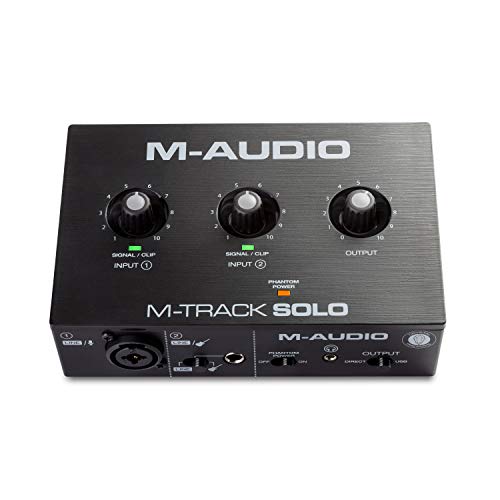
Ideal for aspiring artists and content creators, the M-AUDIO M-Track Solo USB Audio Interface stands out with its user-friendly design and versatile input options. It’s perfect for recording, streaming, and podcasting, compatible with both Mac and PC. With 48kHz audio resolution, you’ll achieve high-quality recordings. The interface features one combo XLR/Line input with phantom power for mics and an additional Line/Instrument input for guitars. Monitoring is a breeze with a 1/8 headphone output and stereo RCA outputs, plus a USB/Direct switch for zero latency. Plus, it comes with MPC Beats Software for enhanced music creation.
Best For: Aspiring artists and content creators looking for a user-friendly audio interface for recording, streaming, and podcasting.
Pros:
- High-quality 48kHz audio resolution for professional recordings.
- Versatile input options including phantom power for microphones and a dedicated input for instruments.
- Zero latency monitoring feature for real-time audio feedback.
Cons:
- Limited to one microphone input, which may not suffice for multi-mic setups.
- The included software may not meet the needs of advanced users seeking more complex production tools.
- Build quality may feel less robust compared to higher-end interfaces.
Factors to Consider When Choosing a Bus Powered Audio Interface
When choosing a bus-powered audio interface, you need to evaluate several key factors. Audio quality standards, connectivity options, and portability play a huge role in your decision. Additionally, think about the input and output channels and how well the interface will work with your devices.
Audio Quality Standards
Choosing a bus-powered audio interface involves careful consideration of audio quality standards to guarantee you get the best recordings possible. Look for specifications like sample rates of up to 192 kHz and 24-bit depth, which are important for high-fidelity sound. High-performance converters are essential, ensuring accurate analog-to-digital and digital-to-analog conversions that preserve your audio’s integrity. Pay attention to dynamic range, with 120dB providing greater detail, especially for vocals and instruments. Low-noise mic preamps and phantom power support are crucial for capturing clean audio without distortion. Additionally, zero-latency monitoring is a game-changer, letting you hear your input in real-time—important for live performances and precise tracking. Prioritize these factors to elevate your recording quality.
Connectivity Options Available
Understanding the connectivity options available for bus-powered audio interfaces is essential for guaranteeing your setup meets your needs. Most interfaces connect via USB, with many supporting USB-C for quicker data transfer and lower latency. You’ll want to look for multiple input options like XLR/TRS combo inputs, which allow you to connect microphones, instruments, and line-level signals easily. MIDI I/O connectivity is also a great feature, enabling seamless integration with MIDI devices to enhance your music production. Additionally, many interfaces come with headphone outputs and balanced outputs for studio monitors, giving you versatile monitoring options. Finally, guarantee compatibility with various operating systems and DAWs, so you can smoothly incorporate the interface into your existing workflow.
Portability and Weight
Portability and weight play an essential role in selecting a bus-powered audio interface, especially if you’re frequently on the move. Most models weigh around 0.9 pounds, making them easy to transport for mobile recording setups. Compact dimensions—often around 3.78D x 5.63W x 1.83H inches—allow them to fit comfortably in backpacks or gear bags. With lightweight designs typically under 1 pound, you can integrate these interfaces into your recording rig without adding bulk. Plus, many use USB connections, so you won’t need external power supplies, enhancing convenience during travel. A robust build quality guarantees these portable interfaces can withstand travel rigors while delivering high performance in various recording environments, making them perfect for musicians and podcasters on the go.
Input and Output Channels
When selecting a bus-powered audio interface, the number of input and output channels is vital for your recording needs. If you plan to record multiple sources simultaneously, look for configurations with 1, 2, or more input channels. Output channels are equally significant; at least two outputs are necessary for stereo sound, enabling connection to studio monitors or headphones. Consider interfaces with combo inputs that accept both XLR and 1/4″ TRS connections, offering flexibility for various microphones and instruments. If you work with MIDI instruments, check for MIDI I/O capabilities to enhance your production options. Finally, if you anticipate expanding your setup, interfaces with ADAT optical inputs allow you to connect external preamps for more input channels.
Compatibility With Devices
How do you guarantee your bus-powered audio interface will work seamlessly with your devices? First, check the compatibility with your operating system—whether you’re using Mac, Windows, or iOS—to ascertain proper functionality. Next, examine the USB connectivity options; different devices may require USB-C, USB-A, or other types for integration. Additionally, verify that the interface supports the input types you need, like XLR for microphones or Hi-Z for instruments. It’s also essential to assess compatibility with your preferred recording software, confirming it works with DAWs like Pro Tools or Ableton Live. Finally, consider the power requirements, making sure the interface can be bus-powered by your device to maintain portability without needing an external power source.
Software Bundle Included
While choosing a bus-powered audio interface, the included software bundle can greatly enhance your music production experience. Many interfaces come with popular digital audio workstations (DAWs) like Pro Tools Intro+, Ableton Live Lite, or Cubase LE, giving you essential tools for recording and editing audio. Some bundles even feature software instruments and effects, allowing you to create music without purchasing additional applications. The quality and variety of this software can considerably impact your recording and production workflow. It’s vital to assess whether the included software is compatible with your operating system and fits your preferred workflow. This guarantees seamless integration into your existing setup, making your music production process smoother and more enjoyable.
Monitoring Features Offered
Monitoring features are vital for achieving high-quality recordings with a bus-powered audio interface. Look for interfaces that provide zero-latency monitoring, letting you hear your recordings in real-time without any delay—this is essential for accurate performance and mixing. Consider models with multiple monitoring options, such as stereo mode for precise recording, mix mode for blending input with playback audio, and USB mode for monitoring computer audio only. Dedicated headphone outputs are a must, offering a direct connection for high-fidelity listening. Also, check for direct monitoring switches that allow you to toggle between input signals and playback audio. Finally, verify the interface has robust monitoring controls, like illuminated knobs or LED indicators, to manage volume levels effectively and prevent distortion.