
The right camera crane can turn a static setup into a sweeping reveal, elevated tracking shot, or smooth vertical move. The best choice depends on your camera weight, available crew, location, and how much automation you need.
We compare 10 camera cranes for filmmaking, including compact kits, long-reach jib arms, motorized systems, stands, and supporting track equipment.
Best 10 Camera Cranes for Filmmaking Picks for 2026
Best for Automated Repeatability

- 24 programmable movement presets
- Leveling dual-arm parallelogram design
- 74.8-inch reach with included tripod
Best For: Repeatable studio, product, and event shots
Best for Heavy-Duty Tracking

- 16-foot camera movement path
- Designed for dolly and crane systems
- Breaks into four-foot sections
Best For: Professional productions using heavy camera rigs
Best Portable Option

- Works with common action cameras
- Three modular 20-inch poles
- Compact 1.5-pound kit
Best For: Traveling action-camera creators
Best Complete Professional Package

- 14-foot four-section camera jib
- Included motorized pan-tilt head
- Stand, joystick, accessories, and bags included
Best For: Professional controlled crane shots
Compact Jib Package
Proaim Wave-2 7ft Camera Jib Crane

- Complete jib, head, tripod, dolly, spreader, and bag package
- Supports camera setups up to 6kg/13.2lb
- Telescopic 4.1–7ft arm with tool-free setup
Best For: Portable DSLR, mirrorless, camcorder, and content-production setups
Long-Reach Crane
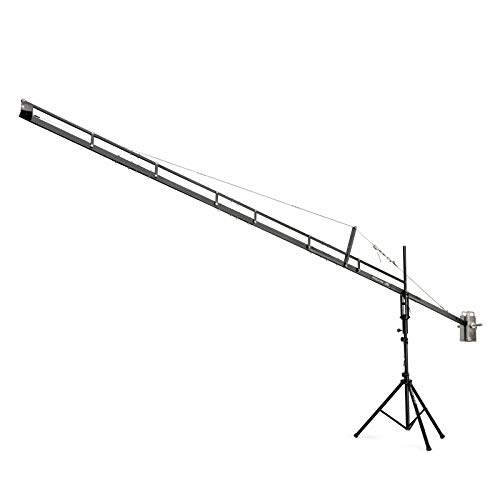
- Adjusts to 12, 14, or 18ft configurations
- Supports rigs up to 8kg/17.6lb
- Includes a 90kg/198lb heavy-duty stand
Best For: Large-scale, elevated, overhead, and crowd-clearing camera moves
Heavy-Duty Flexible Jib
Proaim Wave-2 10ft Camera Crane

- Supports up to 25kg/55lb according to supplied product bullets
- Includes 100mm bowl and 75mm adapter
- Telescopic 10ft arm suits dynamic camera movement
Best For: Heavier DSLR, gimbal, studio, event, and commercial setups
Best Long-Reach Option

- Supports rigs up to 8kg / 17.6lb
- Configures to 12, 14, or 18 feet
- 270-degree tilt with LCD mount included
Best For: Large-scale crane moves and overhead filmmaking
Best Heavy-Duty Support

- Supports up to 90kg / 198lb
- 33mm mounting tube
- Adjusts from 51 to 83 inches
Best For: Professional jib support in studio and field productions
Best Mid-Range Reach

- Supports rigs up to 8kg / 17.6lb
- Runs at 10 or 14 feet
- 270-degree tilt and LCD mount included
Best For: Sweeping shots in moderately sized locations
Best for Automated Repeatability – Motorized Camera Jib Crane
For filmmakers and studios comparing camera cranes for filmmaking, this motorized jib stands out when repeatable movements matter. Its controller supports 24 preset programs, while the dual-arm design helps keep the camera level during vertical travel.
Best For: Product photography, e-commerce videos, repeatable B-roll, studio shooting, and stage or live-event recording.
Pros:
- Stores up to 24 programmable movement sequences with speed, pause, loop, and return controls.
- Dual-arm parallelogram design helps reduce unwanted camera tilt.
- Includes a servo motor, counterweights, heavy-duty tripod, and controller.
- Provides up to 74.8 inches of arm reach and 102.4 inches of working height.
Cons:
- Requires careful counterweight adjustment before operation.
- Camera is not included.
- Its 47.2-inch folded length may still require dedicated transport space.
This is a practical choice for controlled productions where identical camera moves must be repeated across multiple takes or products. It is less suited to users seeking a lightweight, run-and-gun jib.
Best for Heavy-Duty Tracking – Proaim Stream 16ft Track
When evaluating camera cranes for filmmaking, a solid track can be just as important as the crane itself. The Proaim Stream provides a 16-foot rail path for controlled dolly and crane movement and is built for demanding production setups.
Best For: Feature films, television, commercials, music videos, studio shoots, and heavy camera-dolly or crane systems.
Pros:
- Designed to support up to a stated 1,000 kg / 2,200 lb payload.
- Compatible with professional camera dollies and crane systems.
- Collapsible four-foot sections make transport and storage more manageable.
- Rigid aluminum rails are intended for repeated professional use.
Cons:
- The 125.7-pound item weight makes this a substantial transport and setup commitment.
- It is a track system rather than a complete camera crane package.
- Listed dimensions and capacity should be checked against the specific dolly or crane being used.
This track makes sense for crews that need a stable, extended movement path and already have compatible dolly or crane hardware. It is overkill for small, lightweight mobile productions.
Best Portable Option – Joby Action Jib Kit
Joby action jib kit with pole pack - capture cinematic crane shots with your action video camera
Check Price On AmazonFor lightweight creators searching camera cranes for filmmaking, the Joby Action Jib Kit offers a compact way to create elevated and sweeping action-camera shots. Its modular poles and adjustable clamps make it easy to configure and carry.
Best For: GoPro, Contour, and Sony action-camera users who need a portable jib for travel, events, or quick outdoor setups.
Pros:
- Compatible with action cameras including GoPro, Contour, and Sony models.
- Three modular 20-inch aluminum extension poles allow adjustable length.
- Handle and integrated pulley system support camera rotation.
- Weighs 1.5 pounds and packs into a compact carry bag.
Cons:
- Designed for action cameras rather than larger DSLR or mirrorless setups.
- Its three 20-inch poles provide a shorter reach than professional jib systems.
- Manual assembly and adjustment are required.
This is the most travel-friendly choice in the group and suits creators who prioritize portability over payload and automated control. It is a simple entry point for action-camera crane effects.
Best Complete Professional Package – Proaim 14ft Motorized Jib
For productions needing broad, controlled movement, this Proaim system is a strong contender among camera cranes for filmmaking. It combines a 14-foot, four-section jib with a stand, motorized pan-tilt head, joystick controls, and transport bags.
Best For: Professional film, television, commercial, studio, and location shoots requiring overhead views, reveals, sweeping rises, and remote framing.
Pros:
- Complete package includes the jib, stand, motorized head, joystick, monitor arm, power accessories, and storage bag.
- Motorized head provides 360-degree pan and tilt movement with variable-speed and damping controls.
- Cable-assisted automatic leveling helps maintain platform angle during jib movement.
- Four 3.5-foot sections improve transport and storage compared with a one-piece jib.
Cons:
- The jib supports up to 8 kg, so camera and accessory weight must be carefully managed.
- At 35 pounds, the system still requires substantial transport and setup planning.
- The equipment is not water resistant.
This is the most feature-rich option for crews that want a ready-to-use crane package with remote pan-tilt control. Its payload limits and multi-part setup make careful balancing and production planning essential.
Compact Jib Package – Proaim Wave-2 7ft Camera Jib Crane
For filmmakers seeking camera cranes for filmmaking in a portable format, the Proaim Wave-2 combines a 7-foot telescopic jib with a Jr. pan-tilt head, tripod, dolly, spreader, and carrying bag. It is designed for camera setups up to 6kg/13.2lb and supports smooth rising, lowering, and sweeping movements.
Best For: DSLR, mirrorless, camcorder, interview, event, commercial, and content-creation setups that need an all-in-one jib package.
Pros:
- Complete package includes the jib, pan-tilt head, tripod, dolly, spreader, and bag.
- Telescopic 4.1–7-foot aluminum arm supports flexible shot sizes.
- Tool-free setup, bubble level, and dual-arm rigidity simplify production use.
- Portable dolly helps reposition the setup between locations.
Cons:
- Its 6kg/13.2lb camera capacity limits heavier cinema configurations.
- A 7-foot reach is less suited to very large-scale crane shots.
- The full package may be more equipment than a stripped-down jib-only setup requires.
This is a practical starting point for crews that want a complete, mobile camera crane system rather than sourcing each support component separately.
Long-Reach Crane – Proaim 18ft Camera Crane Jib
For productions that need camera cranes for filmmaking with substantial height and reach, the Proaim 18ft jib extends to 18 feet and can reach 19 feet from the ground with its included 5-foot stand. Its modular design and heavy-duty support make it suited to large crane moves and elevated perspectives.
Best For: Professional film, event, commercial, and location work requiring long-reach overhead, crowd-clearing, or high-angle camera movements.
Pros:
- Five-section arm supports 12-, 14-, or 18-foot configurations.
- Carries camera rigs up to 8kg/17.6lb, including gimbals and accessories.
- Included steel stand supports up to 90kg/198lb.
- 270-degree camera-platform tilt enables overhead and unusual creative angles.
Cons:
- The 31kg jib and large stand are less convenient for small crews or quick setups.
- Its extended reach requires considerable operating space.
- It is more specialized than a compact jib for everyday indoor work.
Choose this model when reach, modular length, and stand capacity matter more than portability. The two-arm structure, LCD mount, and auto/manual tilt options add useful control for demanding crane shots.
Heavy-Duty Flexible Jib – Proaim Wave-2 10ft Camera Crane
The Proaim Wave-2 10ft is a strong option for filmmakers comparing camera cranes for filmmaking and needing more payload capacity than a lightweight DSLR jib. Its telescopic arm supports up to 25kg/55lb and includes 100mm and 75mm bowl compatibility for a range of camera-head setups.
Best For: Studios, event crews, commercial productions, and filmmakers using gimbals, pan-tilt heads, or heavier camera configurations.
Pros:
- 25kg/55lb stated payload supports heavier camera and accessory setups.
- 10-foot telescopic arm enables rising, lowering, sweeping, and reveal shots.
- 100mm bowl and included 75mm adapter broaden head compatibility.
- Works with DSLR, camcorder, camera, and three-axis gimbal configurations.
Cons:
- Its 10-foot format needs more operating space than a compact jib.
- A head, stand, or other support accessories may be needed depending on the package configuration.
- Its stated product details include differing payload figures, so buyers should verify the current listing specifications.
This model fits crews prioritizing payload flexibility and professional mounting compatibility. It is a sensible middle ground between compact jibs and very long-reach crane systems.
Best Long-Reach Option – Proaim 18ft Camera Crane Jib
For filmmakers who need maximum reach, this 18-foot jib is one of the more capable camera cranes for filmmaking. Its modular design supports 12-, 14-, or 18-foot setups, while the 8kg payload accommodates a rigged DSLR or mirrorless camera with accessories.
Best For: Large cinematic crane moves, overhead shots, and productions that need adjustable reach.
Pros:
- Supports camera rigs up to 8kg / 17.6lb.
- Configures to 12, 14, or 18 feet.
- Offers 270-degree platform tilt with auto and manual modes.
- Includes an LCD mounting arm and carry bag.
Cons:
- Its 18-foot reach requires substantial setup space and support.
- At 20.5 pounds, it is less convenient to transport than a shorter jib.
- Stand support is not included in the supplied product notes.
The two-arm structure and thrust roller bearings are designed to help maintain smooth movement at full extension. Choose this model when shot scale and flexibility matter more than compactness.
Best Heavy-Duty Support – PROAIM Jib Crane Stand
A camera crane is only as dependable as its base, and this PROAIM stand is built to provide a stable foundation for professional jib systems. It features a 33mm mounting tube, telescopic height adjustment, and a stated 90kg / 198lb weight limit.
Best For: Studio, broadcast, commercial, and on-location setups requiring heavy-duty jib support.
Pros:
- Supports up to 90kg / 198lb.
- 33mm mounting tube suits compatible professional jib systems.
- Telescopic height adjusts from 51 to 83 inches.
- Includes a mid-level spreader and rubber feet for stability.
Cons:
- Compatibility depends on a jib using a 33mm mounting interface.
- Its heavy-duty steel construction weighs 5.6kg.
- This is a stand, not a complete camera crane or jib arm.
With quick-lock height adjustment and a robust powder-coated steel frame, this stand is a practical foundation for demanding camera-crane setups. Verify the mounting specification before pairing it with your jib.
Best Mid-Range Reach – Proaim 14ft Camera Crane Jib
This 14-foot jib offers a useful middle ground for filmmakers who want more reach than a compact crane without committing to an 18-foot system. Among camera cranes for filmmaking, it stands out for its 10- or 14-foot configurations and support for camera rigs up to 8kg.
Best For: Sweeping tracking shots, elevated perspectives, and productions with moderate space and transport needs.
Pros:
- Supports DSLR, mirrorless, gimbal, and other rigs up to 8kg / 17.6lb.
- Configures to either 10 or 14 feet.
- Provides 270-degree tilt with auto and manual control.
- Includes an LCD mounting arm and storage bags.
Cons:
- Its 14-foot configuration still needs considerable operating space.
- The 16kg jib weight may be demanding for frequent solo transport.
- Stand support is not included in the supplied product notes.
The two-arm design and thrust roller bearings help support smooth, stable movement, while the shorter configuration is useful in tighter locations. It is a strong compromise when you need cinematic reach but not the full scale of an 18-foot jib.
How We Picked the Best Camera Cranes for Filmmaking
We focused on the factors that most affect real-world crane shots: reach, payload support, stability, portability, movement control, and system compatibility. The selection includes short jibs for smaller cameras, long professional arms for dramatic movement, motorized options for repeatable shots, and essential support hardware.
Because a crane arm is only as reliable as its base, we also considered whether each option is designed to work with a heavy-duty stand, tripod, dolly, gimbal, pan-tilt head, or counterweight system. Always confirm the manufacturer’s stated payload and mounting requirements before purchase.
Quick Comparison
| Best For | Recommended Type | What to Prioritize |
|---|---|---|
| Action cameras and travel shoots | Compact jib kit | Low weight and fast setup |
| DSLR and mirrorless cameras | Short or mid-length jib | Payload capacity and balance |
| Large cinematic cameras | Heavy-duty crane system | Stand strength, counterweights, and reach |
| Repeatable commercial shots | Motorized crane | Programmable movement and pan-tilt control |
| Complex tracking setups | Crane and track combination | Compatibility, leveling, and operating space |
Key Buying Factors for Camera Cranes for Filmmaking
Reach and Operating Space
Longer arms create wider arcs and more dramatic rises, but they need more room, stronger support, and additional counterweight. A shorter jib is easier to transport and control on crowded sets.
Payload and Balance
Check the complete payload, including the camera, lens, battery, monitor, gimbal, pan-tilt head, and accessories. The counterweight system must be capable of balancing that total safely, not merely supporting the camera at the front.
Movement Control
Manual jibs are simple and flexible, while motorized systems can provide repeatable moves and controlled pan-tilt operation. Automation is especially useful for product videos, visual effects plates, and multi-take productions.
Support and Portability
A sturdy stand, tripod, or dolly improves safety and smoothness. Look for reliable locking points, a compatible mounting diameter, adjustable leveling, and a setup weight your crew can handle.
Camera and Head Compatibility
Verify mounting plates and load limits before combining a jib with a gimbal or remote pan-tilt head. Some arms are sold separately from stands, heads, and counterweights, so budget for the complete working system.
Who Should Buy Which Camera Cranes for Filmmaking?
Choose a compact action-camera jib if portability and quick setup matter most. Choose a short DSLR or mirrorless jib for weddings, events, and small productions where space is limited. Choose a mid-length Wave-style jib when you want a practical balance of reach, stability, and transportability.
Choose a long heavy-duty crane for larger cameras, expansive establishing shots, and professional sets with enough crew and operating room. Choose a motorized system when precise, repeatable motion is more valuable than the simplicity of manual operation. If you already own compatible crane hardware, a dedicated arm or heavy-duty stand may be the most cost-effective upgrade.