
Mobile recording setups need more than basic level control. The right mixer can combine microphones, instruments, Bluetooth playback, USB connectivity, phantom power, and effects without overwhelming a portable workflow.
We selected 10 digital mixing consoles for mobile recording across compact, mid-size, and professional formats so you can match channel capacity and connectivity to your actual recording needs.
Best 10 Digital Mixing Consoles for Mobile Recording Picks for 2026
Best Compact Connectivity
BOMGE BM-05 5-Channel Digital Mixer

- USB-B recording interface for computers and mobile devices
- Three XLR inputs with switchable 48V phantom power
- Bluetooth, USB playback, headphone monitoring, and effects
Best For: Portable recording, podcasting, and livestreaming
Best Effects-Focused Option

- Eight channels with XLR and stereo line connectivity
- USB playback, computer recording, and audio editing support
- Seven-band main EQ plus 99 built-in DSP effects
Best For: DJ sets, karaoke, parties, and live events
Best Established Recording Workflow
PreSonus StudioLive 16.0.2 USB

- 16 input channels with 12 Class A XMAX mic preamps
- 18-in/16-out USB recording interface
- Includes recording, DAW, and remote-control software
Best For: Multitrack live recording and studio sessions
Best Simple Analog-Style Layout

- Four mono mic/line inputs plus two stereo inputs
- 16 DSP effects and three-band channel EQ
- No USB; requires separate recording equipment
Best For: Home studios, karaoke, and external-recorder setups
Professional Control

- 32-channel console with motorized faders
- 128-channel USB and SD multitrack recording
- AVB networking and integrated software
Best For: Demanding mobile recording and live production
Feature-Packed Value
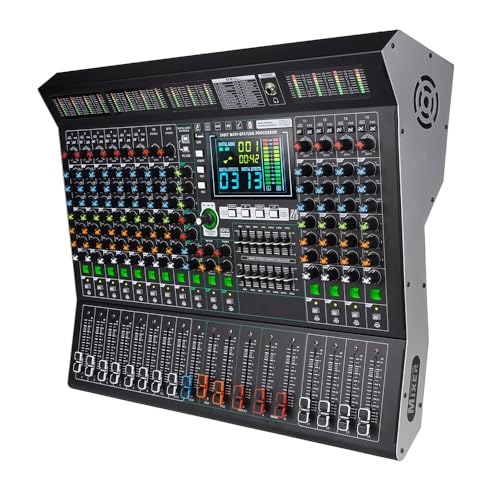
- 14 channels with LED parameter display
- 99 DSP effects and 9-band EQ
- Bluetooth, USB, and 48V phantom power
Best For: Small live, DJ, and studio setups
Compact Recording Companion

- Eight channels with Bluetooth and USB media support
- Built-in recorder, reverb, and 3-band EQ
- 48V phantom power for compatible microphones
Best For: Small events, karaoke, podcasts, and basic recording
Best All-Rounder

- 16 channels with Bluetooth and USB playback
- 99 DSP effects plus 7-band master EQ
- 48V phantom power and broad input support
Best For: Multi-source home studios, small venues, and live performances
Best Compact Option

- USB playback, mixing, and flash-drive recording
- Bluetooth streaming from mobile devices
- Headphone monitoring and per-channel EQ
Best For: Mobile recording, streaming, podcasting, and small performances
Best for Sound Shaping

- 99 DSP presets and 7-band graphic EQ
- Channel compressors and dual AUX sends
- USB recording, Bluetooth, and individual PAD controls
Best For: Home recording, PA systems, and live streaming
Best Compact Connectivity – BOMGE BM-05 5-Channel Digital Mixer
The BOMGE BM-05 is a compact option for digital mixing consoles for mobile recording, especially when you need USB-B connectivity, Bluetooth playback, and several microphone or stereo inputs in a small setup. A phone or tablet connection requires a USB OTG adapter for data transfer.
Best For: Mobile recording, podcasting, livestreaming, small performances, and basic music playback.
Pros:
- USB-B interface supports computer, phone, or tablet recording with the appropriate OTG adapter.
- Three XLR inputs include switchable 48V phantom power for condenser microphones.
- Includes Bluetooth playback, USB-A MP3 playback or recording, headphone monitoring, and echo/delay effects.
Cons:
- Bluetooth, USB, and channel 4/5 functions cannot be used simultaneously.
- Phone recording requires a separate USB-to-phone OTG adapter.
- Bluetooth is intended for input playback, not connection to an output device.
Choose this mixer when portability and flexible device connections matter more than a large channel count. Its compact format and built-in recording features make it practical for straightforward mobile setups.
Best Effects-Focused Option – GF8PRO 8-Channel DJ Console
The GF8PRO is a feature-heavy choice among digital mixing consoles for mobile recording, combining USB audio functions with Bluetooth 5.0, an LCD color screen, and extensive sound-shaping controls. Its eight-channel layout is suited to users who want more hands-on control for performances or events.
Best For: DJ performances, karaoke, parties, live events, and multichannel setups requiring built-in effects.
Pros:
- Eight-channel design supports XLR and stereo line connections.
- USB audio supports MP3, WAV, and WMA playback, computer recording, and audio editing.
- Includes a seven-band main EQ, per-channel three-band EQ, independent mute, and 99 DSP effects.
- Bluetooth 5.0 provides wireless mobile-device playback from up to 33 feet.
Cons:
- The supplied details do not specify a mobile recording adapter or app workflow.
- Its larger feature set may be more than needed for a simple two-channel mobile rig.
- The listed warranty is a 30-day return and exchange policy.
This console is a strong fit when effect selection and live control are priorities. Consider it for event-oriented recording and playback rather than the most minimal mobile setup.
Best Established Recording Workflow – PreSonus StudioLive 16.0.2 USB
The PreSonus StudioLive Classic 16.0.2 USB is a substantial option for digital mixing consoles for mobile recording when you need extensive inputs and direct multichannel computer capture. Its USB 2.0 interface records all channels and the main stereo mix, while included software supports recording and remote control.
Best For: Larger recording sessions, live recording, studio work, and users who want software-based mixer control.
Pros:
- Offers 16 channel inputs, including eight mono and four stereo channel inputs.
- 18-in/16-out USB 2.0 interface records all channels and the main L/R mix at 24-bit/44.1 or 48 kHz.
- Provides Fat Channel processing, two digital effects processors, four auxiliary buses, and MIDI I/O.
- Includes Studio One Artist, Capture, UC Surface, and QMix-UC software support.
Cons:
- At 20 pounds, it is less convenient for highly portable mobile recording.
- Its supplied connectivity is USB rather than Bluetooth.
- The feature-rich workflow may be excessive for small, simple sessions.
This mixer makes the most sense when channel count and multitrack computer recording outweigh portability. It is better suited to a transported live or studio rig than casual handheld recording.
Best Simple Analog-Style Layout – 6-Channel Stereo Audio Mixer
This six-channel mixer offers a straightforward control surface for digital mixing consoles for mobile recording, but it is important to note that it has no USB interface. Recording therefore requires separate equipment, while the mixer itself focuses on XLR inputs, stereo sources, EQ, and onboard effects.
Best For: Home studios, keyboards, karaoke, DJ events, and analog-style mixing with external recording gear.
Pros:
- Four mono mic/line inputs and two true stereo inputs accommodate microphones and stereo devices.
- Switchable 48V phantom power supports condenser microphones.
- Provides three-band EQ on all channels, 16 DSP effects, and separate master mix outputs.
- Stepped knobs and PAD switches provide more deliberate level adjustment and input handling.
Cons:
- There is no USB connection for direct mobile or computer recording.
- External recording equipment is needed to capture the mix.
- The supplied details do not list Bluetooth connectivity.
Select this model if you already have a recorder or interface and want a compact mixer with useful effects and stereo inputs. It is less suitable as an all-in-one mobile recording console.
Professional Control – PreSonus StudioLive 32SX
For serious digital mixing consoles for mobile recording, the PreSonus StudioLive 32SX combines substantial channel capacity with onboard recording and flexible connectivity. Its 128-channel USB interface, SD card recorder, motorized faders, and AVB networking make it suited to demanding mobile and installed workflows.
Best For: Mobile recording teams, live engineers, and users building a broader PreSonus AVB-based system.
Pros:
- 40-input, 32-channel fully recallable digital console with 25 motorized faders.
- Built-in 128-channel USB interface and multitrack SD card recorder.
- AVB networking supports NSB stage boxes, EarMix 16M mixers, and SW5E switches.
- Includes Studio One Artist and Capture software, plus 16 FlexMixes and onboard effects.
Cons:
- At 30.9 pounds, it is less convenient to transport than compact mixers.
- Its extensive features may be more than needed for simple recording setups.
The StudioLive 32SX is a full-featured choice when mobile recording requires extensive routing, recallable control, and integrated multitrack recording rather than basic mixing alone.
Feature-Packed Value – MD-14 14-Channel Mixer
The MD-14 is a practical option among digital mixing consoles for mobile recording when you want multiple inputs, built-in effects, and wireless playback in one corded mixer. Its 14 channels, USB support, 48V phantom power, and noise-reduction processing cover a range of stage, DJ, and studio tasks.
Best For: Small live setups, DJs, basic studio recording, and users who want extensive built-in effects.
Pros:
- Provides 14 independent channels with a large LED display.
- Includes 99 DSP effects, including reverbs, delays, choruses, and flangers.
- Bluetooth playback and USB lossless audio support add flexible source options.
- Offers 9-band EQ, intelligent noise reduction, and 48V phantom power.
Cons:
- Its 18-pound weight and 16.1-by-19.9-inch footprint may limit portability.
- The listed warranty information is a 30-day return and exchange policy.
The MD-14 balances channel count and effects at a practical scale, making it appealing for mobile users who prioritize flexible playback and live-oriented processing over advanced networked recording.
Compact Recording Companion – AX-80 8-Channel Mixer
For budget-conscious mobile recording, the AX-80 offers a compact eight-channel format with Bluetooth, USB playback and recording, built-in effects, and 48V phantom power. It is designed for straightforward setups such as podcasts, karaoke, small performances, and casual recording.
Best For: Portable small-event audio, karaoke, podcasting, and simple recording setups using compatible USB devices.
Pros:
- Compact design with eight channels and a listed weight of 4.51 kg.
- Includes Bluetooth, MP3/USB playback, and a built-in MP3 player and recorder.
- Provides 3-band EQ, reverb, balanced inputs, and 48V phantom power.
- Supports MP3, WAV, and WMA formats and includes a 2-year warranty.
Cons:
- The notes specify that it cannot connect to a MacBook for recording.
- Its eight-channel layout is less suitable for larger multitrack sessions.
- It uses corded 110V power rather than a battery-based mobile setup.
The AX-80 is best viewed as an accessible all-in-one mixer for modest recording and event needs, especially when Bluetooth and direct USB media handling matter more than expansive routing.
Best All-Rounder – 16-Channel DSP Mixer
For digital mixing consoles for mobile recording, this 16-channel model offers plenty of inputs plus Bluetooth and USB playback. Its independent channel controls, 99 DSP effects, and 48V phantom power make it adaptable for studio work, rehearsals, karaoke, and small live setups.
Best For: Multi-source home studios, small venues, live performances, and karaoke systems.
Pros:
- 16 channels with XLR, 1/4-inch, microphone, line, and instrument support.
- Bluetooth and U-disk playback with onboard playback controls.
- 99 DSP effects, channel-level 3-band EQ, and a master 7-band graphic EQ.
- 48V phantom power supports compatible condenser microphones.
Cons:
- Its larger 18.9-inch width and 8.26 kg weight may be less convenient for mobile setups.
- Bluetooth range is listed at up to 33 feet, which may limit placement flexibility.
This is the strongest choice when channel capacity and built-in sound shaping matter more than portability. It provides a broad control set for recording and live mixing, though its substantial chassis is better suited to a semi-permanent setup or careful transport.
Best Compact Option – 8-Channel USB Mixer
This 8-channel console is a practical pick among digital mixing consoles for mobile recording, combining USB connectivity, Bluetooth streaming, and direct USB recording. Its compact design, headphone monitoring, and per-channel controls suit recording, streaming, podcasting, and smaller stage applications.
Best For: Mobile recording, livestreaming, podcasting, Zoom meetings, and small performances.
Pros:
- Eight channels accept XLR and unbalanced 1/4-inch connections.
- USB connection supports computer playback, mixing, and recording to a flash drive.
- Bluetooth provides wireless music playback from phones, tablets, and computers.
- Includes headphone monitoring, 3-band EQ, reverb, delay, and peak indicators.
Cons:
- Eight channels provide less expansion room than larger consoles.
- The supplied notes do not specify the number of onboard DSP presets.
Its feature mix favors flexible, space-conscious setups. The USB interface, headphone output, and Bluetooth playback are especially useful when recording or streaming away from a full studio, while the eight-channel layout keeps operation manageable.
Best for Sound Shaping – 8-Channel Mixer with PAD
For digital mixing consoles for mobile recording, this 8-channel board emphasizes detailed control. It combines 99 DSP presets, a 7-band graphic EQ, channel compressors, dual AUX sends, USB recording, and Bluetooth playback in a relatively portable 4.9-pound chassis.
Best For: Home recording, PA systems, live streaming, and users who need flexible dynamics and effects control.
Pros:
- 99 DSP presets and a 7-band graphic EQ provide extensive sound shaping.
- Channel-level 3-band EQ, compressor controls, and dual AUX sends support detailed routing.
- USB recording, MP3 playback, Bluetooth, and headphone monitoring are built in.
- Individual PAD and 48V phantom power functions help accommodate varied input levels.
Cons:
- With eight channels, it offers less input capacity than a 16-channel console.
- The board is corded electric, so mobile use still requires access to suitable power.
This model stands out for users who want hands-on control over dynamics, effects, and routing without moving to a larger console. Its lighter weight helps with transport, while the PAD, compressor, AUX, and DSP features add flexibility for demanding recording and live applications.
How We Picked the Best Digital Mixing Consoles for Mobile Recording
We compared these mixers by the features that matter most outside a permanent studio: input count, USB audio connectivity, phantom power, built-in effects, physical control layout, monitoring options, and portability. We also considered whether each console is better suited to simple voice recording, mobile music production, livestreaming, DJ use, or larger multi-source sessions.
Feature lists can vary by model and seller, so confirm the current specifications before buying. In particular, check whether USB supports recording and playback, how many channels are available through USB, and whether the mixer requires external power.
Quick Comparison
| Best For | Recommended Type | Prioritize |
|---|---|---|
| Solo creators and podcasts | Compact 5- or 6-channel mixer | USB, Bluetooth, simple controls |
| Small bands and livestreams | 8-channel console | Phantom power, effects, monitoring |
| Multiple microphones and instruments | 14- or 16-channel mixer | Channel count, EQ, routing |
| Professional recording or live production | PreSonus digital console | Reliable workflow, scene control, expandability |
Key Buying Factors for Digital Mixing Consoles for Mobile Recording
Inputs and Channel Capacity
Count every source you may use at once, not just your current setup. Microphones, guitars, keyboards, phones, and playback devices can quickly use available inputs. Leave spare channels if you expect your sessions to grow.
USB Recording and Device Compatibility
USB connectivity is central to mobile recording, but “USB” does not always mean multitrack recording. Look for details about USB interface functionality, supported computers or tablets, driver requirements, and whether the mixer can return playback to the main mix.
Phantom Power and Microphone Support
48V phantom power is useful for condenser microphones and active direct boxes. Confirm that phantom power behaves safely with your planned microphones and that the mixer provides suitable preamp gain and input types.
Effects, EQ, and Monitoring
Built-in reverb, delay, compression, and equalization can reduce the need for extra equipment during mobile sessions. Headphone outputs, channel muting, accurate meters, and independent monitor control are equally important when recording in an untreated or changing environment.
Size, Power, and Controls
A smaller mixer is easier to carry, while a larger console provides more hands-on control. Check dimensions, power requirements, fader or knob layout, and whether the controls are easy to operate while standing or working in a compact space.
Who Should Buy Which Digital Mixing Consoles for Mobile Recording?
Choose a compact mixer if you record one or two people, stream casually, or need a lightweight setup. Choose an 8-channel model for small ensembles, several microphones, or a flexible livestream station. Choose a 14- or 16-channel console when you regularly combine multiple instruments, vocalists, and playback sources. Choose a PreSonus StudioLive model if you need a more structured digital-console workflow, deeper live-production control, and room to build a serious recording system.
The best choice is the smallest mixer that comfortably supports your complete signal chain. Extra inputs and routing flexibility are worth paying for only when they simplify your sessions or leave useful room for expansion.