
The best digital mixing consoles for professional studios combine hands-on control with reliable routing, recallable settings, quality preamps, and flexible computer integration. The right choice depends on your channel count, workflow, monitoring needs, and budget.
This roundup includes full-size studio consoles, compact digital mixers, and versatile models with USB connectivity, onboard effects, and recording software. Use the guide below to narrow the list before comparing individual products.
Best 10 Digital Mixing Consoles for Professional Studios Picks for 2026
Best Overall
Behringer X32 Digital Mixing Console

- 40 inputs and 25 buses for complex routing
- 32 programmable MIDAS-designed mic preamps
- 25 motorized faders and scene management
Best For: Larger studios and hybrid studio/live setups
Best Effects-Focused Option
MD-14 Professional Audio Mixer
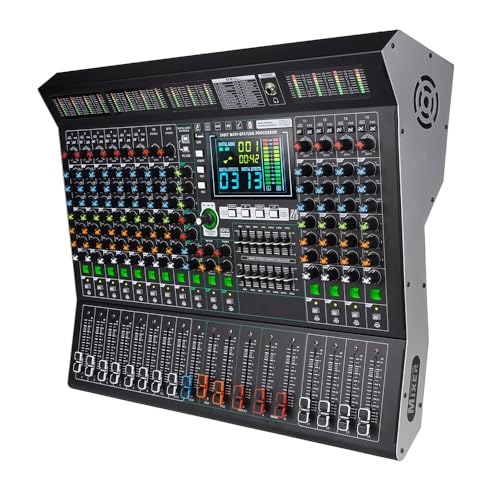
- 14 channels with LED parameter display
- 99 built-in DSP effects and 9-band EQ
- Bluetooth, USB, and 48V phantom power
Best For: Small studios needing integrated effects and playback
Best for Recording Integration

- 128-channel USB interface for multitrack recording
- Onboard SD recorder with Virtual Soundcheck
- AVB networking and 16 flexible mix buses
Best For: Recording studios and mobile production systems
Best Compact Analog-Style Choice

- 10 inputs in a compact 7.7-pound chassis
- USB connectivity and SPX digital effects
- D-PRE preamps, EQ, filters, and compressors
Best For: Home and project studios with limited space
Versatile Production Hub
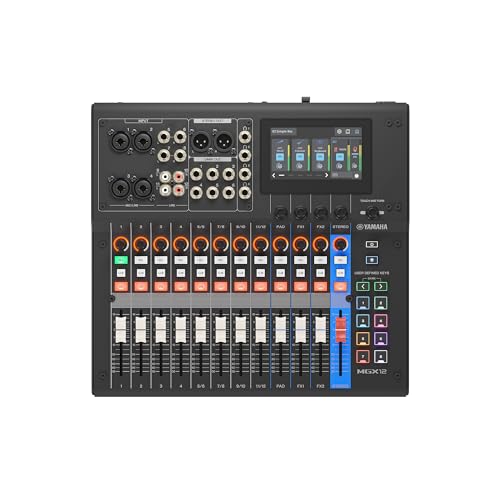
- 18-channel console with tactile faders and touchscreen control
- DSP, Auto Gain, Clip Safe, and latency-free monitoring
- USB-C, Bluetooth, microSD, and 4K HDMI video connectivity
Best For: Hybrid studios needing hands-on control and modern connectivity
Performance-Focused Control

- Eight channels with independent mute, EQ, AUX, and PAN controls
- 99 DSP effects plus a 7-band main-output equalizer
- USB recording/playback and Bluetooth 5.0 audio input
Best For: DJ, karaoke, stage, and small performance setups
Established Recording Workflow
PreSonus StudioLive 16.0.2 USB

- 16 inputs with 12 XMAX preamps and four auxiliary buses
- Fat Channel processing, internal effects, and scene recall
- 18-in/16-out USB recording with included PreSonus software
Best For: Multichannel studio recording and live-tracking workflows
Modern Workflow Pick

- 18-channel digital console with tactile faders
- Touchscreen, USB-C, Bluetooth, and microSD connectivity
- DSP, Scene Recall, and latency-free monitoring
Best For: Hands-on studio workflows with flexible connectivity
Professional Routing Choice
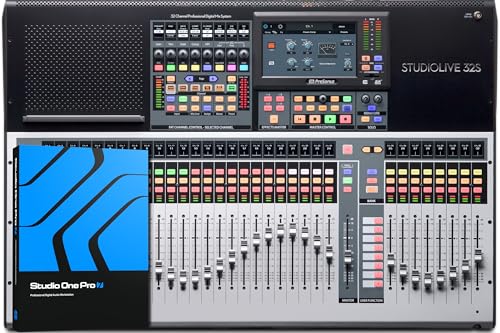
- 32-channel console with 40 fully recallable inputs
- 128-channel USB interface and onboard SD recorder
- AVB networking, 16 FlexMixes, and FLEX FX
Best For: Large recording, installed-sound, and networked setups
Value Effects Option
16-Channel Digital Audio Mixer

- 16 channels with 99 built-in DSP effects
- Bluetooth, USB playback, and digital display player
- 48V phantom power plus channel EQ and mute controls
Best For: Home studios, karaoke, rehearsals, and small venues
Best Overall – Behringer X32 Digital Mixing Console
For studios that need substantial routing and hands-on control, the Behringer X32 is a strong option among digital mixing consoles for professional studios. It combines 40 inputs, 32 MIDAS-designed programmable mic preamps, 25 buses, and motorized faders in a console suited to both studio and live work.
Best For: Larger recording setups, hybrid studio/live applications, and engineers who want extensive routing with automated scene management.
Pros:
- 40-input, 25-bus architecture supports complex sessions.
- 32 programmable MIDAS-designed mic preamps.
- 25 motorized 100 mm faders provide quick visual control and scene recall.
- Includes 16 XLR outputs, additional line I/O, phones connections, and talkback.
Cons:
- At 45.4 pounds, it is less convenient to move than compact consoles.
- Its 40.4-by-25.9-inch footprint requires substantial desk or rack space.
The X32 is best when channel count, bus flexibility, and recallable control matter more than portability. Its large format and extensive I/O make it a practical centerpiece for a demanding studio, though smaller rooms may not need all of its capacity.
Best Effects-Focused Option – MD-14 Professional Audio Mixer
The MD-14 offers a compact, feature-rich approach to digital mixing consoles for professional studios. Its 14 independent channels, 99 DSP effects, Bluetooth playback, USB audio support, 9-band EQ, and 48V phantom power cover recording, stage, DJ, and general production needs.
Best For: Small studios and creators who want built-in effects, wireless playback, and straightforward channel control in one mixer.
Pros:
- 14 independent channels with a large LED display for monitoring parameters.
- 99 built-in DSP effects include reverbs, delays, choruses, and modulation effects.
- Bluetooth and USB support provide flexible playback options.
- 9-band EQ, noise reduction, and 48V phantom power support detailed processing.
Cons:
- Its 14-channel capacity is more limited than larger professional consoles.
- The 30-day return and exchange policy is relatively brief.
- At 18 pounds, it is portable but not as lightweight as a small desktop mixer.
The MD-14 is a practical all-in-one choice for smaller setups that prioritize onboard processing and convenient playback. It is less suited to large, complex sessions, but its effects and connectivity can reduce the need for additional equipment.
Best for Recording Integration – PreSonus StudioLive 32SC
The PreSonus StudioLive 32SC is designed for studios that want digital console control alongside recording and networking features. This portable, rack-mountable mixer provides 32 recallable channels, a dual-core FLEX DSP engine, a 128-channel USB interface, AVB networking, and onboard multitrack SD recording.
Best For: Recording facilities and mobile engineers who need multitrack capture, virtual soundcheck, networked expansion, and flexible routing.
Pros:
- 128-channel USB interface supports extensive computer-based recording.
- Onboard multitrack SD recorder enables true Virtual Soundcheck.
- AVB networking integrates with compatible PreSonus stage boxes and monitor mixers.
- 16 FlexMixes can function as aux, subgroup, or matrix mixes.
Cons:
- The feature set may be more than a simple studio mixing workflow requires.
- AVB expansion depends on compatible networking equipment.
- It is a corded console, so mobile use still requires appropriate power access.
The 32SC stands out when recording workflow and system integration are central priorities. Its combination of USB, SD, AVB, effects, and recallable processing makes it especially adaptable for professional production environments.
Best Compact Analog-Style Choice – Yamaha MG10XU Mixer
The Yamaha MG10XU is a compact alternative for smaller studios comparing digital mixing consoles for professional studios. It provides 10 inputs, USB connectivity, SPX digital effects, Class A D-PRE preamps, three-band EQ, high-pass filters, and one-knob compressors in a 7.7-pound chassis.
Best For: Home and project studios that need reliable channel processing, USB connectivity, and effects without the size of a larger digital console.
Pros:
- Compact 10-input format fits smaller workspaces.
- USB connectivity and SPX digital effects support computer-based workflows.
- D-PRE preamps, three-band EQ, and high-pass filters provide useful tone shaping.
- One-knob compressors simplify control of vocals and instruments.
Cons:
- Ten inputs offer less capacity for large sessions.
- It has fewer advanced digital routing features than the larger consoles here.
- The one-year manufacturer warranty is shorter than the PreSonus warranty listed.
The MG10XU is a sensible choice when space, simplicity, and dependable basic processing matter most. It will not replace a high-channel-count digital system, but it offers a practical feature set for smaller recording and production setups.
Versatile Production Hub – Yamaha MGX12
For professional studios seeking digital mixing consoles for professional studios, the Yamaha MGX12 combines hands-on tactile control with modern digital connectivity. Its 18-channel layout, touchscreen, DSP, USB-C interface, and flexible inputs make it suitable for recording, monitoring, and hybrid production setups.
Best For: Studios that want tactile faders, touchscreen control, versatile routing, and built-in computer and video connectivity.
Pros:
- 18 channels with tactile faders and a 4.3-inch touchscreen with five control knobs.
- New MGX preamps provide an 86 dB gain range, with Bluetooth and microSD connectivity.
- Built-in DSP supports professional processing and latency-free monitoring.
- Assistive features include Auto Gain, Clip Safe, Simple/Standard Mode, and Scene Recall.
Cons:
- At 14.7 pounds, it may be less convenient for frequently mobile setups.
- The included manufacturer warranty is listed as one year.
The MGX12 stands out when you need a studio console that balances physical mixing controls with streamlined digital features. Its USB-C, HDMI, and 4K video pass-through capabilities also make it unusually adaptable for contemporary audio-video workflows.
Performance-Focused Control – GF8PRO 8-Channel DJ Console
The GF8PRO is a compact option among digital mixing consoles for professional studios, especially where DJ, karaoke, stage, and live-performance features matter. It combines an LCD color screen, per-channel controls, USB playback and recording, Bluetooth 5.0, and a broad DSP effects library.
Best For: DJs, performers, karaoke operators, and small studios needing straightforward effects, wireless playback, and independent channel control.
Pros:
- Each of the eight channels offers gain, 3-band EQ, AUX, PAN, and independent mute control.
- Includes 99 preset DSP effects and a 7-band main-output equalizer.
- USB audio supports MP3, WAV, and WMA playback, computer recording, and audio editing.
- Bluetooth 5.0 provides wireless audio input from compatible mobile devices.
Cons:
- Its eight-channel design offers less input capacity than larger studio consoles.
- The listed warranty is limited to a 30-day return and exchange policy.
- The supplied specifications list a 220-volt AC power requirement.
With its colorful display, quick-access controls, and extensive preset effects, the GF8PRO is oriented toward immediate performance control rather than large-scale studio expansion. It is a practical fit for smaller setups that prioritize playback, live mixing, and convenience.
Established Recording Workflow – PreSonus StudioLive 16.0.2 USB
The PreSonus StudioLive Classic 16.0.2 USB is a strong candidate for digital mixing consoles for professional studios that need integrated recording, channel processing, and scene recall. Its 16 input channels, XMAX preamplifiers, Fat Channel processing, and 18-in/16-out USB interface support both studio work and live recording.
Best For: Project and professional studios that need multichannel USB recording, onboard dynamics, effects, and repeatable mixer settings.
Pros:
- Offers 16 channel inputs, 12 Class A XMAX mic preamplifiers, four auxiliary buses, and two internal FX buses.
- Fat Channel processing is available across channels and buses with EQ, compression, expansion, and limiting.
- The 18-in/16-out USB 2.0 interface records all channels and the main stereo mix at 24-bit/44.1 or 48 kHz.
- Includes scene recall, MIDI I/O, Studio One Artist, Capture, UC Surface, and QMix-UC software support.
Cons:
- At 20 pounds, it is relatively heavy for a portable console.
- Its USB interface is specified as USB 2.0 rather than a newer USB standard.
- The listed warranty is a one-year limited manufacturer warranty.
The StudioLive 16.0.2 remains compelling for workflows built around structured channel processing and multitrack computer recording. Its combination of onboard dynamics, effects, buses, and included software gives studios a cohesive recording and mixing system.
Modern Workflow Pick – Yamaha MGX12
For studios seeking digital mixing consoles for professional studios, the Yamaha MGX12 combines tactile faders with a 4.3-inch touchscreen and five control knobs. Its 18-channel layout, USB-C connectivity, Bluetooth audio input, microSD recording, and built-in DSP support a flexible computer-based or standalone workflow.
Best For: Studio users who want hands-on control, assistive mixing features, and versatile recording and monitoring connectivity.
Pros:
- Tactile faders plus a touchscreen interface for practical control.
- 18 channels with new preamps offering an 86 dB gain range.
- Built-in DSP enables latency-free monitoring and professional effects processing.
- Includes a USB-HDMI interface with 4K video capture and pass-through.
Cons:
- Software update support is not specified in the supplied details.
- The listed warranty is one year.
The MGX12 is a feature-rich option for producers who value physical mixing controls without giving up modern USB, Bluetooth, memory-card, and video connectivity. Its Simple and Standard modes, Auto Gain, Clip Safe, and Scene Recall can also streamline setup and repeat sessions.
Professional Routing Choice – PreSonus StudioLive 32S
PreSonus StudioLive Series III 32S Digital Console Mixer with Studio One Pro Software
Check Price On AmazonThe PreSonus StudioLive Series III 32S is built for demanding recording, installed-sound, and mobile applications. Among digital mixing consoles for professional studios, it stands out with 32 channels, 40 fully recallable inputs, dual-core FLEX DSP, extensive AVB networking, and a 128-channel USB interface.
Best For: Professional studios and production teams that need extensive routing, multitrack recording, recallable mixes, and networked monitoring options.
Pros:
- Dual-core FLEX DSP supports 286 simultaneous processors.
- Built-in 128-channel USB interface supports large computer-based sessions.
- Onboard SD recording includes true Virtual Soundcheck.
- Offers 16 FlexMixes and four-slot FLEX FX processing.
Cons:
- At 37 pounds, it is less convenient for frequent transport.
- Its broad feature set may be more than a small studio requires.
- Software update support is not specified in the supplied details.
The 32S is a comprehensive centerpiece for studios that need substantial I/O and repeatable mixes. AVB compatibility with NSB stage boxes, EarMix 16M personal mixers, and the SW5E switch further supports expansion, while Studio One Artist and Capture add to its integrated workflow.
Value Effects Option – 16-Channel Digital Audio Mixer
This 16-channel mixer offers an accessible feature set for smaller studios, rehearsal spaces, and live applications. It combines Bluetooth and USB playback with 99 DSP effects, 48V phantom power, independent channel mutes, and dedicated EQ controls for flexible everyday mixing.
Best For: Home studios, karaoke setups, small venues, and performers who want digital effects and wireless playback at a practical scale.
Pros:
- 99 built-in DSP effects include reverb, delay, and ambience.
- Bluetooth and U-disk playback provide convenient music-input options.
- Each channel includes gain, three-band EQ, a fader, and an individual mute.
- 48V phantom power supports condenser microphones and compatible equipment.
Cons:
- Its 16-channel design is smaller than many professional console formats.
- The listed warranty is 360 days.
- Software update support is not specified in the supplied details.
With a 7-band master graphic EQ and support for microphones, line sources, instruments, headphones, and XLR outputs, this mixer covers a broad range of basic studio and performance tasks. It is best suited to users who prioritize built-in effects and simple playback features over advanced networking or large-scale computer integration.
How We Picked the Best Digital Mixing Consoles for Professional Studios
We focused on the features that matter in real recording and production environments: input capacity, preamp quality, routing flexibility, onboard processing, computer connectivity, monitoring options, and ease of operation. We also considered whether each console is better suited to multitrack recording, overdubbing, mixing, rehearsals, live sound, or hybrid studio work.
The selection spans established models from Behringer, PreSonus, and Yamaha alongside more affordable compact mixers. Because product listings can vary in specifications and included software, confirm current input counts, USB capabilities, compatibility, and package contents before buying.
Quick Comparison
| Best For | What to Prioritize | Typical Strength |
|---|---|---|
| Large tracking rooms | High channel count and flexible routing | Multitrack recording and complex sessions |
| Project studios | USB integration, recall, and onboard processing | Efficient recording and mixing |
| Small studios | Compact footprint and straightforward controls | Podcasts, overdubs, and small ensembles |
| Live/studio hybrid setups | Scene storage, effects, and monitoring buses | Fast setup changes and flexible sound control |
| Budget-conscious users | Useful DSP, phantom power, and basic USB features | Versatility at a lower upfront cost |
Key Buying Factors for Digital Mixing Consoles for Professional Studios
Inputs, Buses, and Expansion
Count the microphone preamps you need today, then allow room for growth. Separate channel count from bus count: a console may offer many inputs but limited aux sends, subgroups, or monitor mixes. Expandability through digital networking or stage boxes can be especially valuable in larger rooms.
Recording and Computer Connectivity
Check whether USB provides stereo recording, multitrack I/O, or both. Multitrack connectivity is important when recording several sources independently, while a simple stereo interface may be sufficient for a finished mix or streaming setup. Verify operating-system support and included DAW software.
Processing, Control, and Workflow
Onboard EQ, compression, gates, reverb, and delay can reduce plugin dependence and simplify tracking. Look for scene or preset recall if you regularly switch artists or projects. Physical faders, touchscreen control, apps, and encoders each suit different working styles, so consider how much hands-on access you want.
Monitoring and Reliability
Review headphone outputs, control-room routing, talkback, solo modes, mute groups, and independent monitor mixes. For professional use, dependable drivers, clear documentation, firmware support, and solid construction may matter more than a long effects list.
Who Should Buy Which Digital Mixing Consoles for Professional Studios?
Choose a large Behringer or PreSonus Series III console if you record full bands, need numerous monitor mixes, or want extensive routing and recall. A smaller PreSonus StudioLive or Yamaha mixer may be a better fit for project studios that need practical recording features without a large control surface.
Yamaha’s compact options suit creators who prioritize familiar controls, reliable basic effects, and manageable channel counts. The smaller MD-14, GF8PRO, and 16-channel budget models are best for entry-level production, rehearsal, streaming, DJ work, or secondary rooms—provided their USB routing and driver features meet your needs.
Before ordering, map your sources, monitor outputs, DAW workflow, and available desk space. That simple checklist will help you select a console that supports your current setup without paying for inputs or features you will rarely use.