
Choosing a digital stage box with Dante can simplify your entire workflow, from stage inputs to FOH routing and recording.
In this roundup, we focus on networked audio boxes and interfaces that deliver the right mix of I/O, integration, and reliability for real-world use.
Best 10 Digital Stage Box with Dante Picks for 2026
Editor’s Pick
Yamaha Tio1608-D Digital Stage Box with Dante

- 16 mic preamps and 8 line outputs
- Dante digital connectivity via Ethernet
- Purpose-built 16-in/8-out stage box
Best For: Live and installed setups needing Yamaha Dante I/O
Runner-Up
Allen & Heath DT168 16-input Dante I/O Expander

- 16 XLR mic inputs and 8 XLR line outputs
- Dual Dante ports for networked audio setups
- 48 kHz operation with 2-year warranty
Best For: XLR-focused Dante expansion with dual network ports
Premium Choice
Yamaha Tio1608-D2 Dante-Enabled Stage Box Audio I/O Rack

- 16 inputs, 8 outputs, 3U rack size
- 96 kHz max sample rate with D-PRE pres
- QUICK CONFIG support for DM3 and TF series
Best For: Yamaha users wanting 96 kHz and fast setup
Redundancy Pick
Focusrite RedNet D16R MkII 16x16 Dante Interface

- 16-channel bi-directional Dante interface
- Dual PSUs plus redundant network connections
- Channel-level control with RedNet Control
Best For: Redundant networked audio systems needing control
Digital Expansion Card
BEHRINGER X-DANTE 32-Channel Card

- 32-channel Dante expansion for X32 systems
- Ethernet-based network audio connectivity
- Compact Audinate expansion card format
Best For: X32 owners needing a compact Dante expansion card
Network Audio Converter

- Bi-directional Dante and AES67 RTP audio
- Adjustable 0-170 ms lip-sync delay
- RCA and 3.5 mm analog connections
Best For: Small-source setups needing a compact Dante encoder/decoder
Wall-Mounted Dante Interface
RDL DD-BN40 4x2 Dante Interface

- Four XLR mic/line inputs to Dante
- Two Dante-to-line outputs on rear panel
- Selectable gain, phantom power, and level options
Best For: Installed systems needing a compact wall-mounted Dante I/O
Compact 4-Channel Dante Output Box
Switchcraft SD104QA 4-Channel Dante Output Box

- 4-channel Dante analog output box
- Single RJ45 Ethernet input
- PoE and 4 XLR outputs
Best For: Small live setups that need a compact Dante output box with four XLR analog outputs and PoE.
High-Capacity Dante/MADI Bridge
RME Digiface Dante 128x128 Interface
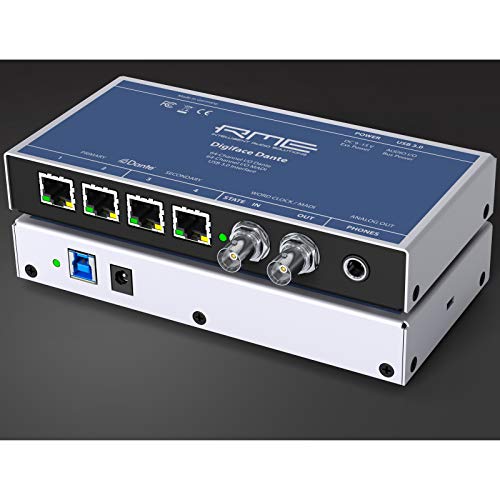
- 128-in/128-out Dante/MADI/USB 3.0 interface
- Headphone output for monitoring
- Bus power and word clock I/O
Best For: Engineers and studios that need high-channel-count Dante connectivity with MADI and USB 3.0 integration.
Rackmount Dante Recording Interface
Universal Audio Apollo x16D Rackmount Dante Interface

- 16 x 16 Dante network I/O
- Thunderbolt 3 with HEXA Core Processing
- AES67 support and pro I/O
Best For: Professional users who want a rackmount Dante interface with extensive network I/O, plug-in processing, and studio-grade connectivity.
Editor’s Pick – Yamaha Tio1608-D Digital Stage Box with Dante
If you need a digital stage box with Dante for a straightforward 16-in/8-out setup, the Yamaha Tio1608-D is built around 16 microphone preamplifiers and 8 line outputs. Its Ethernet-based Dante connectivity makes it a practical fit for systems that already rely on networked audio.
Best For: Live rigs and installed systems that want a Yamaha stage box with 16 mic pres and 8 outputs.
Pros:
- 16 microphone preamplifiers for multi-channel input handling
- 8 line outputs for flexible routing
- Dante digital connectivity over Ethernet
- Compact rack-style stage box format
Cons:
- Product details do not list sample rate or control features
- Very limited info is provided about included accessories
This is a simple, purpose-built option if your priority is getting a reliable digital stage box with Dante into a Yamaha-oriented setup. The specifications focus on core I/O and network connectivity rather than extra features.
Runner-Up – Allen & Heath DT168 16-input Dante I/O Expander
The Allen & Heath DT168 is a digital stage box with Dante designed as a 16-input I/O expander, and it pairs 16 XLR microphone inputs with 8 XLR line outputs. Dual Dante ports and 48 kHz operation make it a practical networking piece for compatible audio systems.
Best For: Users who want dual Dante ports and XLR-heavy I/O in a stage box expander.
Pros:
- 16 XLR microphone inputs for direct stage connectivity
- 8 XLR line outputs for output routing
- Dual Dante ports for network redundancy or flexible integration
- 2-year warranty listed in the product details
Cons:
- Runs at 48 kHz, which may not suit every workflow
- Details do not mention built-in preamp-specific features
For buyers comparing a digital stage box with Dante, this model stands out for its straightforward XLR I/O and dual network ports. It looks like a solid choice when the priority is connectivity and channel count rather than advanced onboard processing.
Premium Choice – Yamaha Tio1608-D2 Dante-Enabled Stage Box Audio I/O Rack
If you want a digital stage box with Dante and a higher sample-rate spec, the Yamaha Tio1608-D2 offers 16 inputs and 8 outputs in a 3U rack format. It also includes recallable D-PRE preamplifiers and QUICK CONFIG Mode support for DM3 and TF series mixers.
Best For: Yamaha users who want 96 kHz operation and quick setup with compatible mixers.
Pros:
- 16 inputs and 8 outputs in a 3U chassis
- 96 kHz maximum sample rate
- Recallable D-PRE preamplifiers
- QUICK CONFIG Mode for DM3 and TF series
Cons:
- Compatibility notes are specific to Yamaha TF mixers with Dante cards
- Heavier than the original Tio1608-D at 12.6 pounds
This model is the most feature-rich Yamaha option in the group, especially if higher sample rate support and quick configuration matter to your workflow. It is aimed at users who already work inside the Yamaha ecosystem.
Redundancy Pick – Focusrite RedNet D16R MkII 16×16 Dante Interface
The Focusrite RedNet D16R MkII is a digital interface for Dante networks that gives you 16 channels of bi-directional routing with channel-level control through RedNet Control software. If your digital stage box with Dante needs to live in a more system-focused workflow, its dual power supplies and network redundancy are major advantages.
Best For: Installations and broadcast-style systems that value redundancy and channel-level control.
Pros:
- 16-channel bi-directional Dante interface
- Individual input and output level control via RedNet Control
- Dual PSUs and dual locking etherCON network ports
- Redundant power and ethernet with auto switchover
Cons:
- Product is framed as a digital interface rather than a traditional stage box
- Details list USB connectivity and a Windows operating system note, which may limit appeal for some users
This is the best pick if your priority is reliability and remote control rather than a simple stage box layout. The redundancy features and software-based control make it especially useful in demanding networked audio environments.
Digital Expansion Card – BEHRINGER X-DANTE 32-Channel Card
The BEHRINGER X-DANTE is a straightforward option when you need to add Dante connectivity to an X32-based setup. As a digital stage box with Dante-style network integration, it gives you 32 channels over Ethernet and is aimed at expanding an existing system rather than acting as a standalone interface.
Best For: X32 users who want a compact 32-channel Dante expansion card for networked audio integration.
Pros:
- 32-channel Dante expansion for compatible X32 systems
- Uses Ethernet connectivity for network audio routing
- Very compact and lightweight card format
- Made for easy integration as an Audinate Dante expansion option
Cons:
- Requires compatible X32 hardware, so it is not a standalone box
- Limited to expansion-card use rather than front-panel I/O
For buyers who already have the right mixer platform, this card is a clean way to bring Dante into the signal chain without adding a separate external interface. It is best viewed as a system upgrade component, not a general-purpose digital stage box with Dante.
Network Audio Converter – MSQ-3600D Dante Audio Box
This Dante digital audio box is built for bidirectional conversion, letting you send and receive audio over Dante and AES67 RTP in one unit. For a digital stage box with Dante in a compact form, it also adds RCA and 3.5 mm connections plus adjustable delay for AV sync.
Best For: Users who need a small Dante encoder/decoder with flexible analog inputs and adjustable sync delay.
Pros:
- Bi-directional Dante audio transmission and decoding
- Supports AES67 RTP alongside Dante network integration
- Adjustable audio delay from 0 to 170 ms for sync control
- Offers RCA, 3.5 mm, micro-USB, Ethernet, and DC 5V power options
Cons:
- Only 2 channels, so it is not built for larger I/O counts
- Front-panel touch controls may be less ideal than hardware knobs for some users
This is a practical choice when you need a simple Dante interface for stereo or small-source applications, especially where delay adjustment matters. It is more of a compact converter than a full stage-box replacement, but the network flexibility is strong.
Wall-Mounted Dante Interface – RDL DD-BN40 4×2 Dante Interface
The RDL DD-BN40 is a wall-mounted Dante interface designed to bring multiple mic or line sources into a networked audio system. If you are shopping for a digital stage box with Dante for installed use, this 4-in/2-out unit offers front-panel XLR inputs and rear-panel outputs in a clean, fixed-location format.
Best For: Installed audio systems that need a compact wall-mounted Dante interface for four inputs and two outputs.
Pros:
- Four XLR inputs convert mic or line sources to Dante channels
- Two Dante network signals convert back to line-level outputs
- Selectable mic gain, phantom power, and line gain options
- Studio-quality, low-noise performance in a wall-mounted design
Cons:
- Fixed 4×2 channel count limits larger applications
- Wall-mounted format is less flexible than portable stage-box designs
For installed rooms, the DD-BN40 gives you practical Dante routing with basic gain and level flexibility built in. It is a strong fit when you want straightforward networked I/O at the wall rather than a rack or floorbox solution.
Compact 4-Channel Dante Output Box – Switchcraft SD104QA 4-Channel Dante Output Box
If you need a simple digital stage box with Dante for getting network audio out to four analog destinations, the Switchcraft SD104QA is built around that job. It takes a single RJ45 Ethernet input and provides 4-channel XLR output with PoE, making it a tidy fit for small rigs where straightforward Dante-to-analog conversion matters more than extra routing features.
Best For: Small live setups that need a compact Dante output box with four XLR analog outputs and PoE.
Pros:
- 4-channel Dante analog output box for straightforward network-to-analog use
- Single RJ45 Ethernet input keeps the connection simple
- 4-channel XLR output supports direct analog feed runs
- PoE can simplify power on stage or in a rack
Cons:
- Output-only design, so it is not a full stage box
- Limited to four channels
- Stainless steel, compact unit may be too basic for larger I/O needs
Overall, this is a focused Dante output box rather than a feature-heavy interface. If your system mainly needs a dependable way to move four Dante channels into XLR analog outputs, the SD104QA keeps the setup lean and practical.
High-Capacity Dante/MADI Bridge – RME Digiface Dante 128×128 Interface
The RME Digiface Dante is aimed at users who need a digital stage box with Dante-level channel capacity and flexible computer hookup. With 128-in/128-out Dante/MADI/USB 3.0 audio interface functionality, plus headphone output, bus power, and word clock I/O, it suits more complex routing tasks than a basic stage box.
Best For: Engineers and studios that need high-channel-count Dante connectivity with MADI and USB 3.0 integration.
Pros:
- 128-in/128-out channel capacity is far beyond small-format boxes
- Dante, MADI, and USB 3.0 support add routing flexibility
- Headphone output is useful for quick monitoring
- Bus power and word clock I/O support streamlined system setup
Cons:
- More interface than a simple stage box for basic live use
- Channel count and features may be unnecessary for small rigs
- Requires planning to take full advantage of its routing options
In practice, the Digiface Dante is best viewed as a serious Dante bridge and interface rather than a basic box for a handful of stage inputs and outputs. If your workflow depends on large-channel digital routing, it has the capacity and connectivity to fit that role.
Rackmount Dante Recording Interface – Universal Audio Apollo x16D Rackmount Dante Interface
Universal Audio Apollo x16D Essentials+ 18 x 20 Audio Interface with Dante I/O and UAD DSP
Check Price On AmazonThe Universal Audio Apollo x16D is a rackmount digital stage box with Dante built for demanding live and studio workflows. It combines 16 x 16 Dante network I/O with Thunderbolt 3 connectivity, AES67 mode support at 48 kHz, and onboard HEXA Core Processing for near-zero-latency mixing with UAD plug-ins.
Best For: Professional users who want a rackmount Dante interface with extensive network I/O, plug-in processing, and studio-grade connectivity.
Pros:
- 16 x 16 Dante network I/O with Thunderbolt 3 connection
- AES67 mode support at 48 kHz expands network compatibility
- Onboard HEXA Core Processing supports near-zero-latency mixing with UAD plug-ins
- Word clock I/O, stereo AES I/O, and dual monitor outs add pro integration options
Cons:
- Heavier and more rack-oriented than compact stage boxes
- Feature set is geared toward advanced users
- May be more interface than needed for simple Dante-only setups
For users who need Dante plus serious processing and integration, the Apollo x16D is the most fully featured option in this group. It is less about basic I/O expansion and more about combining network audio, plug-ins, and professional connection options in one rackmount unit.
How We Picked the Best Digital Stage Box with Dante
We prioritized units that fit common live sound and installation needs: stable Dante networking, practical channel counts, pro-grade connectors, and straightforward integration with mixers, interfaces, and installed audio systems. We also favored products with strong reputations for reliability, since a Digital Stage Box with Dante is often expected to perform in demanding environments.
Quick Comparison
Some options are built primarily as stage boxes for live input expansion, while others serve as Dante interfaces, output expanders, or flexible rack/installed-audio devices. Higher-channel boxes are better for full-band stage setups, while compact wall or output units make more sense for installs, distributed audio, or targeted routing tasks.
Key Buying Factors for Digital Stage Box with Dante
I/O Count and Channel Direction
Start with how many inputs and outputs you actually need. A 16-channel stage box is a common sweet spot for small to mid-sized productions, but some buyers may need mostly outputs, bidirectional conversion, or just a few channels for overflow or install use.
Compatibility and Network Setup
Make sure the unit works cleanly with your mixer, audio interface, and Dante Controller workflow. For larger systems, consider whether AES67 support, clocking behavior, and redundant network options matter to your setup.
Form Factor and Placement
Rackmount boxes work well on stage or in portable rigs, while wall-mounted or compact boxes are better for houses of worship, corporate AV, broadcast rooms, and fixed installations. Choose the form factor that matches cable runs and physical access.
Audio Path Quality and Control
Look for features like per-channel gain, output level control, low-noise design, and sensible latency behavior. These matter more than flashy specs when you need clean, predictable audio.
Who Should Buy Which Digital Stage Box with Dante?
If you need a straightforward live-sound stage box, choose a higher-channel rack unit with familiar mic inputs and solid Dante integration. If your priority is install or distributed audio, a wall-mounted or compact interface may be a better fit. If you need conversion, routing, or studio-to-network flexibility, a specialized Dante interface can outperform a traditional stage box. The best Digital Stage Box with Dante is the one that matches your channel count, workflow, and long-term system plan.