
Portable livestreaming demands dependable encoding without the weight, heat, or setup complexity of a full production computer. The right hardware encoder can convert HDMI or SDI sources into a stable stream while keeping your workflow compact and repeatable.
This roundup compares 10 hardware streaming encoders for portable production, including standalone HDMI and SDI models, 4K-capable units, NDI-focused devices, and budget-friendly multi-protocol encoders.
Best 10 Hardware Streaming Encoders for Portable Production Picks for 2026
Flexible HDMI Workhorse
Magewell Ultra Encode HDMI Plus

- 4K HDMI encoding with loop-through
- Streams and records simultaneously
- Ethernet, PoE, Wi-Fi, and USB modem support
Best For: HDMI-based mobile production and live events
SDI Streaming Specialist
Blackmagic Design Streaming Encoder HD

- 12G-SDI input and loop output
- H.264 and H.265 encoding
- Supports 1080p60 delivery
Best For: Professional HD SDI production workflows
Protocol-Rich Value Pick
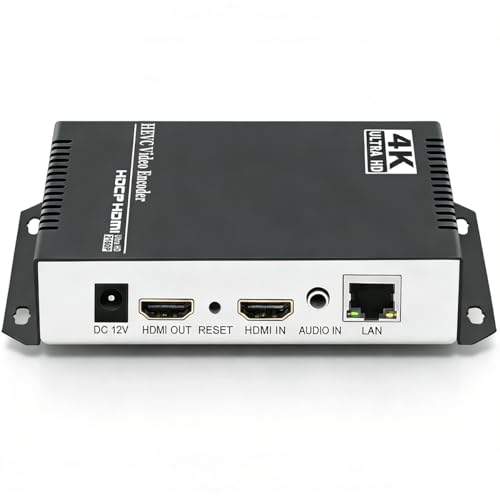
- 4K HDMI encoding with H.264/H.265
- Supports numerous streaming protocols
- Up to four simultaneous protocol outputs
Best For: Flexible multi-platform HDMI streaming
All-in-One Production Hub

- HDMI and SDI inputs with dual-source mixing
- 4K encoding with HDMI up to 60 fps
- Streams to up to six destinations
Best For: Mixed HDMI/SDI field and rack production
Best Compact NDI Encoder
ZowieBox 4K HDMI NDI Encoder/Decoder

- 5.9-ounce enclosure with LCD and tally light
- 4K passthrough with NDI|HX, SRT, RTMP(S), and RTSP
- Supports USB-C power, PoE, DC output, and tripod mounting
Best For: Portable gaming and compact NDI production setups
Best 4K SDI Encoder
Blackmagic Streaming Encoder 4K
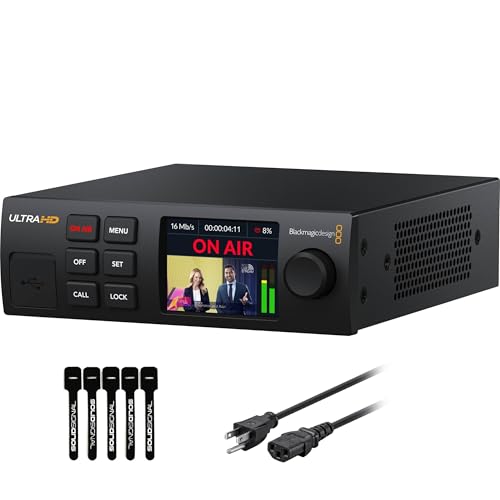
- 12G-SDI input and encoding up to 2160p60
- Ethernet plus USB-C mobile auto-failover
- Adds standards conversion, captions, timecode, and REST API control
Best For: Professional SDI productions and mobile broadcasts
Best Multi-Protocol 1080p Encoder

- 1080p60 H.264/H.265 encoding from HDMI sources
- Supports RTSP, RTMP(S), SRT, HLS, UDP, and more
- Provides up to four streams plus overlays and audio options
Best For: Customizable 1080p HDMI-to-IP streaming systems
Multi-Protocol 4K SDI Encoder
Multi-Channel 4K SDI-to-IP Encoder

- 4K at 30 fps; up to 120 fps at lower resolutions
- Outputs up to four streams using different protocols
- Adds overlays and supports SDI plus line-in audio
Best For: Portable SDI productions needing multi-platform streaming
4K HDMI Streaming Encoder

- Encodes 4K HDMI video at up to 30 fps
- Supports four simultaneous protocol outputs
- Includes WebRTC, SRT, RTMP(S), HLS, and UDP support
Best For: Portable single-source HDMI streaming
Compact 1080p Multi-Channel Encoder

- Encodes HDMI sources for 1080p streaming
- Outputs two streams per HDMI input
- Supports SRT, RTMPS, HLS, WebRTC, and UDP
Best For: Portable 1080p broadcasts needing dual streams
Flexible HDMI Workhorse – Magewell Ultra Encode HDMI Plus
The Magewell Ultra Encode HDMI Plus is a strong choice among hardware streaming encoders for portable production when your workflow centers on HDMI sources. It combines 4K encoding, loop-through monitoring, multi-protocol streaming, onboard recording, and flexible wired or wireless connectivity in a compact 4.2-inch-square chassis.
Best For: HDMI cameras, switchers, gaming systems, corporate AV, education, and event production where local monitoring and recording are useful.
Pros:
- Encodes HDMI video up to 4096×2160p30 with HDMI loop-through for monitoring or pass-through.
- Supports RTMP, RTMPS, SRT, NDI|HX, HLS, and TS over UDP/RTP, including simultaneous destinations.
- Streams and records at the same time to 128GB internal storage, USB media, or network locations.
- Offers Gigabit Ethernet with PoE, Wi-Fi, and support for USB 4G/5G modems.
Cons:
- Designed around HDMI input rather than SDI workflows.
- 4K encoding is limited to 30 fps.
- 4G/5G modem is not included.
For HDMI-based mobile production, this encoder provides an unusually broad mix of streaming, recording, overlay, and network options without requiring a computer at the encoding point. Its loop-through and multiple control methods make it practical for both field kits and installed AV systems.
SDI Streaming Specialist – Blackmagic Design Streaming Encoder HD
The Blackmagic Design Streaming Encoder HD is a focused option for hardware streaming encoders for portable production when dependable SDI connectivity and Full HD delivery matter more than 4K output. It supports H.264 and H.265 encoding at up to 1080p60 and includes 12G-SDI input with loop output.
Best For: HD live production setups using professional SDI cameras, switchers, and monitoring equipment.
Pros:
- Supports 1080p output at up to 60 fps.
- Provides H.264 and H.265 codec support.
- Includes 12G-SDI input and loop output for professional video workflows.
Cons:
- Limited to 1080p resolution rather than 4K.
- The supplied notes do not specify recording, wireless, or multi-protocol features.
- Its SDI-focused design is less suited to HDMI-only sources without additional conversion.
This encoder makes the most sense when your production infrastructure is already SDI-based and Full HD is sufficient. Its feature set is narrower than the all-in-one alternatives here, but the 12G-SDI loop-through is a useful fit for compact professional video chains.
Protocol-Rich Value Pick – URayCoder 4K HDMI IP Encoder
The URayCoder 4K HDMI IP encoder is a versatile entry for hardware streaming encoders for portable production, especially when you need broad protocol compatibility and configurable output. It accepts 4K HDMI sources at up to 30 fps, supports H.264 and H.265, and can output multiple streams for platforms such as YouTube, Facebook, Twitch, and Vimeo.
Best For: Budget-conscious creators and organizations that need flexible HDMI-to-network streaming with custom overlays and multiple delivery protocols.
Pros:
- Supports 4K input and output at up to 30 fps, plus up to 120 fps at 2K and lower resolutions.
- Handles RTSP, RTMP(S), SRT, HLS, UDP/RTP, WebRTC, and other listed protocols.
- Can output up to four video streams with different protocols simultaneously.
- Includes text, scrolling captions, logos, timestamps, cropping, and audio-input adjustments.
Cons:
- Does not list HDMI loop-through or onboard recording in the supplied details.
- Its many configuration options may require more setup than a simpler encoder.
- 4K operation is limited to 30 fps.
For producers who value protocol flexibility over a polished all-in-one field appliance, this box offers an extensive feature list in a compact HDMI-to-Ethernet format. It is particularly appealing for multi-platform distribution and branded streams, provided you do not need the loop-through or recording features found on some competitors.
All-in-One Production Hub – Magewell Ultra Encode AIO
The Magewell Ultra Encode AIO is one of the most capable hardware streaming encoders for portable production in this group. It combines HDMI and SDI inputs, 4K encoding, dual-input mixing, multi-destination streaming, recording, overlays, PoE, Wi-Fi, and USB modem support for demanding live workflows.
Best For: Mobile and rack-based productions that may need to switch between HDMI and SDI sources or combine both in picture-in-picture and side-by-side layouts.
Pros:
- Accepts HDMI and SDI, with picture-in-picture or side-by-side mixing from both inputs.
- Supports HDMI up to 4096×2160p60 and SDI up to 4096×2160p30 with H.264 or HEVC.
- Streams to up to six destinations using RTMP(S), SRT, NDI|HX2/HX3, HLS, and other protocols.
- Records to SD card, USB storage, or network drives while streaming.
Cons:
- Larger and heavier than the compact HDMI-only Magewell model.
- SDI 4K input is limited to 30 fps.
- Its broader production feature set may be more than a simple single-source stream requires.
If your portable production kit needs to accommodate both consumer-style HDMI and professional SDI sources, the Ultra Encode AIO is the most flexible choice here. Dual-input layouts, six-destination streaming, recording, and multiple control and network options make it well suited to complex field or rack workflows.
Best Compact NDI Encoder – ZowieBox 4K HDMI NDI Encoder/Decoder
For creators seeking hardware streaming encoders for portable production, the ZowieBox packs HDMI-to-IP conversion, NDI support, and standalone streaming into a 5.9-ounce enclosure. It can capture up to 4K, provide zero-lag HDMI passthrough, and stream through SRT, RTMP(S), or RTSP without requiring a PC.
Best For: Portable gaming, small live productions, and NDI-based workflows that need flexible HDMI and network connectivity.
Pros:
- Compact design includes an LCD status screen, tally light, and tripod mount.
- Supports NDI|HX3, NDI|HX2, and NDI|HX, plus SRT, RTMP(S), and RTSP.
- Offers 4K passthrough and USB-C, PoE, and DC power options.
- Web interface supports stream, audio, OSD, network, and PTZ-related settings.
Cons:
- Encoder and decoder modes cannot operate simultaneously.
- Full NDI signals are not supported.
- USB capture-card functionality is not currently supported.
The ZowieBox is a strong fit when portability and protocol flexibility matter more than a broad production control surface. Its limitations are worth noting for workflows that require full NDI or USB capture.
Best 4K SDI Encoder – Blackmagic Streaming Encoder 4K
The Blackmagic Streaming Encoder 4K is built for professional hardware streaming encoders for portable production, combining 12G-SDI input, 4K60 H.264/H.265 encoding, and direct SRT or RTMP delivery. Its standards conversion, mobile failover, and front-panel controls make it suited to productions that need dependable connectivity without a dedicated encoding PC.
Best For: SDI-based live production, broadcast-style streaming, and mobile events requiring Ethernet and cellular backup.
Pros:
- Encodes H.264 or H.265 in HD or Ultra HD up to 2160p60.
- 12G-SDI input supports sources up to DCI 4K60 with loop output.
- Automatic failover can switch between Gigabit Ethernet and USB-C-tethered mobile data.
- Includes SDI and HDMI monitor outputs, webcam outputs, captions, timecode, and REST API control.
Cons:
- At 1.7 pounds and a 1/3 RU form factor, it is less compact than pocket-sized encoders.
- Its primary video input is SDI, so HDMI-only sources may require additional equipment.
This is the most production-oriented option in the group, particularly for SDI cameras and workflows where internet redundancy, standards conversion, and broadcast control features justify the larger form factor.
Best Multi-Protocol 1080p Encoder – URayCoder HDMI to IP Encoder
For budget-conscious setups evaluating hardware streaming encoders for portable production, the URayCoder HDMI-to-IP encoder provides 1080p60 H.264/H.265 encoding in a straightforward network appliance. It supports RTSP, RTMP(S), SRT, HLS, UDP, and other formats, with configuration through computers or mobile devices.
Best For: HDMI cameras and sources that need customizable 1080p streaming, multi-protocol output, or simultaneous platform delivery.
Pros:
- Supports 1920×1080 input and output at up to 60fps.
- Offers H.265, H.264, and MJPEG encoding with HDMI or 3.5mm line-in audio.
- Can output up to four video streams using different protocols.
- Includes overlays, captions, logos, timestamps, cropping, rotation, and mirroring options.
Cons:
- Resolution is limited to 1080p rather than 4K.
- Its 6-by-5-by-1.5-inch enclosure and 0.5 kg weight are less pocketable than the ZowieBox.
- The supplied notes do not specify a current software-update date.
The URayCoder emphasizes protocol breadth and customization over compactness or 4K capability. It is a practical choice for fixed or semi-portable HDMI streaming systems that benefit from multiple outputs and built-in branding tools.
Multi-Protocol 4K SDI Encoder – Multi-Channel 4K SDI-to-IP Encoder
For portable production setups built around SDI sources, this multi-channel encoder offers a flexible way to convert video into network streams. It supports 4K input and output at up to 30 fps, with lower-resolution support reaching 120 fps, making it a versatile option among hardware streaming encoders for portable production.
Best For: Portable SDI-based productions, multi-platform streaming, and users who need several simultaneous protocol outputs.
Pros:
- Supports 4K UHD at up to 30 fps and up to 120 fps at 2K and lower resolutions.
- Offers SDI connectivity and support for RTMP(S), SRT, HLS, HTTP, RTSP, UDP, multicast, and other protocols.
- Can output up to four video streams with different protocols simultaneously.
- Includes overlays, cropping, rotation, audio adjustments, and lifetime technical support.
Cons:
- Its SDI-focused design may be less suitable for HDMI-only workflows.
- 4K output is limited to 30 fps.
This is a strong fit when a portable production rig needs SDI compatibility, multi-platform distribution, and extensive stream customization in one encoder. Its 16-ounce listed weight and management from computers or mobile phones also support flexible field deployment.
4K HDMI Streaming Encoder – 4K HDMI-to-IP HEVC Encoder
Designed for HDMI sources, this encoder converts 4K video into network streams for platforms and streaming servers. Its H.265/H.264 support, broad protocol compatibility, and compact 5.12-inch chassis make it a practical choice among hardware streaming encoders for portable production.
Best For: Portable HDMI production rigs, 4K live streaming, and creators distributing one source to multiple services.
Pros:
- Supports 4K UHD input and output at up to 30 fps, plus up to 120 fps at 2K and lower resolutions.
- Supports RTMP(S), RTSP, SRT, HLS, HTTP, UDP, WebRTC, TRTC, ICECAST, and additional protocols.
- Can simultaneously output four video streams using different protocols.
- Provides text, logo, timestamp, cropping, rotation, mirroring, and audio customization tools.
Cons:
- It has one HDMI port, so it is intended for a single HDMI source.
- 4K operation is limited to 30 fps.
For HDMI-centered mobile workflows, this model combines high-resolution encoding with unusually broad protocol support. It is especially useful when a single camera or source must feed several streaming destinations without adding another distribution device.
Compact 1080p Multi-Channel Encoder – Compact 1080p HDMI IP Encoder
This compact encoder is aimed at HDMI-based 1080p streaming workflows where portability and multiple outputs matter more than 4K resolution. Each HDMI input can provide two simultaneous streams, making it a capable, space-conscious option among hardware streaming encoders for portable production.
Best For: Portable 1080p broadcasts, HDMI live-streaming rigs, IPTV, NVR use, and multi-destination delivery.
Pros:
- Supports 1080p HD HDMI encoding for live broadcast and streaming applications.
- Provides two simultaneous video streams per HDMI input, with separate protocol choices.
- Supports RTMPS, RTSP, SRT, HLS, UDP, MP4, FLV, WebRTC, and other formats.
- Offers overlays, bitrate and frame-rate controls, image transformations, and lifetime support.
Cons:
- It is a 1080p model rather than a 4K encoder.
- Its 7 x 5 x 1.5-inch size and 0.66 kg weight may be less convenient for ultra-light kits.
This model makes sense for producers who want dependable protocol flexibility and dual-stream output in a 1080p package. Its aluminum shell and 12-volt input suit fixed or mobile production setups, while SDK, API, and CGI documentation may help more advanced integrations.
How We Picked the Best Hardware Streaming Encoders for Portable Production
We focused on features that matter when production moves between venues: input compatibility, supported streaming protocols, resolution, network flexibility, recording options, portability, and setup simplicity. Models were also considered for their usefulness across common workflows such as live events, education, worship, corporate video, field reporting, and remote production.
Because encoder specifications can vary by firmware and configuration, verify the manufacturer’s current documentation before purchase. Pay particular attention to whether advertised 4K support applies to encoding, pass-through, or both.
Quick Comparison
| Priority | Look for | Best suited to |
|---|---|---|
| Simple HDMI streaming | HDMI input, RTMP/SRT, compact design | Solo creators and small events |
| 4K production | 4K input or encoding, HDMI or SDI, strong thermal design | Higher-resolution live workflows |
| Professional integration | SDI, NDI|HX, genlock or loop-through features | Studios and production teams |
| Flexible distribution | RTSP, RTMP, SRT, HLS, UDP, and multicast support | AV networks and custom platforms |
Key Buying Factors for Hardware Streaming Encoders for Portable Production
Inputs and Video Format
Match the encoder to your camera or switcher. HDMI is common for mirrorless cameras, laptops, and compact switchers, while SDI is preferable for longer cable runs and professional cameras. If you need to monitor or feed another device, HDMI loop-through can reduce the need for a separate splitter.
Resolution, Frame Rate, and Codec
H.264 remains the safest choice for broad platform compatibility. HEVC/H.265 can deliver better efficiency but may have more limited playback and platform support. Confirm the desired resolution and frame rate, rather than assuming a device marketed as “4K” encodes every 4K format.
Network and Protocol Support
RTMP is widely supported by major streaming platforms, while SRT is valuable for unpredictable networks and longer-distance contribution. RTSP, HLS, UDP, and multicast matter for private distribution and AV networks. Ethernet is usually the most reliable portable connection; models with Wi-Fi, cellular support, or USB tethering can add flexibility.
Power and Field Operation
Check the power input, startup behavior, cooling, mounting options, and whether the unit can run from a battery or power bank. A compact encoder is only portable if its cables, adapters, and power accessories fit your production kit.
Who Should Buy Which Hardware Streaming Encoders for Portable Production?
Choose a compact HDMI encoder if you stream from a single camera, laptop, or small switcher and want the fastest setup. Pick a 4K model if your cameras or delivery workflow genuinely require ultra-high-definition video. SDI-equipped units are the better choice for professional cameras, longer cable runs, and installed production environments.
NDI-capable encoders suit teams that already use IP-based video production and need to move feeds across a local network. For contribution over the public internet, prioritize SRT and practical network redundancy. Finally, buyers with specialized IPTV or private-network requirements should favor broad protocol support, multicast capability, and documented compatibility over headline resolution alone.