
As you plan for 2025, ensuring flawless video quality is essential, and choosing the right HDMI to SDI cross converter can make all the difference. With numerous options available, you’ll want to focus on reliability and advanced features that enhance performance. The top converters on the market offer unique capabilities tailored to professionals in broadcasting and content creation. Let’s explore the best choices that could elevate your video production standards.
Decimator MD-Cross Miniature SDI/HDMI Cross Converter

If you’re a videographer or content creator looking for a reliable solution to convert HDMI to SDI without compromising quality, the Decimator MD-Cross Miniature SDI/HDMI Cross Converter is an excellent choice. It supports 3G level A and B input/output, allowing seamless conversions. With built-in scaling and frame rate conversion, you can easily adjust your video to meet specific requirements. The user-friendly LCD interface simplifies navigation, letting you access features on the go. Its compact design guarantees portability, while the four SDI outputs function as a distribution amplifier, mirroring your input or matching pairs. Elevate your video quality effortlessly with this converter.
Best For: Videographers and content creators in need of a reliable HDMI to SDI conversion solution with scaling and frame rate capabilities.
Pros:
- Compact and portable design for easy transport.
- User-friendly LCD interface for effortless navigation and access to features.
- Four SDI outputs function as a distribution amplifier, allowing for efficient video signal distribution.
Cons:
- Limited to specific input/output levels (3G level A and B).
- May require additional setup time for complex configurations.
- Lacks advanced features that some high-end converters offer.
AVMatrix SC2030 3G/HD/SD-SDI/HDMI Updown Cross Converter

For professionals in broadcasting and AV post-production, the AVMatrix SC2030 3G/HD/SD-SDI/HDMI Updown Cross Converter stands out as an essential tool. This professional-grade converter supports up/down scaling and frame rate conversion, making it perfect for various applications. You’ll appreciate its versatile input options—HDMI or SDI—along with two 3G-SDI outputs. The device features automatic detection for easy configuration, while analog audio embedding enhances your audio quality. With dual threaded locking power and a detachable bracket for wall mounting, setup is straightforward. Plus, you can control it via DIP switches or a PC, ensuring a seamless experience.
Best For: Professionals in broadcasting and AV post-production looking for a reliable and versatile signal converter.
Pros:
- Supports both up/down scaling and frame rate conversion, making it adaptable for various media formats.
- Automatic detection and configuration for HDMI and SDI inputs simplify setup and use.
- Dual threaded locking power supply provides redundancy for uninterrupted operation.
Cons:
- Limited to a single HDMI input, which may restrict connectivity options in complex setups.
- Requires additional software for PC control, which may not be ideal for all users.
- The detachable bracket for wall mounting may not be suitable for all installation environments.
AVMATRIX SC2030 SDI to HDMI Video Converter
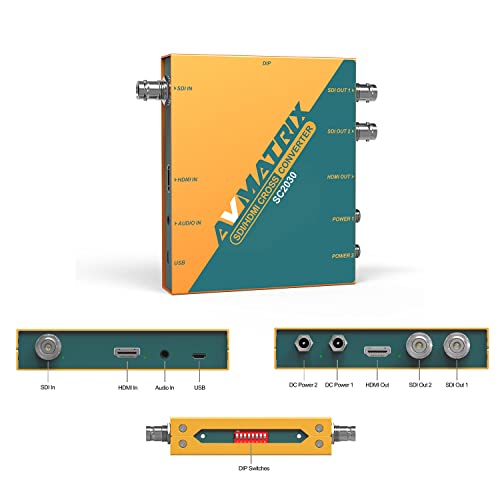
The AVMATRIX SC2030 SDI to HDMI Video Converter is a top choice for professionals in live streaming and broadcasting who need seamless signal conversion. This versatile device supports cross-conversion between SDI and HDMI, making it perfect for various applications like OB vans and security systems. You’ll appreciate its quick input switching via DIP switches and USB connectivity for remote setup. With automatic signal detection and compatibility with SD, HD, and Full HD formats, you won’t miss a beat. Plus, the 3.5mm audio input allows for easy external audio integration. Enjoy peace of mind with a 3-year warranty and reliable after-sales support.
Best For: Professionals in live streaming, broadcasting, and security systems looking for reliable SDI to HDMI signal conversion.
Pros:
- Quick input switching via DIP switches for easy operation.
- Supports a wide range of formats including SD, HD, and Full HD, ensuring compatibility with various devices.
- Plug-and-play functionality with no driver installation required, making setup straightforward.
Cons:
- Limited to SDI and HDMI conversion, which may not suit users needing other formats.
- The reliance on DIP switches for input switching may not be as user-friendly for some.
- External audio embedding is only available through a 3.5mm input, potentially limiting audio options.
AVMATRIX SDI/HDMI Up/Down/Cross Converter (SC2030)

Designed with versatility in mind, the AVMATRIX SDI/HDMI Up/Down/Cross Converter (SC2030) is ideal for professionals in video production who require reliable signal conversion across various formats. It supports SDI to HDMI, HDMI to SDI, and cross-conversion with simultaneous outputs. With features like up/down scaling and frame rate conversion, it guarantees seamless compatibility across devices. You can embed external audio via a 3.5mm jack, maintaining sync for high-quality output. Quick adjustments with DLP switches and USB connectivity for remote control make it user-friendly, while dual redundant power supplies enhance reliability for demanding environments.
Best For: Professionals in video production needing reliable and versatile signal conversion across various formats.
Pros:
- Supports multiple formats including SDI to HDMI and HDMI to SDI with simultaneous outputs.
- Features up/down scaling and frame rate conversion for seamless compatibility.
- Dual redundant power supplies ensure reliability in demanding environments.
Cons:
- May be overkill for casual users or non-professional setups.
- Requires some technical knowledge for optimal use and adjustments.
- Limited to specific input/output types, which may not suit all setups.
Blackmagic Design Micro Converter HDMI to SDI 12G

Offering unmatched versatility, the Blackmagic Design Micro Converter HDMI to SDI 12G is perfect for video professionals who demand high-quality output across various formats. It supports SD, HD, Ultra HD, and 4K DCI, automatically detecting input for seamless conversion. With an HDMI 2.0 input and dual SDI outputs, you’ll enjoy multi-rate support up to 12G, ensuring compatibility with multiple devices. Plus, you can easily control your settings via user-friendly software on MacOS and Windows. Real-time conversion and reclocking on SDI outputs maintain signal integrity, so you can trust this converter for stable, professional-grade video quality.
Best For: Video professionals seeking high-quality, versatile conversion solutions for a variety of formats.
Pros:
- Supports a wide range of resolutions including SD, HD, Ultra HD, and 4K DCI for flexible usage.
- User-friendly software controls available for both MacOS and Windows, simplifying configuration and settings management.
- Reliable signal integrity with reclocking on SDI outputs, ensuring stable performance over long cable runs.
Cons:
- Limited to HDMI 2.0 input, which may restrict compatibility with some older devices.
- Requires USB connection for software control, which may not be convenient for all users.
- No built-in power supply, meaning an external power source is necessary for operation.
HDMI to SDI Converter with Dual Output Adapter

For video professionals and enthusiasts who need to showcase high-quality HDMI signals on multiple SDI displays, the HDMI to SDI Converter with Dual Output Adapter is an ideal solution. This converter supports a high bit rate of 2.970 Gbit/s, ensuring your resolutions, including 1080p, remain sharp and clear. It efficiently transmits signals up to 300m, depending on the SDI type. With a robust metal shell, it promotes durability and effective heat dissipation. Plus, its plug-and-play functionality makes installation a breeze. However, remember it only converts HDMI to SDI; it won’t work for SDI to HDMI conversions.
Best For: Video professionals and enthusiasts needing to display high-quality HDMI signals on multiple SDI displays.
Pros:
- Supports high bit rate of 2.970 Gbit/s for clear, sharp resolutions.
- Durable metal shell design promotes effective heat dissipation.
- Easy plug-and-play installation for hassle-free setup.
Cons:
- Limited to HDMI to SDI conversion; does not support SDI to HDMI.
- Maximum output distance varies by SDI type, which may limit usability in larger setups.
- May not support very low or non-standard HDMI resolutions.
SDI to HDMI Video Audio Converter

If you’re looking to connect your SDI cameras to HDMI displays, the SDI to HDMI Video Audio Converter is a reliable solution. This converter supports HD-SDI, 3G-SDI, and SD-SDI devices, providing a full 1080P display with synchronous audio and video. It’s compatible with coaxial cables featuring BNC male connectors but won’t work with HDMI to SDI conversions or other signal types like CVBS. Easy to install, it has a durable metal shell for heat dissipation and a smart chip design for plug-and-play functionality. Just verify your output signal is SDI to enjoy seamless connectivity.
Best For: Broadcast professionals and multimedia conference organizers looking to connect SDI cameras to HDMI displays seamlessly.
Pros:
- Supports full 1080P resolution for high-quality video output.
- Durable metal shell provides good heat dissipation and enhances the product’s longevity.
- Plug-and-play functionality allows for easy installation and operation without technical expertise.
Cons:
- Does not support 4K resolution, limiting its use for high-end displays.
- Only converts SDI to HDMI, making it incompatible for HDMI to SDI applications.
- Not compatible with other signal types such as RF, CVBS, AHD, TVI, or CVI.
BiDirect HDMI/SDI Converter (1080P)

The BiDirect HDMI/SDI Converter (1080P) is an ideal choice for professionals in broadcasting and multimedia applications who demand seamless connectivity between high-end video equipment and consumer electronics. This converter enables bidirectional conversion, enhancing device compatibility. With its FPGA chip design, it supports resolutions up to 1920×1080 at 60fps, ensuring high-speed, long-distance signal transmission. Its durable metal housing withstands harsh environments, while built-in ESD protection enhances reliability. You can rely on it for applications like large-screen displays, multimedia conferencing, and medical imaging, guaranteeing lossless audio and video quality even during high-speed motion. Choose this converter for flawless performance.
Best For: Professionals in broadcasting and multimedia applications seeking seamless connectivity between high-end video equipment and consumer electronics.
Pros:
- Supports bidirectional conversion between HDMI and SDI interfaces, enhancing device compatibility.
- High-speed transmission with resolutions up to 1920×1080 at 60fps, ensuring excellent video quality.
- Durable metal housing with ESD protection, making it reliable for use in harsh environments.
Cons:
- May require additional power supply for optimal performance in certain setups.
- Limited to a maximum resolution of 1080p, which may not meet the needs of some high-end applications.
- Physical size may be cumbersome for portable use in some scenarios.
ACHAVE SDI to HDMI Video Converter (4 in 4 Out)

Achieve seamless video integration with the ACHAVE SDI to HDMI Video Converter, perfectly designed for professionals needing to connect multiple HD-SDI/3G-SDI sources to HDMI displays. With 4 SDI input ports and 4 HDMI output ports, you can easily manage multiple video feeds simultaneously. It supports HD-SDI and 3G-SDI formats, ensuring compatibility with various sources. Enjoy crystal-clear video output at resolutions up to 1080p@60Hz. Plus, the built-in cable equalization and clock recovery guarantee reliable long-distance transmission without quality loss. The package includes everything you need for a quick setup, ensuring you’re ready to go in no time.
Best For: Professionals needing to connect multiple HD-SDI/3G-SDI video sources to HDMI displays for seamless integration.
Pros:
- Supports both HD-SDI and 3G-SDI formats for versatile compatibility.
- Delivers high-quality video output up to 1080p@60Hz for crisp visuals.
- Built-in cable equalization and clock recovery ensure reliable long-distance signal transmission.
Cons:
- May require additional cables for complete setup not included in the package.
- Limited to HDMI outputs, which may not suit all display types.
- The automatic signal identification feature may not recognize some less common SDI formats.
Blackmagic Design Micro Converter BiDirectional SDI/HDMI 12G

For professionals in video production seeking seamless integration between SDI and HDMI formats, the Blackmagic Design Micro Converter BiDirectional SDI/HDMI 12G stands out with its real-time conversion capabilities. Supporting resolutions up to 4K DCI, it automatically detects input formats, ensuring efficient workflows. Its bi-directional conversion allows simultaneous use of SDI and HDMI, making it versatile for various setups. You’ll appreciate the reclocking feature that reduces jitter, enhancing signal integrity. Connecting via USB Type-C simplifies updates and configurations, while the user-friendly software utility for MacOS and Windows makes setup a breeze. Trust it for reliable video transmission in critical applications.
Best For: Professionals in video production looking for seamless integration between SDI and HDMI formats.
Pros:
- Supports resolutions up to 4K DCI, providing high-quality output.
- Bi-directional conversion allows simultaneous use of both SDI and HDMI, enhancing versatility.
- User-friendly software utility simplifies setup and configuration for MacOS and Windows.
Cons:
- Requires a USB Type-C connection for updates and power, which may not be available on all devices.
- May not support older or less common video formats, limiting compatibility in some situations.
- Depending on the setup, additional cables or adapters may be needed for optimal use.
Factors to Consider When Choosing an HDMI SDI Cross Converter
When you’re choosing an HDMI to SDI cross converter, consider several key factors to guarantee it meets your needs. You’ll want to look at resolution support, input and output types, and scaling capabilities. Don’t forget to evaluate audio embedding options and the user interface design for ease of use.
Resolution Support Requirements
Choosing the right HDMI to SDI cross converter involves understanding resolution support requirements, especially since different applications demand various formats. You’ll want to guarantee the converter supports the desired resolutions, like SD, HD, Ultra HD, or 4K DCI, based on your needs. Pay attention to the maximum output resolution; some converters handle only up to 1080p, while others support 4K. Frame rate compatibility is also essential, as it can impact video quality. Look for converters with automatic detection capabilities to simplify setup and optimize resolution matching. Finally, confirm compatibility with common video standards, such as SMPTE 259M and 292M, for seamless integration into your video production workflow.
Input and Output Types
Input and output types play an essential role in selecting the right HDMI to SDI cross converter. You’ll want to take into account the formats supported, such as HDMI and SDI, along with any additional audio inputs like analog audio embedding. Make sure the converter meets your specific resolution and frame rate needs, offering standards like 1080p and 4K. Look for models that automatically detect and configure input signals, simplifying setup and reducing manual adjustments. Additionally, check the number of output ports; some converters allow multiple simultaneous connections to various displays or devices. Finally, consider the maximum transmission distance for SDI outputs, as this can vary based on the converter’s specifications and the SDI standard supported.
Scaling and Frame Rate
For ideal performance in video production, scaling and frame rate capabilities are key factors to take into account in an HDMI to SDI cross converter. Scaling allows you to adjust the resolution of your input signal to fit the requirements of your output display, guaranteeing optimal image quality. Up/down scaling can considerably enhance video clarity and detail, perfect for high-definition displays. Frame rate conversion is equally important, enabling smooth playback across various devices and formats. Some converters even support simultaneous scaling and frame rate conversion, offering versatility for different production environments. By choosing a converter that handles multiple resolutions and frame rates, you’ll assure compatibility with a wide range of professional video equipment and broadcast standards.
Audio Embedding Capabilities
When selecting an HDMI to SDI cross converter, you’ll want to contemplate its audio embedding capabilities, as they play an essential role in enhancing audio-visual synchronization. Look for converters that allow you to integrate external analog audio into both SDI and HDMI outputs. Some models come equipped with a 3.5mm audio input, making it easy to embed external audio signals for versatile applications. This feature is significant for professional broadcasting, ensuring audio stays in sync with video during transmission. Additionally, devices with audio embedding support various audio formats, catering to different professional needs. Proper audio embedding also helps prevent latency issues, ensuring a harmonious transmission of audio and video signals for an ideal viewing experience.
User Interface Design
A well-designed user interface can make all the difference when choosing an HDMI to SDI cross converter. You want a user-friendly interface that simplifies setup and operation, allowing you to access features without needing extensive technical knowledge. Look for converters with LCD displays and button controls, as they provide clear feedback on settings and enable quick adjustments in real-time. Some models even offer remote configuration via USB, making management and updates easier from your computer. Intuitive controls, like DIP switches for fast parameter adjustments, are also beneficial for urgent setups. Prioritize accessibility in design, ensuring you can navigate features effortlessly, especially in high-pressure situations where every second counts.
Portability and Mounting Options
Choosing the right HDMI to SDI cross converter involves more than just user interface design; portability and mounting options play a significant role, especially for professionals on the move. Look for a compact design that makes transport easy, as you’ll often be shifting between locations. Detachable mounting brackets are a great feature, offering flexible installation for both temporary and permanent setups. Pay attention to the weight and build quality; a durable metal housing enhances heat dissipation and guarantees stable operation in various environments. While you’ll want to take into account user-friendly interfaces for quick adjustments, prioritize portability and mounting options to maintain efficiency during your projects. This will ultimately lead to a smoother workflow in your video production.
Power Supply Features
While selecting an HDMI to SDI cross converter, power supply features can greatly impact your workflow and reliability. Consider models with dual redundant power supplies; they enhance reliability during power outages. It’s also wise to look for converters with locking power connectors to guarantee a secure connection and minimize accidental disconnections. If you’re working in portable setups, some models offer USB power input, providing flexibility in your power sources. Additionally, check for low power consumption ratings to promote energy efficiency during operation. Finally, converters that support power over USB can simplify your setup by reducing the number of cables required, making your workflow more streamlined and efficient.
Signal Processing Quality
When it comes to maintaining video and audio integrity during HDMI to SDI conversions, signal processing quality is paramount. You’ll want to choose a converter that uses advanced technologies, like FPGA chips, for stable, low-latency transmission. This guarantees high resolutions without sacrificing performance. Versatility is also key; look for converters that can handle multiple formats, including SD, HD, and Ultra HD. Features like reclocking on SDI outputs can greatly enhance signal integrity, minimize jitter, and improve transmission quality, especially over long distances. Additionally, effective scaling and frame rate conversion capabilities are essential for adapting video signals to various display devices, guaranteeing seamless playback without artifacts. Prioritize these features for the best results in your projects.