
When it comes to filmmaking, having the right tools can make all the difference. HDR field monitors are essential for achieving that precise visual quality, especially in challenging lighting conditions. You might wonder which models stand out in today’s market. From touch screens to exceptional color accuracy, the options are impressive. Let’s explore the top contenders that can truly elevate your production quality.
NEEWER F700 7″ Camera Field Monitor with Touch Screen

If you’re a filmmaker seeking an exceptional viewing experience, the NEEWER F700 7″ Camera Field Monitor should be at the top of your list. With its 7-inch IPS touch screen boasting a stunning 1920×1080 resolution and 2000nit brightness, you’ll never miss a detail. The ultra-wide 160° viewing angle guarantees everyone sees the action. Plus, it supports 4K HDMI loop in and out for seamless connectivity. You’ll love features like False Color and Peak Focus for precise monitoring. Power it with NP-F batteries or via DC port, and enjoy flexible mounting options. This monitor is designed to elevate your filmmaking game.
Best For: Filmmakers and content creators looking for a high-quality, versatile field monitor that enhances their shooting experience with advanced features and excellent display quality.
Pros:
- High Brightness: With 2000nit brightness, the monitor is easily viewable in bright outdoor settings.
- Advanced Monitoring Features: Includes tools like False Color, Zebras, and Vectorscope for precise video monitoring.
- Flexible Power Options: Can be powered by NP-F batteries or through a DC port, offering flexibility during shoots.
Cons:
- Weight: The monitor is relatively heavy when using two batteries, which may be cumbersome for some users.
- Limited Battery Life: The NP-F750 battery only provides 2.4 hours of runtime, which may require frequent recharging during long shoots.
- Price Point: Higher-end features may result in a more expensive product compared to basic field monitors.
Osee G7 Pro 7’’ Camera Monitor

The Osee G7 Pro 7’’ Camera Monitor is a game-changer for filmmakers working in bright outdoor environments, boasting an impressive 3000 Nits brightness. Its touchscreen interface lets you control camera functions like white balance and ISO directly, ensuring you stay focused on your shot. You can easily switch between camera and monitor with one click, enhancing your workflow. It supports advanced features like touch-to-focus and dynamic tracking, perfect for HDR bracketing. With tools like waveform and vectorscope, you can fine-tune your footage. Plus, flexible power options make it convenient to use in various shooting conditions.
Best For: Filmmakers and content creators who need a high-brightness monitor for outdoor shooting with advanced camera control features.
Pros:
- Exceptional 3000 Nits brightness, ideal for bright outdoor environments.
- Touchscreen interface allows for easy camera control and quick switching between modes.
- Comprehensive analysis tools, including waveform and vectorscope, enhance video quality.
Cons:
- Requires NP-F battery for certain camera control functions which may not be included.
- Limited touch-to-focus support for specific camera models only.
- Higher price point compared to standard monitors may not fit all budgets.
Atomos Shinobi GO HDMI 4K Camera Field Monitor

Designed for filmmakers who demand exceptional clarity and detail, the Atomos Shinobi GO HDMI 4K Camera Field Monitor boasts a stunning 1500-nit brightness level, making it perfect for outdoor shoots in bright conditions. Its 5-inch display delivers 1920 x 1080 pixels, ensuring you see every detail. Weighing just 210g, it’s lightweight and 30% thinner than previous models, making it easy to mount on your rig. With advanced monitoring tools like waveforms and histograms, it helps you achieve precise shots. Plus, its durable build and locking cable system mean you can rely on it during your most challenging shoots.
Best For: Filmmakers and content creators looking for a high-brightness, portable monitor for outdoor shooting and precise color grading.
Pros:
- High Brightness: 1500 nits for exceptional visibility in bright conditions.
- Lightweight Design: At only 210g, it’s easy to mount and carry.
- Advanced Monitoring Tools: Includes waveforms, histograms, and LUT support for accurate shooting.
Cons:
- Limited Customer Rating: Average rating of 3.7 out of 5 stars based on 33 reviews.
- Battery Not Included: NP-F battery sold separately for extended runtime.
- AC Power Accessory Sold Separately: Atomos battery eliminator required for AC power.
Desview 5.5 Inch 4K HDMI HDR Field Monitor

For filmmakers seeking a compact yet powerful monitoring solution, the Desview 5.5 Inch 4K HDMI HDR Field Monitor stands out with its impressive 600-nit brightness and HDR-ready visuals. This monitor features a 5.5-inch Full HD IPS touchscreen, guaranteeing vibrant colors and wide viewing angles. With 4K HDMI input/output, real-time audio monitoring, and professional tools like waveform and vectorscope, it optimizes your production workflow. The dual power options and lightweight design make it perfect for on-the-go shoots. Plus, its anti-glare screen guarantees clarity in bright conditions, enhancing your filming experience without fatigue. Elevate your filmmaking with this versatile monitor!
Best For: Filmmakers and content creators looking for a portable, high-quality field monitor to enhance their shooting experience with vibrant visuals and professional monitoring tools.
Pros:
- Excellent 600-nit brightness for visibility in various lighting conditions.
- Comprehensive professional monitoring tools including waveform, RGB histogram, and vectorscope.
- Dual power options (battery and DC) and lightweight design enhance portability for on-the-go shoots.
Cons:
- Limited screen size may not suit all filmmakers’ preferences for detailed monitoring.
- Requires additional accessories for full functionality, such as batteries or power adapters.
- Touchscreen responsiveness may vary in different lighting conditions.
FEELWORLD H5 5.5″ 4K HDMI Camera Field Monitor

With its impressive 1200nits brightness, the FEELWORLD H5 5.5″ 4K HDMI Camera Field Monitor is perfect for filmmakers who often shoot in bright outdoor conditions. Its touchscreen interface allows you to quickly access functions, while supporting resolutions up to 4096×2160/60fps. You’ll appreciate the color accuracy, as it’s calibrated by CALMAN and supports both DCI-P3 and REC709 color spaces. Weighing just 240g and made from CNC-machined aluminum, it’s both durable and lightweight. Plus, the extensive accessory bundle guarantees you have everything you need, making this monitor an invaluable asset for your filmmaking toolkit.
Best For: Filmmakers and videographers seeking a portable, high-brightness monitor for outdoor shooting.
Pros:
- High Brightness: 1200nits brightness ensures visibility even in bright sunlight.
- Color Accuracy: CALMAN calibration provides precise color reproduction, supporting various color spaces.
- Lightweight Design: Weighing only 240g and made from durable aluminum, it’s easy to carry and use.
Cons:
- Limited Screen Size: The 5.5-inch display may be small for some users who prefer larger monitors.
- Touchscreen Sensitivity: Touch interface may not be preferred by everyone for certain functions.
- Battery Life: Depending on usage, the battery life may not be sufficient for long shoots without additional power sources.
Desview R5II 5.5-inch Camera Field Monitor for DSLR Video Production
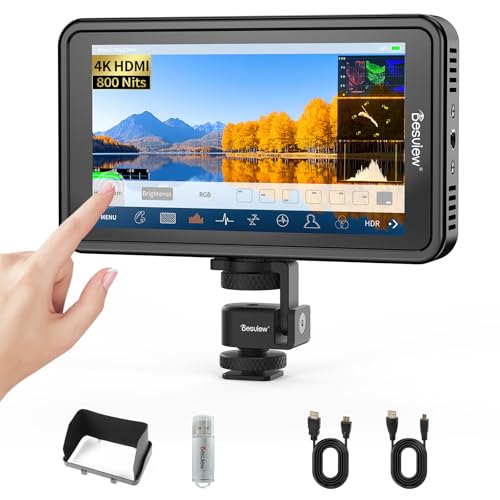
The Desview R5II 5.5-inch Camera Field Monitor stands out as an excellent choice for filmmakers looking for portability and high-quality visuals. With a Full HD resolution of 1920 x 1080 and a brightness of 800 cd/m², you’ll easily see your shots in daylight. Its 178° viewing angle guarantees everyone can see the display clearly. Plus, with HDR support, you’ll capture a wider color range. You can connect directly to your DSLR via HDMI, and the built-in monitoring tools help you achieve precision. Weighing just 1.03 pounds, it’s a lightweight, reliable option for any shoot.
Best For: Filmmakers and videographers seeking a portable and high-quality field monitor for DSLR video production.
Pros:
- High brightness of 800 cd/m² ensures visibility in bright outdoor conditions.
- Comprehensive monitoring tools such as waveform and false color assist in achieving precise shots.
- Lightweight design (1.03 pounds) makes it easy to transport and handle during shoots.
Cons:
- Batteries not included, requiring additional purchases for power.
- DC power adapter not included, which may necessitate extra investment.
- Limited reviews (28) may not provide a comprehensive view of long-term performance.
VILTROX DC-A1 2800 Nit Camera Monitor (7 inch HD Touch Screen)

Bright and vibrant, the VILTROX DC-A1 2800 Nit Camera Monitor is perfect for filmmakers who often shoot outdoors. With its 7-inch HD IPS touch screen and impressive 2800 nits brightness, you’ll see every detail clearly, even in bright sunlight. The monitor boasts 4K HDMI 2.0 inputs and outputs, ensuring lossless HD transmission. You’ll appreciate the professional monitoring functions like False Color and Histogram, along with shortcut buttons for quick access. Plus, it features a built-in cooling system and multiple mounting options. With NP-F battery compatibility and USB-C charging, this monitor is ready for any shoot you tackle.
Best For: Filmmakers and content creators who frequently shoot outdoors and require a high-brightness monitor for detailed visibility.
Pros:
- Exceptional 2800 nits brightness for clear visibility in direct sunlight.
- Comprehensive professional monitoring functions, including False Color and Histogram for precise adjustments.
- Versatile mounting options and USB-C charging enhance usability on location.
Cons:
- The included battery may not provide long-lasting power for extended shoots.
- No DC IN cable included, which may require additional purchases for power supply.
- Some users may find the interface complex due to the abundance of features and settings.
FEELWORLD P6XL 6 inch Camera Field Monitor

For filmmakers seeking a reliable and portable solution, the FEELWORLD P6XL 6-inch camera field monitor stands out with its impressive 1200nit brightness. This lightweight monitor, weighing just 332g, is perfect for handheld shooting and travel. Its advanced monitoring capabilities include screenshot storage and support for up to 32 custom 3D LUTs, ensuring accurate color grading previews. The 4K HDMI input allows compatibility with the latest DSLRs, while built-in tools like waveform and histogram help you achieve precise exposure and focus. With a built-in rechargeable battery providing up to 2 hours of runtime, the P6XL is an essential tool for any filmmaker.
Best For: Filmmakers and videographers looking for a portable and high-brightness monitor for accurate shot monitoring in various lighting conditions.
Pros:
- Exceptional 1200nit brightness for clear visibility in direct sunlight.
- Lightweight and portable design, ideal for handheld shooting and travel.
- Advanced features like screenshot storage and support for 32 custom 3D LUTs for enhanced color grading.
Cons:
- Built-in battery provides only up to 2 hours of runtime, which may limit extended shooting sessions.
- Limited compatibility with non-DSLR cameras, potentially restricting user base.
- The monitor’s size may be too small for some users who prefer larger displays for detailed monitoring.
FEELWORLD P6XL 6 Inch Camera Monitor
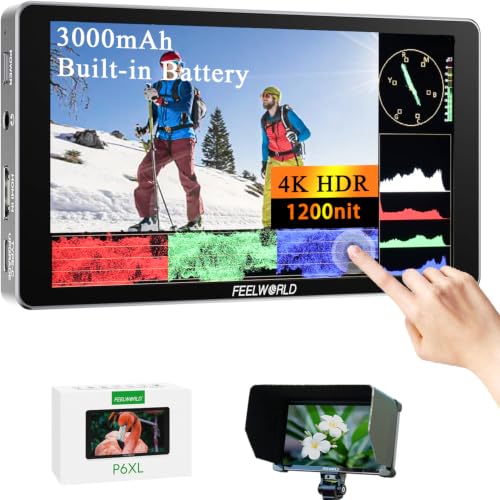
With its 1200nit brightness and 6-inch Full HD IPS touch screen, the FEELWORLD P6XL 6 Inch Camera Monitor is ideal for filmmakers who need reliable visibility in challenging lighting conditions. You’ll appreciate the HDR monitoring options and versatile waveform displays that enhance your shooting precision. The sensitive touch control lets you navigate easily with tap and swipe gestures, while the scroll wheel key offers additional functionality. Lightweight and portable, it features a built-in rechargeable battery for 2 hours of runtime and a USB Type-C port for convenient charging. Plus, the included sunshade helps you maintain clarity outdoors.
Best For: Filmmakers and videographers seeking a high-performance monitor for accurate shooting in various lighting conditions.
Pros:
- High brightness (1200nit) ensures visibility even in bright outdoor environments.
- Lightweight and portable design makes it easy to carry and use in different shooting locations.
- Versatile monitoring features like HDR options and waveform displays enhance shooting precision and control.
Cons:
- Limited battery life of 2 hours at full brightness may require frequent recharging during extended shoots.
- Touch screen sensitivity may lead to accidental adjustments if not handled carefully.
- Potential compatibility issues with certain cameras or video signals despite HDMI input supporting 4K.
FEELWORLD F7 Plus 7 Inch DSLR Camera Field Monitor

The FEELWORLD F7 Plus 7 inch DSLR camera field monitor shines as an ideal choice for filmmakers needing exceptional image clarity in bright environments. With a stunning 1200 nit brightness and a 1920 x 1200 resolution, you’ll capture every detail with incredible accuracy. Its 160° viewing angle and 1200:1 contrast ratio guarantee you’ll see vibrant colors and sharp images from various perspectives. Plus, features like waveform and histogram help you achieve precise exposure and focus. The monitor supports loading up to 32 LUT files via SD card, making it versatile for different shooting scenarios.
Best For: Filmmakers and content creators seeking a high-performance monitor for use in bright outdoor conditions.
Pros:
- 1200 nit brightness ensures visibility in direct sunlight, enhancing outdoor shooting capabilities.
- Versatile LUT support allows for creative color grading and monitoring during shoots.
- Professional monitoring tools like waveform and histogram provide precise exposure control.
Cons:
- The monitor’s size may be cumbersome for those looking for more portable options.
- Requires external power supply, which may add complexity to setup.
- HDMI compatibility may limit use with some older camera models lacking HDMI outputs.
Factors to Consider When Choosing an HDR Field Monitor for Filmmaking
When you’re choosing an HDR field monitor for filmmaking, several key factors come into play. You’ll want to take into account display brightness levels, size and portability, and connectivity options to guarantee it fits your needs. Don’t overlook color accuracy features and the monitoring tools provided, as they can greatly influence your filming experience.
Display Brightness Levels
Choosing the right brightness level for your HDR field monitor can greatly impact your filmmaking experience. Brightness, measured in nits, is vital for visibility, especially outdoors. For indoor use, a brightness level of 1000 nits works well, but if you’re shooting in direct sunlight, aim for at least 1500 nits. Monitors exceeding 2000 nits are ideal for high-ambient light situations, enhancing contrast and detail. This capability is essential for capturing bright scenes accurately. Additionally, having the ability to adjust brightness—either manually or automatically—can greatly improve usability in varying lighting conditions. Higher brightness levels also enhance HDR performance, ensuring you get the best representation of highlights and shadows for a broad dynamic range in your video production.
Size and Portability
Finding the right HDR field monitor goes beyond brightness; size and portability play a big role in your filmmaking process. A monitor’s size impacts its portability—larger models, like 7 inches, offer better visibility but can be heavier. On the other hand, smaller options, around 5.5 inches, are lighter and easier to carry. You’ll want a lightweight monitor that weighs under 1 pound, making it perfect for handheld shooting and travel. Consider the thickness and dimensions, as slimmer designs integrate more easily into tight filming rigs. A compact form factor also aids in storage and transport, essential for filmmakers on the move. Plus, built-in batteries can enhance portability by minimizing reliance on external power.
Connectivity Options Available
Connectivity options are crucial in selecting an HDR field monitor for filmmaking. Look for monitors with 4K HDMI input and output to guarantee compatibility with high-resolution cameras, delivering peak video quality. Additionally, consider models that feature 3G-SDI connectivity, as this provides a more robust signal for professional setups, especially over longer distances. Check for simultaneous audio monitoring through a 3.5mm headphone jack, allowing you to perform real-time audio checks during filming. It’s also important to verify the monitor supports various video formats, including resolutions up to 4096×2160, catering to different filming needs. Finally, opt for monitors with multiple HDMI ports for lossless HD transmission and easy switching between devices without constant cable changes.
Color Accuracy Features
When you’re selecting an HDR field monitor for filmmaking, color accuracy features are vital to achieving stunning visuals. Look for monitors that support multiple color spaces like DCI-P3 and REC709 to guarantee accurate color reproduction across various video workflows. It’s also beneficial to choose monitors that allow you to load 3D LUTs, enabling real-time color grading previews. High bit depth processing, such as 10-bit or 22-bit, is essential for capturing nuanced color details and smoother gradients in HDR footage. Additionally, built-in color analysis tools like vectorscopes and RGB histograms provide insights for precise adjustments. Finally, a brightness level of at least 1000 nits helps maintain color accuracy in bright environments, minimizing glare and reflections.
Monitoring Tools Provided
Choosing the right HDR field monitor involves considering several key monitoring tools that can enhance your filmmaking process. Advanced features like waveform, histogram, and vectorscope are essential for achieving precise exposure and color accuracy. You’ll find tools like false color and peaking focus help identify overexposed areas and guarantee your subjects are sharply in focus. Many monitors also support customizable 3D LUTs, allowing you to preview color grading in real-time. Integrated audio monitoring tools, such as audio bars, help you track sound levels while visualizing your footage. Additionally, multiple monitoring functions like zebras and oscillograms boost your ability to capture high-quality video in varying lighting conditions, assuring your production meets professional standards.
Power Supply Flexibility
Power supply flexibility is essential for filmmakers who need reliable performance in various shooting environments. Look for field monitors that offer multiple power options, like NP-F batteries, DC power, and USB Type-C charging. This versatility guarantees you can adapt to different locations seamlessly. Some models support high-capacity batteries, extending runtime to over four hours, which is a game changer for long shoots. Hot-swappable batteries allow you to change power sources without interrupting your filming. Additionally, monitors with D-tap connections can enhance your setup by utilizing external power supplies. Integrated power management features, like smart charging or functioning as a dummy battery for your camera, can streamline your workflow and reduce equipment clutter, making your shoots more efficient.
Build Quality and Durability
Reliable power supply options are just one aspect of what makes an HDR field monitor effective for filmmaking. When choosing a monitor, prioritize those with a robust build, like CNC-machined aluminum, which enhances durability for outdoor shoots. Lightweight designs, ideally under 1 pound, improve portability, making it easier to mount on camera rigs without adding extra weight. Look for anti-reflective coatings to minimize glare and guarantee clear visibility in bright conditions. Built-in cooling systems are essential for preventing overheating during extended use, maintaining performance when you need it most. Finally, secure mounting options, such as 1/4 screw holes and cold shoe mounts, provide flexibility and stability for various filming setups, making sure your monitor stays in place.