
If you’re looking to elevate your LED display’s visual performance in 2025, you’ll want to explore the top calibration systems available. With advancements like pixel-level calibration and adaptive frame rate technology, these systems promise impressive accuracy and stability. From the NovaStar MRV336 to the Colorlight K5+, each option offers unique features worth considering. Let’s uncover what sets these systems apart and how they can meet your specific needs.
NovaStar MRV336 LED Receiving Card for LED Display Systems

The NovaStar MRV336 LED Receiving Card is an excellent choice for professionals looking to enhance their LED display systems, whether for indoor or outdoor use. Supporting resolutions up to 256×256@60Hz, this card guarantees pixel-level brightness and chroma calibration for stunning visuals. Weighing only 1.6 ounces, it’s compact and easy to integrate. With 12 HUB75E connectors and a gigabit Ethernet port, you’ll enjoy stable communication even in demanding environments. Plus, its eco-friendly design meets RoHS and EMC Class B standards, assuring durability. With features like temperature monitoring and pre-stored image settings, you’ll maintain flawless visual performance effortlessly.
Best For: Professionals looking to enhance their indoor and outdoor LED display systems with high-quality visuals and reliable performance.
Pros:
- Supports high resolutions up to 256×256@60Hz for stunning image quality.
- Compact design and lightweight build make integration into various display systems easy.
- Features like temperature monitoring and pre-stored image settings ensure consistent and reliable performance.
Cons:
- Limited to a maximum power consumption of 2.5W, which may not be sufficient for larger installations.
- Requires additional components for full functionality, which could increase overall system costs.
- The best sellers rank indicates it may not be as widely adopted as other products in the market.
NovaStar MRV210-4 Receiving Card by AzarPixel

For professionals seeking top-tier performance in LED display setups, the NovaStar MRV210-4 Receiving Card by AzarPixel stands out with its enhanced image precision and color stability. This card guarantees uniform brightness and vivid colors, creating seamless displays for any environment. Its reliable signal transmission, backed by EMC Class A certification, minimizes interference, making it perfect for large screens. With features like real-time monitoring and dual backup, you can maintain continuous operation even during faults. Its compact design supports high resolutions while fitting easily in tight spaces, delivering exceptional results for high-demand applications like concerts and control rooms.
Best For: Professionals in the event production and commercial display industries looking for reliable, high-performance LED display solutions.
Pros:
- Enhanced image precision ensures vibrant color and brightness uniformity for superior display quality.
- Real-time monitoring features aid in diagnostics and system maintenance, preventing downtime.
- Compact design allows for easy installation in tight spaces while supporting high resolutions.
Cons:
- Potentially higher cost compared to basic receiving cards may be a consideration for budget-conscious buyers.
- Requires technical knowledge for installation and configuration, which may not be suitable for all users.
- Limited compatibility with non-NovaStar LED modules may restrict options for some setups.
NovaStar MX40 Pro All-in-One LED Video Wall Controller

Designed for professionals managing large-scale LED video wall installations, the NovaStar MX40 Pro All-in-One LED Video Wall Controller stands out with its impressive support for up to 9,000,000 pixels. You’ll appreciate its 20 Gigabit Ethernet ports and 4 optional 10G optical ports, ensuring flexible and reliable signal transmission. With compatibility for various video inputs, including HDMI 2.0 and DP 1.2, it effortlessly handles high resolutions. Advanced image processing features like full grayscale calibration and HDR support enhance your visuals, providing exceptional performance for creative video wall designs. The MX40 Pro is your go-to solution for flawless, stunning displays.
Best For: Professionals managing large-scale LED video wall installations seeking high-quality performance and advanced image processing capabilities.
Pros:
- High pixel capacity: Supports up to 9,000,000 pixels for detailed and expansive displays.
- Flexible connectivity: Features 20 Gigabit Ethernet ports and 4 optional 10G optical ports for reliable signal transmission.
- Advanced image processing: Offers HDR support, full grayscale calibration, and various video input formats for exceptional visual quality.
Cons:
- Complex setup: May require technical expertise to configure and optimize for specific installations.
- Cost: High-end features may lead to a significant investment compared to simpler controllers.
- Size and weight: The all-in-one design may be bulkier, making it less portable for smaller setups.
Colorlight K5+ LED Receiving Card for LED Screens

Experience superior image quality with the Colorlight K5+ LED Receiving Card, a top choice for professionals managing both indoor and outdoor LED displays. Supporting resolutions up to 512×384 at 240Hz, it delivers 8-bit input and an impressive 16.7 million colors. You’ll appreciate the adaptive frame rate technology and per-pixel calibration, which enhance contrast and color accuracy. Plus, real-time monitoring of cabinet conditions guarantees stable performance in demanding environments. With features like Ethernet loop redundancy and dual receiving card hot backup, you can trust its reliability for mission-critical installations. The Colorlight K5+ is perfect for your display needs.
Best For: Professionals managing indoor and outdoor LED displays who require high resolution, reliability, and performance.
Pros:
- High-quality visuals with support for 16.7 million colors and adaptive frame rate technology.
- Robust monitoring capabilities ensure real-time assessment of cabinet conditions for stable performance.
- Redundancy features like Ethernet loop and dual receiving card hot backup minimize downtime and enhance reliability.
Cons:
- Higher cost compared to basic LED receiving cards, which may be a consideration for budget-conscious projects.
- Complexity in setup may require professional installation and configuration.
- Limited compatibility with older LED display systems that do not support advanced features.
Mini-Ligno E/D Pin Moisture Meter for Wood and Home Maintenance

The Mini-Ligno E/D Pin Moisture Meter stands out as an essential tool for woodworkers and homeowners alike, thanks to its automatic calibration feature. You’ll appreciate its versatility, measuring moisture levels from 6% to 45%, making it perfect for wood floors and firewood. With settings for softwoods and hardwoods, you get reliable results every time. The compact design and durable red LED display guarantee you can easily read measurements, even in low light. Weighing just 5.6 ounces, it’s portable and user-friendly. With a 2-year warranty and a high customer rating, this meter is a smart investment for any home maintenance project.
Best For: The Mini-Ligno E/D Pin Moisture Meter is best for woodworkers, homeowners, and DIY enthusiasts who need an accurate and reliable moisture detection tool for wood and home maintenance projects.
Pros:
- Automatic Calibration: Ensures precise readings for various wood species, enhancing usability for both professionals and hobbyists.
- Versatile Measuring Range: Capable of measuring moisture levels from 6% to 45%, suitable for a wide range of wood types and firewood.
- User-Friendly Design: Compact and lightweight with a durable LED display, making it easy to use and read in different lighting conditions.
Cons:
- Requires Battery Replacement: Being battery-powered means you’ll need to replace the 9V alkaline battery periodically.
- Limited to Wood Materials: Not suitable for measuring moisture in materials other than wood, which may limit its versatility for some users.
- Pin Insertion May Damage Surfaces: The use of pins for measurement can potentially leave small holes or marks on softer woods or delicate surfaces.
Ultrasonic Thickness Gauge NDT330 for Various Materials
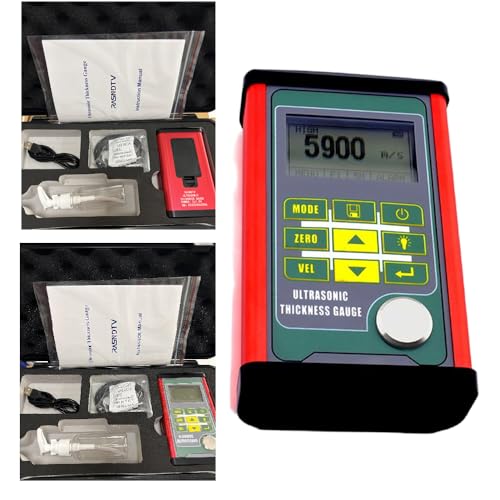
For professionals in industries where material integrity is crucial, the NDT330 Ultrasonic Thickness Gauge stands out as an essential tool. This intelligent device uses advanced microprocessor technology to measure thickness across various materials like metals, plastics, ceramics, and glass. You’ll appreciate its ability to monitor corrosion in pipes and pressure vessels, ensuring safety. The gauge boasts a display resolution of 0.01/0.1, along with features like probe zero calibration and error correction. With multiple probes for accurate measurements of non-metallic materials, the NDT330 enhances versatility and precision in your work, making it an indispensable asset in your toolkit.
Best For: Professionals in industries such as construction, manufacturing, and maintenance who require reliable thickness measurements for material integrity.
Pros:
- The NDT330 utilizes advanced microprocessor technology for precise and accurate measurements.
- It features a versatile range of applications, suitable for various materials including metals, plastics, ceramics, and glass.
- The device includes calibration features and multiple probes, enhancing usability and measurement accuracy.
Cons:
- The initial setup and calibration may require some technical knowledge, which could be a barrier for inexperienced users.
- Depending on the material type, some measurements may take longer to obtain accurate results.
- The cost of the device may be higher compared to simpler thickness gauges, which could deter budget-conscious buyers.
NDT310 Digital Ultrasonic Thickness Gauge Wall Thickness Tester

Precision matters in industries that rely on accurate material measurements, making the NDT310 Digital Ultrasonic Thickness Gauge an ideal choice for professionals in construction, manufacturing, and maintenance. This meter, with its 2P probe, measures thickness from 5.0 to 300mm across various materials. Its multi-probe compatibility and dual-use design guarantee versatility for both thin and thick workpieces. You’ll appreciate the high-brightness LED backlit display, perfect for low-light environments. Compact and lightweight, it’s easy to transport for on-site inspections. Plus, with dual calibration modes and intelligent power management, you’ll enjoy high accuracy and extended battery life, making it a reliable tool.
Best For: Professionals in construction, manufacturing, and maintenance who require precise material measurements.
Pros:
- High-brightness LED backlit display for clear visibility in low-light conditions.
- Compact and lightweight design enhances portability for on-site inspections.
- Dual calibration modes ensure high measurement accuracy.
Cons:
- Limited measurement range of 5.0 to 300mm may not suit all applications.
- Multi-probe compatibility could require additional investment in probes.
- Dependence on battery power may necessitate frequent replacements if not managed effectively.
Ultrasonic Thickness Gauge NDT310 Pipe Wall Thickness Tester
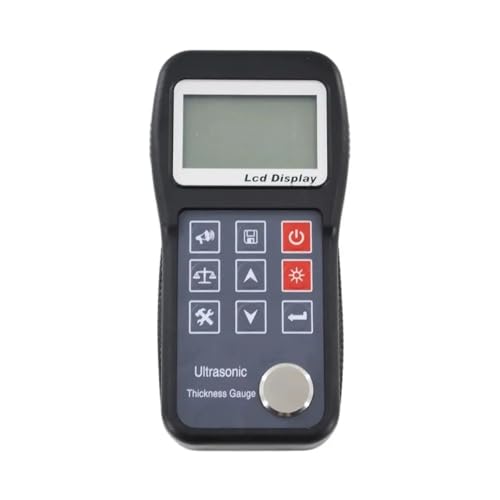
When you need to guarantee the integrity of pipes without causing any damage, the Ultrasonic Thickness Gauge NDT310 shines as an essential tool. It measures wall thickness from 0.75mm to 300.0mm with high precision, making it perfect for various industrial applications. You’ll appreciate its non-destructive testing capability, ensuring safety and reliability during inspections. With a clear LCD display and easy controls, even beginners can operate it effortlessly. Plus, its lightweight design makes it portable for on-site inspections across manufacturing, construction, and maintenance. Invest in the NDT310 for accurate assessments that keep your operations running smoothly.
Best For: The Ultrasonic Thickness Gauge NDT310 is best for professionals in manufacturing, construction, and maintenance who require reliable pipe wall thickness measurements without damaging the materials.
Pros:
- High precision measurement range from 0.75mm to 300.0mm.
- Non-destructive testing ensures safety and integrity during inspections.
- Lightweight and portable design for easy on-site use.
Cons:
- May require calibration for optimal accuracy over time.
- Limited to measuring thickness; does not provide information on other pipe conditions.
- Initial learning curve for complete beginners despite simple controls.
Ultrasonic Thickness Gauge NDT310 Pipe Wall Thickness Tester
The Ultrasonic Thickness Gauge NDT310 Pipe Wall Thickness Tester stands out for its ability to measure pipe wall thickness with remarkable accuracy, making it an essential tool for professionals in manufacturing, construction, and maintenance. You’ll appreciate its non-destructive testing capability, allowing you to assess pipe integrity without causing any damage. The user-friendly interface, complete with a clear LCD display and simple controls, makes it easy for anyone to operate, even beginners. Plus, its lightweight design guarantees portability for on-site inspections. With a measurement range from 0.75mm to 300.0mm, it’s versatile for various materials and tough environments.
Best For: Professionals in manufacturing, construction, and maintenance who require accurate and non-destructive pipe wall thickness measurements.
Pros:
- High precision measurement capabilities for various industrial applications.
- User-friendly interface with a clear LCD display, suitable for beginners.
- Lightweight and portable design ideal for on-site inspections and tough environments.
Cons:
- Limited to a specific measurement range of 0.75mm to 300.0mm.
- May require calibration for optimal accuracy over time.
- Non-destructive testing may not be suitable for all types of material assessments.
Factors to Consider When Choosing a Led Wall Calibration System
When choosing an LED wall calibration system, you need to take into account several key factors. Image quality precision and signal stability requirements are essential for ideal performance. Additionally, monitoring features, compatibility with your modules, and overall reliability will impact your system’s effectiveness.
Image Quality Precision
Choosing an LED wall calibration system hinges on image quality precision, which plays an essential role in achieving pixel-level brightness and color accuracy. Look for systems that support advanced features like 16-bit grayscale compensation and per-pixel calibration, as these can greatly enhance image quality and contrast. Monitoring real-time temperature and voltage conditions is another important factor; it helps maintain ideal performance and prevents degradation due to environmental factors. High refresh rates, such as 240Hz, are critical for smooth motion and reducing flicker, especially with dynamic content. Additionally, calibration systems that allow for pre-stored image settings can greatly streamline achieving precise image quality quickly and efficiently during setup and maintenance.
Signal Stability Requirements
Signal stability is key to achieving consistent color and brightness across your LED panels, as even minor fluctuations can lead to noticeable visual discrepancies. When choosing a calibration system, consider advanced error correction features like loop backup and dual program storage; these enhance signal stability and provide redundancy during transmission faults. Additionally, the receiving cards you select must support reliable data transmission protocols such as HUB75E or HUB 26 to guarantee effective communication between the controller and LED modules. Don’t overlook environmental factors, like electromagnetic interference (EMI), which can impact signal stability—aim for systems compliant with EMC standards (Class A or B). Your final choice should prioritize these elements to maximize performance and reliability in your LED display systems.
Monitoring Features Importance
While you might focus on visual quality and calibration accuracy, monitoring features play an essential role in ensuring your LED wall operates at peak performance. These features provide real-time oversight of significant parameters like temperature, power supply voltage, and data transmission quality. Advanced systems often store image settings for quick recovery from signal loss, boosting operational efficiency. By monitoring temperature and voltage, you can detect potential issues early, reducing downtime and maintaining consistent visuals in demanding environments. Continuous monitoring capabilities offer valuable diagnostics that enhance system reliability. Furthermore, effective monitoring can integrate redundancy measures, such as dual backups, minimizing the risk of failure during critical operations and ensuring uninterrupted service. Don’t overlook these fundamental features when choosing your calibration system.
Compatibility With Modules
When selecting a LED wall calibration system, compatibility with your modules is essential for achieving ideal performance. First, verify the system supports your LED modules’ specific pixel resolution and refresh rate; this can greatly impact image quality. Next, check if it handles the required color depth—like 8-bit or 10-bit—for accurate color reproduction. You’ll also want to confirm that the system can connect using the type of data transmission your modules require, such as HUB connectors, for seamless communication. Additionally, evaluate if the calibration system accommodates the size and layout of your modules to fit your display setup. Finally, investigate whether the calibration software is compatible with the operating systems your modules use for peak functionality.
Redundancy and Reliability
After ensuring compatibility with your LED modules, consider the importance of redundancy and reliability in a calibration system. Look for features like dual receiving card hot backup, which guarantees continuous operation during transmission faults or firmware updates, minimizing downtime. Ethernet loop redundancy is essential too, as it prevents signal loss and maintains data integrity across multiple panels. Advanced monitoring capabilities, such as real-time temperature and power supply voltage tracking, allow for proactive maintenance, reducing the risk of failures. Implementing pre-stored image settings for startup and no-signal scenarios can streamline maintenance, ensuring seamless visual output. Finally, prioritize systems designed for high-demand environments that comply with EMC standards to minimize electromagnetic interference, enhancing overall reliability.