
Choosing a computer for live streaming across multiple monitors means balancing processor performance, graphics output, memory, storage, and desk space. A capable system should handle broadcast software, chat, browser tabs, recording tools, and several displays without constant slowdowns.
We’ve rounded up 10 compact mini PCs, refurbished business desktops, and monitor bundles suited to different streaming setups and budgets. Use the guide below to match the hardware to your workflow.
Best 10 Live Streaming Computers for Multiple Monitors Picks for 2026
Powerhouse Workstation

- Core i9-13900HK and 32GB DDR5
- Three-display output with HDMI and USB4
- 10G networking, three SSD slots, and PCIe expansion
Best For: Professional multi-monitor workstations and fast network storage
Quad-Display Performer

- Ryzen 7 PRO 6850U with Radeon 680M graphics
- Simultaneous four-screen output
- OCuLink, dual 2.5G LAN, and expandable storage
Best For: Four-monitor productivity, gaming, and eGPU-ready setups
Office Multi-Monitor Value
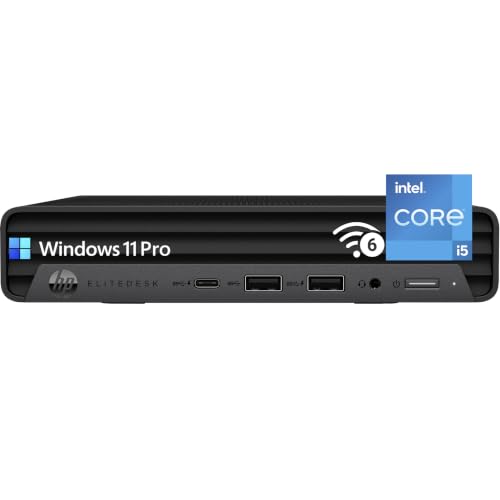
- Core i5, 32GB RAM, and 1TB NVMe SSD
- Dual 4K display support with third-display option
- Compact business design with keyboard and mouse
Best For: Office workstations, trading, and compact productivity setups
Compact Triple-Screen Choice

- High-core-count Intel processor up to 4.9GHz
- Triple 4K display support at 60Hz
- Wi-Fi 6, Bluetooth 5.2, and dual M.2 slots
Best For: Compact triple-monitor offices, studios, and trading desks
Best High-Performance Pick

- Four-display 4K/8K output support
- 32GB DDR5 and Ryzen 7 processing
- AV1, AVC, and HEVC hardware support
Best For: Creators and streamers needing a compact, powerful multi-monitor setup
Best Complete Desk Setup
HP EliteDesk 800G4 with Dual Monitors

- Includes two 24-inch LCD monitors
- 16GB RAM and 1TB SSD
- Windows 11 Pro with peripherals
Best For: Home and office users wanting a ready-to-use dual-screen bundle
Best Budget Triple-Display Pick

- Supports three simultaneous displays
- 16GB RAM with a 1TB SSD
- 2.5GbE and dual M.2 storage slots
Best For: Budget users building a compact three-screen workstation
Best Value Workstation

- 32GB RAM and 1TB SSD
- HDMI plus DisplayPort for dual monitors
- Includes Windows 11 Pro and peripherals
Best For: Budget-conscious multitasking and dual-monitor workstations
Best Expandable Mini PC

- Supports up to three displays
- Ryzen 5 7640HS with Radeon 760M graphics
- Dual 2.5GbE LAN and upgradeable storage
Best For: Compact streaming and multitasking setups with expansion needs
Best Complete Dual-Monitor Bundle
Dell OptiPlex Tiny Dual-Monitor Bundle

- Includes two 27-inch curved monitors
- 32GB RAM and 1TB SSD
- Webcam, soundbar, keyboard, and mouse included
Best For: Ready-to-use dual-screen home and streaming workstations
Powerhouse Workstation – MINISFORUM MS-01-S139K
For live streaming computers for multiple monitors, the MINISFORUM MS-01-S139K stands out as a high-performance workstation with three simultaneous display outputs, fast networking, and substantial expansion potential. Its Core i9 processor and 32GB of DDR5 memory are well suited to demanding multitasking and professional workflows.
Best For: Securities trading, digital signage, CAD, video post-production, and users who need fast networking or expandable storage.
Pros:
- Core i9-13900HK with 14 cores, 20 threads, and boost speeds up to 5.4GHz.
- Supports three displays through HDMI and dual USB4 outputs, including high-resolution displays.
- Includes dual 10G SFP+ ports, dual 2.5G Ethernet, three SSD slots, and a PCIe x16 expansion slot.
Cons:
- Integrated graphics may not suit graphics-intensive gaming or rendering without a discrete card.
- Its advanced expansion and networking features may be more than basic office users need.
This is the strongest choice here for a multi-monitor workstation that also needs serious connectivity and upgrade flexibility. It is especially compelling for professional setups where storage, networking, and display expansion matter as much as raw processing power.
Quad-Display Performer – GMKtec M7 Ultra
The GMKtec M7 Ultra is a versatile option among live streaming computers for multiple monitors, combining four-screen support with an AMD Ryzen 7 PRO processor and Radeon 680M integrated graphics. Its compact design and OCuLink port also make it suitable for users who may add external graphics capability later.
Best For: Multi-monitor productivity, gaming, content creation, and users seeking OCuLink eGPU expansion.
Pros:
- Ryzen 7 PRO 6850U provides 8 cores, 16 threads, and speeds up to 4.7GHz.
- Supports simultaneous four-screen display with HDMI 2.1 and dual USB4 video outputs.
- Includes OCuLink, dual 2.5G Ethernet, Wi-Fi 6, and expandable RAM and SSD storage.
Cons:
- Ships with 16GB of RAM, less than some workstation-focused alternatives.
- Higher-end gaming or graphics workloads may benefit from an external GPU.
Choose this model when four displays are a priority and you want stronger graphics flexibility than a typical office mini PC provides. Its performance modes and cooling system give users useful control over noise and sustained workload behavior.
Office Multi-Monitor Value – HP EliteDesk 800 Mini
For buyers comparing live streaming computers for multiple monitors in an office or home workspace, the HP EliteDesk 800 Mini offers a practical business-focused configuration. It includes 32GB of RAM, a 1TB NVMe SSD, Windows 11 Pro, and support for up to three displays.
Best For: Business productivity, data analysis, trading, video conferencing, and compact desk setups.
Pros:
- Intel Core i5 processor and 32GB DDR4 RAM support everyday multitasking.
- Two DisplayPort outputs support dual 4K monitors, with USB-C DisplayPort Alt Mode for a third display.
- Compact 6.97-by-6.89-by-1.35-inch design includes Wi-Fi 6, Bluetooth, keyboard, and mouse.
Cons:
- Intel UHD Graphics 630 is intended for productivity rather than demanding graphics work.
- Gigabit Ethernet is slower than the 2.5G and 10G networking on some competing models.
This HP is a sensible plug-and-work choice for professional users who value a compact form factor and included peripherals. It delivers useful three-display flexibility without emphasizing gaming or specialized expansion features.
Compact Triple-Screen Choice – KAMRUI H2 Mini PC
The KAMRUI H2 is a compact and capable option for live streaming computers for multiple monitors, supporting a triple-monitor setup through HDMI 2.0, DisplayPort 1.4, and USB-C. Its high-core-count Intel processor and dual M.2 storage support make it useful for busy home offices, studios, and business systems.
Best For: Triple-monitor office work, trading, coding, digital signage, and compact studio setups.
Pros:
- Intel Core i5-14500HX configuration offers up to 14 cores, 20 threads, and speeds up to 4.9GHz.
- Supports three 4K displays at 60Hz through HDMI, DisplayPort, and USB-C.
- Includes Wi-Fi 6, Bluetooth 5.2, dual M.2 storage support, and a cooling system designed for sustained use.
Cons:
- Comes with 16GB of DDR4 RAM, which may be limiting for heavier professional workloads.
- Integrated graphics are better suited to display and productivity tasks than demanding gaming.
This model makes sense when desk space is limited but three displays are still important. It offers strong CPU-focused performance and useful storage expansion, making it a practical middle ground between basic office mini PCs and larger workstations.
Best High-Performance Pick – GMKtec Ryzen 7 H 255 Mini PC
For shoppers seeking live streaming computers for multiple monitors, this GMKtec mini PC is the most capable option in the group. Its Ryzen 7 H 255 processor, 32GB of DDR5 memory, Radeon 780M graphics, and support for up to four 4K/8K displays make it well suited to demanding multitasking, video editing, and multi-screen streaming setups.
Best For: Content creators, gamers, and streamers who need strong performance and four-display support in a compact computer.
Pros:
- Supports four simultaneous 4K/8K displays through HDMI 2.1, DisplayPort 1.4, and USB-C.
- Ryzen 7 H 255 and 32GB DDR5 provide substantial multitasking capability.
- Hardware encoding and decoding support includes AV1, AVC, and HEVC.
- Includes a 2.5GbE port, Wi-Fi 6E, Bluetooth 5.2, and an Oculink port for expansion.
Cons:
- Integrated Radeon 780M graphics are not equivalent to a dedicated gaming GPU.
- The mini PC is sold with the operating system listed as “OS,” so buyers should verify software details.
This is the strongest match for a multi-monitor streaming workstation when compact size, modern connectivity, and high memory capacity matter. Its triple M.2 expansion and Oculink support also leave room for future storage or graphics upgrades.
Best Complete Desk Setup – HP EliteDesk 800G4 with Dual Monitors
This renewed HP EliteDesk package offers a ready-made dual-screen workspace for shoppers comparing live streaming computers for multiple monitors. It combines an Intel Core i5-8500, 16GB of RAM, a 1TB SSD, Windows 11 Pro, and two included 24-inch LCD monitors with keyboard, mouse, and speakers.
Best For: Home offices, business users, and beginners who want a complete dual-monitor computer bundle.
Pros:
- Includes two 24-inch LCD monitors for an immediately expanded workspace.
- 16GB RAM and a 1TB SSD support everyday multitasking and quick application loading.
- Windows 11 Pro, Wi-Fi 6, Bluetooth, keyboard, mouse, and RGB speakers are included.
- Intel Core i5-8500 has six processing cores for routine productivity workloads.
Cons:
- Integrated Intel UHD Graphics 630 is better suited to productivity than demanding graphics work.
- The 30-day warranty is shorter than the warranty listed for the GMKtec systems.
- The package is limited to a dual-monitor configuration.
Rather than focusing on maximum streaming performance, this HP bundle emphasizes convenience and value. It is a practical choice for office-style streaming, monitoring, and multitasking where the included displays are more important than advanced graphics capability.
Best Budget Triple-Display Pick – GMKtec G10 Ryzen 5 Mini PC
The GMKtec G10 is a compact, lower-cost option for shoppers looking at live streaming computers for multiple monitors. Its Ryzen 5 3500U processor, 16GB of DDR4 RAM, 1TB SSD, and Radeon Vega 8 graphics can drive three displays while handling everyday work, media playback, video editing, and light gaming.
Best For: Budget-conscious users who need three-screen productivity and basic multimedia performance.
Pros:
- Supports three simultaneous displays through HDMI, DisplayPort, and full-function USB-C.
- 16GB RAM and a 1TB SSD provide a useful starting configuration.
- Dual M.2 slots allow storage expansion up to a stated 16TB maximum.
- Includes 2.5GbE networking, Wi-Fi 5, Bluetooth 5.0, and dual cooling fans.
Cons:
- Ryzen 5 3500U and Radeon Vega 8 are older and less capable than the Ryzen 7/Radeon 780M combination in the other GMKtec model.
- It supports three displays rather than four.
- Wi-Fi 5 is an older wireless standard than Wi-Fi 6E.
The G10 makes sense when three monitors are enough and the priority is a small, affordable computer for everyday streaming-related multitasking. It offers useful expansion and networking features, but demanding creators should consider a newer processor with stronger graphics.
Best Value Workstation – Dell OptiPlex 7050 SFF
For shoppers comparing live streaming computers for multiple monitors, this renewed Dell OptiPlex 7050 offers a practical desktop foundation with an Intel Core i7 processor, 32GB of RAM, and HDMI plus DisplayPort connectivity. Its compact small-form-factor design fits neatly into many workspaces.
Best For: Budget-conscious streamers, office users, and multitaskers who need a capable dual-monitor setup.
Pros:
- 32GB DDR4 RAM and a 1TB SSD support responsive multitasking and fast boot times.
- HDMI and DisplayPort outputs support a dual-monitor setup.
- Windows 11 Pro, Wi-Fi, Bluetooth, keyboard, and mouse are included.
- Professionally renewed and covered by a 90-day seller warranty.
Cons:
- Integrated Intel UHD Graphics 630 is not intended for demanding modern gaming.
- The older four-core i7-7700 platform may be less suitable for intensive video production.
- Its SFF chassis may limit upgrade flexibility compared with a full-size tower.
This Dell is a sensible choice when reliable everyday performance and multiple display connections matter more than new-generation processing power or dedicated graphics.
Best Expandable Mini PC – GMKtec M6 Ultra
The GMKtec M6 Ultra is a compact option among live streaming computers for multiple monitors, pairing a six-core Ryzen 5 7640HS with Radeon 760M graphics and support for up to three displays. Its modern connectivity and upgrade potential suit compact desk setups.
Best For: Streamers, home-office users, and creators who want a small system with flexible display and storage expansion.
Pros:
- Ryzen 5 7640HS provides six cores, 12 threads, and speeds up to 5.0GHz.
- HDMI, DisplayPort, and USB4 support up to three displays, with USB4 rated for 8K at 60Hz.
- Dual 2.5GbE LAN ports, Wi-Fi 6E, and Bluetooth 5.2 offer versatile connectivity.
- Dual SO-DIMM and dual M.2 slots allow substantial RAM and storage expansion.
Cons:
- It includes 16GB of RAM, which may be limiting for especially demanding streaming workflows.
- Radeon 760M integrated graphics are better suited to casual 1080p gaming than high-end gaming.
- The listing identifies the operating system as “OS” without specifying a Windows edition.
Choose this mini PC if display flexibility, fast networking, and future upgrades are priorities. Confirm the operating-system details before purchase if a ready-to-use Windows installation is essential.
Best Complete Dual-Monitor Bundle – Dell OptiPlex Tiny Dual-Monitor Bundle
This Dell OptiPlex bundle simplifies the search for live streaming computers for multiple monitors by including the mini desktop, two 27-inch curved monitors, and a selection of peripherals. With 32GB of RAM and a 1TB SSD, it is designed as a ready-made workstation rather than a bare PC.
Best For: Buyers who want a complete dual-monitor workspace for streaming, communication, productivity, and entertainment.
Pros:
- Includes two 27-inch curved monitors with up to 2560×1440 resolution.
- 32GB DDR4 RAM and a 1TB SSD support everyday multitasking and quick startup.
- Bundle includes an AI-enabled RGB keyboard, mouse, soundbar, and webcam.
- Windows 11 Pro and HDMI or DisplayPort output are listed.
Cons:
- The Intel Core i5 and integrated graphics are aimed at everyday use rather than demanding gaming.
- It is a renewed system, so condition and included components should be checked carefully.
- The compact design and 32GB maximum listed memory may limit future expansion.
This package is appealing for shoppers who value convenience and a coordinated two-screen setup. Its included monitors and accessories can reduce the effort of assembling a complete streaming workstation separately.
How We Picked the Best Live Streaming Computers for Multiple Monitors
We focused on systems with enough processing headroom for streaming software, multitasking, and display management. The lineup includes modern Intel and AMD mini PCs, refurbished business-class desktops, and complete packages with monitors or accessories. We compared processor generation, core and thread count, RAM, SSD capacity, integrated graphics, stated display support, connectivity, operating system, and upgrade potential.
Because streaming workloads vary, no single computer is ideal for every buyer. A creator running OBS, a camera feed, chat, and multiple browser windows may need more CPU and memory than someone using a computer mainly for presentation, monitoring, and light streaming.
Quick Comparison
- Highest performance potential: The MINISFORUM MS-01-S139K and newer high-wattage Intel or AMD mini PCs are suited to demanding multitasking.
- Best compact workstation approach: The MS-01-S139K combines a powerful mobile processor with multiple high-speed ports and networking options.
- Best business desktop value: HP EliteDesk and Dell OptiPlex systems offer practical ports, Windows Pro editions, and familiar serviceability.
- Best ready-made setup: The EliteDesk and OptiPlex bundles that include monitors reduce the effort required to build a multi-screen station.
- Best for lighter workloads: Entry-level GMKtec and older refurbished systems can work well for basic streaming, office apps, and monitoring.
Key Buying Factors for Live Streaming Computers for Multiple Monitors
Processor and Multitasking Capacity
Look for at least a modern quad-core processor; six or more cores are preferable when streaming, recording, encoding, and browsing simultaneously. Newer Ryzen 7 and Core i7-class chips generally provide more headroom than older office CPUs, although real-world cooling and power limits also matter.
Memory and Storage
Choose 16GB of RAM as a practical minimum and 32GB for heavier OBS scenes, multiple browser tabs, editing, or virtual production tools. A 1TB SSD provides useful room for applications and recordings while keeping startup and file access responsive.
Display Outputs and Graphics
Check the exact port combination rather than relying only on a listing’s “dual” or “triple display” wording. Confirm whether your monitors use HDMI, DisplayPort, USB4, or adapters, and verify the supported resolution and refresh rate. Integrated graphics are often sufficient for dashboards and standard video, but demanding games or effects may require a discrete GPU.
Connectivity, Cooling, and Expansion
Fast Ethernet, Wi-Fi, Bluetooth, USB ports, and reliable cooling are valuable for cameras, microphones, capture devices, and network streaming. Mini PCs save space but may offer less upgrade flexibility than small-form-factor desktops. Refurbished business systems can be easier to service, but inspect warranty coverage and condition.
Who Should Buy Which Live Streaming Computers for Multiple Monitors?
Choose a high-performance mini PC if you stream frequently, operate several displays, record locally, or run demanding creative software. Choose a refurbished HP or Dell desktop if affordability, straightforward Windows use, and conventional ports matter most. Choose a monitor bundle if you need a complete workstation quickly and want to avoid matching screens, cables, and accessories yourself. Choose an entry-level mini PC for light streaming, chat moderation, presentations, and general productivity, provided its output ports meet your monitor requirements.