
When it comes to capturing smooth, professional-quality footage, the right motorized gimbal can make all the difference. You need a tool that can handle heavy cameras and provide stability in various shooting conditions. With so many options available, it’s crucial to know which gimbals stand out. Let’s explore the top choices that can elevate your filmmaking game and guarantee your shots are nothing short of exceptional.
TigerTilt Motorized 360° Pan and Tilt Gimbal Head for Tripods

If you’re a videographer or photographer looking to elevate your shooting game, the TigerTilt Motorized 360° Pan and Tilt Gimbal Head is an excellent choice. This affordable, remote-controlled gimbal head supports cameras up to 8 lbs, making it versatile for various setups like tripods, cranes, and jibs. You’ll appreciate the 360º pans and tilts, all controlled by a variable-speed joystick with a 10 ft cable. Plus, it’s fully portable, running on a BP915 battery or AC adapter. Weighing just 3 pounds, it’s easy to transport. With a 4.7-star rating, it’s a top pick for enhancing your video production.
Best For: Videographers and photographers seeking a portable and affordable motorized pan and tilt solution for their camera setups.
Pros:
- Supports up to 8 lbs, making it versatile for various camera types and setups.
- Remote-controlled operation with a variable-speed joystick for precise movements.
- Lightweight design at just 3 pounds, enhancing portability for on-the-go shooting.
Cons:
- Limited battery life when using the BP915 battery compared to continuous AC power.
- 10 ft cable may restrict movement in larger setups or studio environments.
- May require additional accessories like an off-camera microphone for optimal video production results.
GVM Motorized Camera Slider

The GVM Motorized Camera Slider shines for filmmakers and content creators seeking smooth, professional-quality shots without breaking the bank. Weighing only 8.8 pounds and made from sturdy carbon fiber, it’s both lightweight and stable. You can choose from six shooting modes, including time lapse and panoramic shooting, while the app control makes setting points effortless. With multiple screw ports, it easily mounts on various tripods. However, be aware that it requires a manual setup for starting and ending points. Overall, it offers a budget-friendly option that enhances your creative capabilities with smooth, consistent movements for any project.
Best For: Filmmakers and content creators looking for an affordable solution for smooth, professional-quality camera movements.
Pros:
- Lightweight and sturdy carbon fiber construction ensures portability and stability.
- Offers six versatile shooting modes, including time lapse and panoramic options.
- Easy app control simplifies setting points and managing camera movements.
Cons:
- Requires manual setup for starting and ending points, which can be cumbersome.
- App connectivity issues may arise, impacting usability.
- Lightweight design may lead to instability when using heavier cameras.
FeiyuTech SCORP-C2 Gimbal Stabilizer for DSLR and Mirrorless Cameras

For photographers and videographers seeking stability and precision, the FeiyuTech SCORP-C2 Gimbal Stabilizer stands out as an exceptional choice. With a payload capacity of 3.5kg, it supports popular brands like Canon and Sony effortlessly. Its built-in AI tracking 4.0 offers gesture recognition, allowing you to capture dynamic shots without extra apps. The open mounting platform guarantees flexible camera positioning, while the ergonomic grip enables comfortable control. Plus, the OLED display provides real-time status updates and easy parameter adjustments. Experience reliable performance and seamless shifts between horizontal and vertical shooting with the SCORP-C2—your go-to stabilizer for stunning footage.
Best For: Photographers and videographers looking for a reliable and user-friendly gimbal stabilizer to enhance their shooting experience with DSLR and mirrorless cameras.
Pros:
- Built-in AI tracking 4.0 with gesture recognition for easy dynamic shot capturing.
- Open mounting platform allows for flexible camera positioning and versatility.
- Ergonomic grip and intuitive controls enhance comfort and ease of use during extended shoots.
Cons:
- Payload capacity may be limiting for heavier camera setups or additional accessories.
- Some users may find the learning curve challenging despite intuitive controls.
- The built-in OLED display may not be as visible in bright outdoor conditions.
DJI RS 3 Mini 3-Axis Gimbal Stabilizer for Cameras
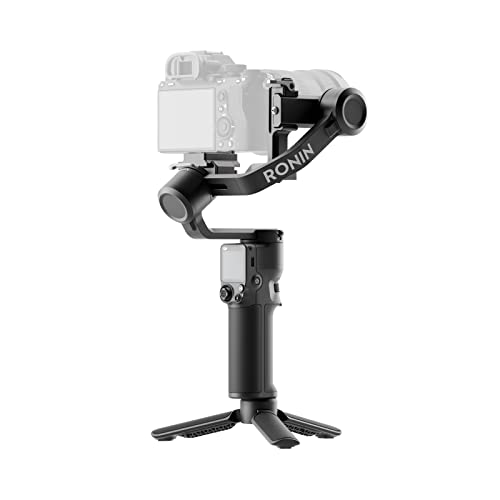
Lightweight and portable, the DJI RS 3 Mini 3-Axis Gimbal Stabilizer is perfect for travel enthusiasts and content creators who need a reliable tool for capturing smooth footage on the go. Weighing just 795g, it supports up to 2 kg of payload, making it versatile for various camera setups like Canon, Sony, and Nikon. With Bluetooth shutter control and a 3rd-Gen stabilization algorithm, you’ll enjoy professional-quality shots effortlessly. Plus, its native vertical shooting option makes social media content a breeze. While some users reported motor issues, overall, it’s an excellent choice for casual videography and travel photography.
Best For: Casual videographers and travel enthusiasts looking for a lightweight and portable gimbal stabilizer to capture smooth footage.
Pros:
- Lightweight and portable design makes it easy to carry during travel.
- Wide compatibility with various camera brands including Canon, Sony, and Nikon.
- Bluetooth shutter control allows for easy photo capture and video recording.
Cons:
- Some users reported issues with the roll motor after limited use.
- Battery life may fall short for extended events or heavy usage.
- Limited payload capacity compared to other models, which may not support heavier camera setups.
Zhiyun Weebill S 3-Axis Gimbal Stabilizer for Cameras
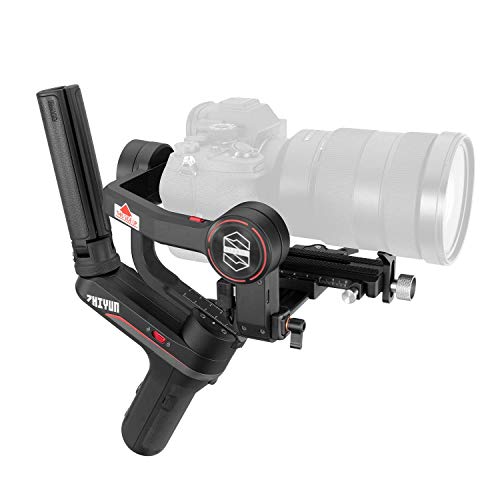
With its impressive 14-hour battery life and compatibility with a wide range of mirrorless and DSLR cameras, the Zhiyun Weebill S 3-Axis Gimbal Stabilizer is a game-changer for videographers. It works seamlessly with popular models from Sony, Canon, Nikon, and more. You’ll appreciate the smooth stabilization thanks to the 8th Instune algorithm, which minimizes jitter during fast movements. Though the setup might be tricky initially, the app connectivity allows for advanced features like timelapse settings. While some users note a few design quirks, overall, it’s a reliable tool for capturing stunning, professional-quality footage in various environments.
Best For: Videographers seeking a reliable and versatile stabilizer for various mirrorless and DSLR camera setups, particularly in real estate and event shooting.
Pros:
- Excellent customer service
- Smooth stabilization and wide variety of gimbal modes
- Lightweight and sturdy design
Cons:
- Awkward button layout
- Small LCD screen
- Mobile app inconsistencies (ongoing updates noted)
Soonpho M4 Motorized Rotating Tripod Head

The Soonpho M4 Motorized Rotating Tripod Head is an excellent choice for photographers and videographers seeking seamless panoramic shots, thanks to its impressive 360° horizontal rotation and ±35° tilt adjustments. With its remote control and eight adjustable rotation speeds, you can effortlessly create stunning panoramic videos. The user-friendly control panel features a clear display, allowing precise adjustments. It accommodates DSLR cameras, camcorders, and smartphones, ensuring versatility. Plus, the built-in rechargeable battery lasts 8-10 hours, making it perfect for extended shoots. While some users reported issues with precision and customer service, its overall performance earns a solid 4.1-star rating.
Best For: The Soonpho M4 Motorized Rotating Tripod Head is best for photographers and videographers looking to capture high-quality panoramic shots with ease and precision.
Pros:
- Versatile Compatibility: Works with DSLR cameras, camcorders, smartphones, and various tripods.
- User-Friendly Controls: Features an intuitive control panel with a clear display for easy adjustments.
- Extended Battery Life: Built-in rechargeable battery offers 8-10 hours of continuous operation.
Cons:
- Precision Issues: Some users have reported concerns regarding the accuracy of the movements.
- Customer Service Challenges: There are experiences reported with defective units and unsatisfactory customer service.
- Remote Control Orientation: Users have mentioned difficulties with the orientation of the remote control buttons.
DJI Osmo Mobile 7P Gimbal Stabilizer for iPhone and Android

Designed specifically for smartphone users, the DJI Osmo Mobile 7P Gimbal Stabilizer is perfect for anyone looking to elevate their mobile videography. With its robust 3-axis stabilization, you’ll enjoy lossless stability and sharp focus, even during fast-paced action. The dual-lens technology allows you to track subjects effortlessly. You can quickly power it on by unfolding and mount your smartphone magnetically. The DJI Mimo app activates automatically for instant filming, while the built-in extension rod and tripod make wide selfies and steady vlogs a breeze. Plus, with a 10-hour battery life, you can shoot without interruptions.
Best For: Mobile videographers and content creators seeking high-quality stabilization and tracking for their smartphone videos.
Pros:
- Robust 3-axis stabilization delivers lossless stability for smooth footage.
- Automatic activation of DJI Mimo app allows for instant filming and creative features.
- Built-in extension rod and tripod enhance versatility for selfies and vlogs.
Cons:
- Limited to smartphone compatibility, which may not appeal to users with dedicated cameras.
- 10-hour battery life might not be sufficient for all-day shooting sessions.
- Dual-lens technology may require a learning curve for optimal tracking results.
NEEWER Gimbal Tripod Head for DSLR Camera
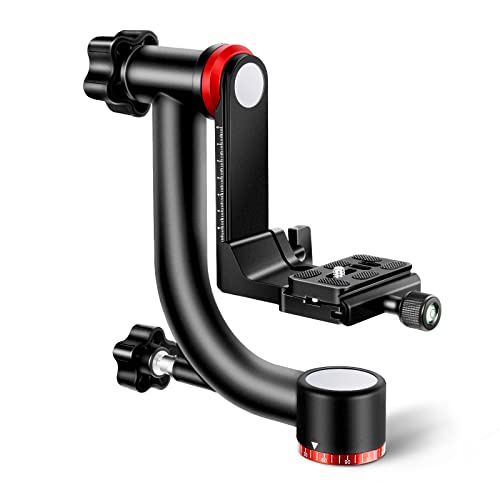
For photographers seeking a reliable solution to stabilize their heavy DSLR cameras, the NEEWER GM101 Gimbal Tripod Head stands out with its robust aluminum alloy construction, supporting weights up to 30 pounds. Its exceptional stability guarantees no wobble, even with heavy telephoto lenses. The smooth camera movement allows precise adjustments, making it perfect for both amateur and professional photographers. With a 360° panning base and Arca type quick release plate, setup is quick and easy. While some users note its weight for backcountry photography, most agree it excels in wildlife and sports photography, delivering sharp images of fast-moving subjects.
Best For: Photographers looking for a stable and reliable gimbal tripod head to support heavy DSLR cameras during wildlife and sports photography.
Pros:
- Exceptional stability for heavy telephoto lenses, ensuring no wobble during use.
- Smooth camera movement allows for precise adjustments in both vertical and horizontal directions.
- Quick setup with an Arca type quick release plate, making it user-friendly for photographers of all skill levels.
Cons:
- Weight may be a concern for backcountry photography, making it less portable.
- Some users suggest that a longer Arca Swiss plate could improve weight distribution.
- While it performs well overall, it may not meet the expectations of those seeking a lighter alternative for travel.
FeiyuTech SCORP 2 Gimbal Stabilizer for DSLR and Mirrorless Cameras

Offering a robust payload capacity of 2.5kg, the FeiyuTech SCORP 2 Gimbal Stabilizer is an ideal choice for videographers using DSLR and mirrorless cameras. Weighing just 2.36 pounds, it’s easy to handle, and the secondary grip enhances stability during shoots. The integrated AI tracking module guarantees smooth subject tracking, while the 1.3-inch touchscreen provides quick access to settings. With fast vertical filming capabilities and customizable shooting modes, you’ll have the flexibility to capture dynamic shots. Users appreciate its high build quality and intuitive controls, making the SCORP 2 a reliable companion for your film projects.
Best For: The FeiyuTech SCORP 2 Gimbal Stabilizer is best for videographers seeking a lightweight, easy-to-use stabilizer for DSLR and mirrorless cameras that offers advanced tracking and customizable settings.
Pros:
- Integrated AI tracking module allows for seamless subject tracking without additional accessories.
- Lightweight design (2.36 pounds) enhances portability and ease of handling during shoots.
- Customizable shooting modes provide flexibility for capturing a variety of dynamic shots.
Cons:
- Limited payload capacity of 2.5kg may not support heavier camera setups.
- Battery life varies depending on payload, which could affect prolonged shooting sessions.
- Touchscreen size (1.3 inches) may be small for some users when adjusting settings on the go.
FeiyuTech SCORP-C Gimbal Stabilizer for DSLR & Mirrorless Cameras

The FeiyuTech SCORP-C Gimbal Stabilizer is an exceptional choice for videographers using heavy DSLR and mirrorless cameras, boasting a maximum payload of 5.5 lbs. It’s compatible with popular models like Sony a7IV, Canon R5, and more. With a runtime of 13 hours, you can shoot all day without worry. The integrated handle grip design and multi-functional knob ring make it easy to control focus and gimbal axes. This stability enhances your filming quality, making it perfect for various shooting scenes. Upgrade from the AK2000C and enjoy broader compatibility with your favorite camera gear.
Best For: Videographers and content creators using DSLR and mirrorless cameras looking for a reliable stabilizer to enhance filming quality.
Pros:
- High payload capacity: Supports cameras up to 5.5 lbs, accommodating a wide range of models.
- Long battery life: Offers a runtime of 13 hours, perfect for extended shooting sessions.
- User-friendly design: Features an integrated handle grip and multi-functional knob for easy control of focus and gimbal axes.
Cons:
- Limited underslung grip options: Does not include an underslung handle grip as an accessory.
- Compatibility check needed: Users must verify the compatibility of their specific camera model.
- Weight: May be heavier compared to some smaller gimbals, which could affect portability.
Factors to Consider When Choosing a Motorized Gimbal for Heavy Cameras
When choosing a motorized gimbal for your heavy camera, you need to take into account several key factors. Start by looking at the payload capacity to guarantee it can support your gear, and check the stabilization technology for smooth shots. Don’t forget to evaluate compatibility with your camera model, battery life, and overall build quality for durability.
Payload Capacity Requirements
Choosing the right motorized gimbal for heavy cameras hinges on understanding its payload capacity. Make certain the gimbal you select can handle the weight of your camera and lens, plus any additional accessories like microphones or lights. Look for a gimbal that exceeds your total setup weight to guarantee excellent stability and performance. Payload capacities can vary widely, from 2.5 kg (5.5 lbs) to 13.6 kg (30 lbs) for professional setups. Also, consider the gimbal’s design and materials, as these affect its ability to support maximum weight without losing stability. Regularly exceeding the specified payload can cause performance issues and potentially damage your gimbal, so choose wisely to protect your investment.
Stabilization Technology Features
Understanding payload capacity is just the beginning; the stabilization technology features of a motorized gimbal play a pivotal role in the quality of your footage. Look for gimbals with high-torque motors, as they provide reliable stabilization for heavier setups, minimizing jitter during motion. Models with 3-axis stabilization guarantee smooth control over pitch, roll, and yaw, even during dynamic movements. Advanced features like AI tracking and gesture recognition enhance usability, allowing hands-free operation while keeping focus on moving subjects. Consider gimbals with longer battery life to maintain consistent stabilization during extended shoots. Finally, integrated app connectivity can offer customizable shooting modes and remote operation, enhancing your overall stabilization experience and making your shooting process seamless.
Compatibility With Camera Models
Selecting the right motorized gimbal for heavy cameras hinges on compatibility with your specific camera model. You’ll want to check that the gimbal can support the weight and dimensions of your camera and lens combination. Many gimbals list payload capacities; for example, some handle up to 8 lbs, while others accommodate heavier setups, so make sure your camera fits within that range. It’s also crucial to take into account mounting options, like quick release plates and screw ports designed for DSLR and mirrorless cameras. Some gimbals provide features like native vertical shooting and AI tracking that may perform better with specific brands. Always refer to the manufacturer’s compatibility list to avoid issues and guarantee ideal stabilization during your shoots.
Battery Life and Power
Once you’ve confirmed your gimbal is compatible with your camera model, battery life and power come into play. You’ll want to evaluate gimbals that offer operating times between 8 to 13 hours, depending on how you use them. Look for models featuring rechargeable lithium-ion batteries, as these provide longer usage without constant replacements. Quick charging via USB-C can be a game-changer, allowing you to recharge between shoots swiftly. Additionally, check the power management features—some gimbals can even extend your smartphone’s battery life when used as a microphone receiver. Make sure the gimbal’s battery capacity suits your shooting needs, especially for longer sessions, to avoid interruptions during those critical moments.
Build Quality and Durability
When you’re investing in a motorized gimbal for heavy cameras, the build quality and durability are essential factors that can greatly affect your shooting experience. Look for materials like aluminum alloy or carbon fiber, as they enhance stability and withstand wear. Verify the gimbal has a weight capacity that accommodates your camera and any additional accessories; exceeding this limit can lead to performance issues. Robust construction with integrated load-bearing structures prevents wobbling, especially with heavy lenses. You’ll also want a design that includes weather-sealing to protect against environmental factors during outdoor shoots. Finally, check user reviews for insights on durability, as models that consistently receive praise for their reliability over time are often the best choice.
Ease of Use
Finding the right motorized gimbal for heavy cameras can be much simpler if you prioritize ease of use. Look for intuitive controls, like touchscreens or well-arranged buttons, that let you make quick adjustments without fumbling. Ergonomic designs are essential too; they guarantee comfortable handling during long shoots, especially with heavier setups. Quick installation systems are a must, allowing you to switch shooting modes effortlessly. User-friendly apps can enhance functionality, giving you remote control and various shooting modes without complex procedures. Finally, choose gimbals with clear instructions and online resources to help you set up and operate smoothly, making your learning curve much easier as you engage with your next project.
Portability and Weight
Choosing the right motorized gimbal for heavy cameras often hinges on portability and weight. You’ll want to take into account the gimbal’s own weight; lighter models can enhance portability but might lack the stability needed for heavier setups. Opt for carbon fiber gimbals, as they strike a good balance between being lightweight and durable. Don’t forget to check the gimbal’s dimensions when folded—compact sizes make transport and storage easier. Make certain the gimbal’s weight capacity matches your camera and lens setup to avoid overloading. Finally, look for features like adjustable legs or carrying cases to boost portability and convenience during your shoots. With these considerations, you can find a gimbal that fits your needs perfectly.