
As you explore the best NDI streaming hardware options for seamless broadcasts in 2026, you’ll find a range of choices designed to enhance your streaming experience. From versatile PTZ cameras to efficient encoders, each option brings unique features to the table. You’ll want to contemplate what fits your specific needs and goals. Let’s take a closer look at these standout devices and see how they can elevate your broadcasts.
AVKANS 30X NDI PTZ Camera Kits for Live Streaming Video Production
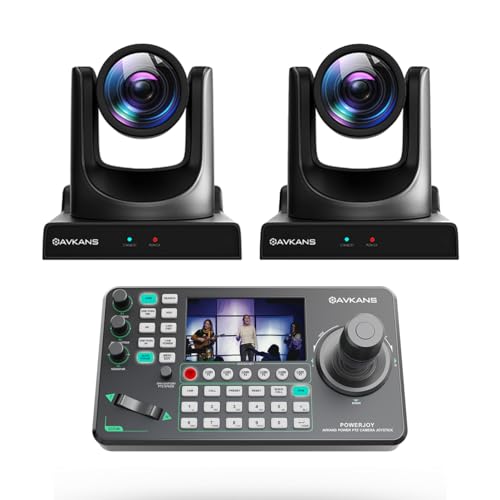
If you’re looking for a complete solution for live streaming video production, the AVKANS 30X NDI PTZ Camera Kit is an excellent choice, especially for churches and event organizers. This kit includes two high-quality AV-CM30-NDI cameras and an AV-JOY-IP joystick controller. With 1080P resolution at 60fps and advanced noise reduction, you’ll capture clear, vibrant images even in low light. The cameras offer multiple output options—3G-SDI, IP, and HDMI—ensuring versatile streaming capabilities. Plus, the included joystick controller allows for seamless integration and control. Stream effortlessly to platforms like YouTube and Facebook with this all-in-one solution.
Best For: Churches and event organizers seeking a high-quality, complete solution for live streaming video production.
Pros:
- Supports multiple output options (3G-SDI, IP, HDMI) for versatile streaming capabilities.
- Delivers 1080P resolution at 60fps with advanced noise reduction for clear images even in low light.
- Includes an easy-to-use joystick controller for seamless camera control and integration.
Cons:
- The Live Multicam App is only available for iOS devices, limiting compatibility for some users.
- The kit may be considered expensive for smaller organizations or individual users.
- Requires a stable internet connection to fully utilize advanced streaming features like SRT technology.
Chameye NDI PTZ Camera with 20x Optical Zoom (C720N)

The Chameye NDI PTZ Camera with 20x Optical Zoom (C720N) stands out as an exceptional choice for live streaming professionals seeking superior video quality and advanced tracking capabilities. With its 1/2.8 CMOS sensor, you can enjoy stunning 1080p@60fps video. The AI auto-tracking technology allows for precise face and body tracking, ensuring you stay in focus. Plus, you’ll appreciate the multiple connectivity options, including NDI, 3G-SDI, HDMI, and USB. Installation is hassle-free, with a user-friendly interface and remote control. Backed by a 30-day guarantee and lifetime support, this camera is ideal for various applications, from corporate meetings to esports events.
Best For: Live streaming professionals and organizations looking for a high-quality camera with advanced tracking features and versatile connectivity options.
Pros:
- High-quality video output with 1080p@60fps thanks to the 1/2.8 CMOS sensor.
- Advanced AI auto-tracking technology for precise face and body recognition.
- Multiple connectivity options including NDI, 3G-SDI, HDMI, and USB for flexible streaming setups.
Cons:
- Initial setup may require technical knowledge to configure correctly.
- Higher price point compared to basic streaming cameras.
- Limited zoom capability compared to some higher-end models with greater optical zoom.
Chameye NDI PTZ Camera Bundle (PTZ Bundle C730Nx2+E300)

For those seeking a versatile solution for live streaming in diverse environments, the Chameye NDI PTZ Camera Bundle (PTZ Bundle C730Nx2+E300) stands out with its advanced AI Auto Tracking feature. This bundle includes two C730N cameras and an E300 controller, delivering 1080p resolution at 60fps and 30x optical zoom. You’ll enjoy seamless integration with NDI HX3 technology, ensuring low-latency video transport. With multiple output options and customizable tracking modes, you can tailor the experience to your needs. Plus, the easy setup and robust support make this bundle a reliable choice for any broadcasting scenario.
Best For: Those looking for a high-quality, versatile PTZ camera solution for live streaming in various professional settings such as churches, schools, and events.
Pros:
- Advanced AI Auto Tracking feature for dynamic and engaging video capture.
- Multiple output options (NDI, 3G-SDI, HDMI, USB3.0) for versatile connectivity.
- Easy setup with DHCP support and a user-friendly LCD display for status monitoring.
Cons:
- Higher initial investment compared to standard PTZ cameras.
- Limited to environments with adequate network infrastructure for optimal performance.
- May require additional training or experience to fully utilize all advanced features.
BG-Stream-NE Encoder for HDMI to IP/UVC Streaming
Streamlining your video production has never been easier with the BG-Stream-NE Encoder, designed specifically for those who demand high-quality HDMI to IP/UVC streaming. This compact device supports Full HD 1080p60 video, ensuring smooth playback at 60 frames per second. With H.264 and H.265 codecs, you’ll enjoy efficient video compression while the AAC-LC audio codec guarantees exceptional sound quality. It easily converts HDMI input to network streams or USB UVC output, and its Power over Ethernet feature simplifies installation. Plus, the intuitive web UI and broad protocol support make setup a breeze, future-proofing your streaming experience.
Best For: Content creators and live streamers looking for a reliable and high-quality HDMI to IP/UVC streaming solution.
Pros:
- Full HD 1080p60 support ensures smooth and high-definition video streaming.
- Power over Ethernet (PoE) simplifies installation with a single cable for power and data.
- Intuitive web UI allows for easy setup and configuration without technical hassles.
Cons:
- Compact design may limit connectivity options for users needing multiple inputs.
- Initial setup might require some technical knowledge for optimal configuration.
- Future upgrade for NDI HX3 support may incur additional costs.
ZowiePTZ 4K HDMI SDI USB NDI Camera with Quad-View Display

Designed for professionals in the broadcasting and event production industry, the ZowiePTZ 4K HDMI SDI USB NDI Camera with Quad-View Display stands out with its 5-inch LCD quad-view feature. This camera simplifies deployment for meetings and events, eliminating setup hassles. You’ll appreciate its centralized control, allowing you to manage two cameras seamlessly with a dedicated keyboard. The NDI|HX3 ecosystem guarantees low-latency transmission, enabling direct streaming to platforms like YouTube. Plus, with PoE support, you can install the camera up to 100 meters away, while enjoying simultaneous HDMI and 3G-SDI outputs for reliable monitoring and recording.
Best For: Professionals in the broadcasting and event production industry seeking a reliable and efficient video solution for meetings and events.
Pros:
- Centralized control allows for easy management of two cameras from a single keyboard, enhancing operational efficiency.
- NDI|HX3 ecosystem ensures low-latency transmission and seamless streaming to platforms like YouTube.
- PoE support enables flexible camera installation up to 100 meters away, reducing cable clutter and setup complexity.
Cons:
- May require additional investment in NDI infrastructure for optimal performance.
- The 5-inch LCD quad-view display might be considered small for detailed monitoring by some users.
- Limited to two camera control, which may not meet the needs of larger productions requiring more cameras.
H.265 H.264 SDI Video Decoder with Dual SDI Output Ports

The H.265 H.264 SDI Video Decoder with Dual SDI Output Ports is an ideal choice for professionals seeking reliable and high-quality video streaming solutions. This compact model, DS931, supports resolutions up to 1080P@60Hz and offers dual SDI output ports for seamless connectivity. You can decode one channel or up to nine channels at 720P, making it versatile for various streaming needs. With an OLED screen for real-time monitoring and multi-protocol support, it’s designed for efficiency. Plus, you’ll benefit from a three-year warranty and responsive customer support, ensuring you’re covered every step of the way.
Best For: Professionals seeking a reliable and high-quality video streaming solution for diverse broadcasting needs.
Pros:
- Supports high video resolution up to 1080P@60Hz for superior image quality.
- Equipped with dual SDI output ports for enhanced connectivity options.
- Offers a three-year warranty and responsive customer support for peace of mind.
Cons:
- Only supports a maximum of nine channels at 720P, which may limit scalability for larger setups.
- May require technical knowledge to fully utilize its multi-protocol capabilities.
- The compact size might lead to overheating if not properly ventilated in certain environments.
Factors to Consider When Choosing Ndi Streaming Hardware
When you’re choosing NDI streaming hardware, it’s important to contemplate several key factors. Think about the camera resolution and quality you’ll need, along with the connectivity options that will work best for your setup. Don’t forget to evaluate streaming capabilities, AI tracking features, and how much control and flexibility you want in your system.
Camera Resolution and Quality
Choosing the right NDI streaming hardware means paying close attention to camera resolution and quality, as these factors directly influence the clarity of your broadcast. For clear, high-definition video, aim for a camera that supports 1080p at 60fps. Advanced features like 2D and 3D noise reduction can greatly enhance image clarity, especially in low-light conditions. Consider a quality CMOS sensor, such as a 1/2.7-inch or 1/2.8-inch model, to improve image sharpness. Additionally, look for streaming hardware that supports multiple output formats like 3G-SDI, HDMI, and NDI for versatile integration. High-resolution cameras with optical zoom capabilities also allow for detailed shots without compromising image quality during live streaming.
Connectivity Options and Protocols
Multiple connectivity options and protocols play an essential role in selecting NDI streaming hardware. You’ll want to take into account a variety of connections like HDMI, 3G-SDI, USB, and IP to integrate smoothly into your existing setup. Verify your hardware supports multiple protocols, including RTSP, RTMP, SRT, and NDI, for greater compatibility with different streaming software and platforms. Look for devices that offer Power over Ethernet (PoE) capabilities, simplifying installation by providing power and data through a single cable. Evaluate the number of simultaneous output options, as multiple outputs allow for multi-view setups, enhancing your streaming versatility. Finally, assess support for advanced compression formats like H.264 and H.265 to maintain video quality while optimizing bandwidth usage.
Streaming Capabilities and Formats
As you explore NDI streaming hardware, understanding streaming capabilities and formats becomes vital for achieving the best performance. Start by considering the supported video resolutions; many devices offer up to 1080P at 60fps for high-quality output. Evaluate the available video outputs like HDMI, 3G-SDI, and USB, as these will impact compatibility with your existing setup. It’s also important to look for support of various streaming protocols, including RTSP, RTMP, and SRT, to guarantee flexibility across platforms. Check if the hardware is NDI HX3 certified for optimized low-latency video transport. Finally, verify it features H.264/H.265 compression to efficiently use bandwidth while maintaining video quality, even in low-bandwidth situations.
AI Tracking Features
When evaluating NDI streaming hardware, AI tracking features can greatly enhance your production’s efficiency and quality. These advanced algorithms streamline camera operation through face recognition and body tracking, allowing for automatic framing of subjects during live events. You can customize tracking modes to adjust settings like speed and target size, providing flexibility for different filming environments. Many systems support multiple simultaneous targets, enabling dynamic coverage of events with various speakers or performers. By considerably reducing the need for manual camera adjustments, you can focus on other vital aspects of production. Plus, AI tracking technology improves viewer engagement by keeping the most relevant subjects in focus and well-framed, making your broadcasts more compelling.
Control Options and Flexibility
Choosing the right NDI streaming hardware involves considering various control options and flexibility features that suit your production needs. You’ll find control methods ranging from remote controls and web-based interfaces to dedicated joystick controllers, each offering unique user interactions. The ability to integrate multiple control protocols like Visca over IP and HTTP/CGI guarantees compatibility with diverse systems. Advanced features such as AI auto-tracking enhance flexibility by allowing cameras to automatically follow subjects while offering customizable tracking settings. Additionally, many NDI cameras and controllers support multiple video output interfaces, including NDI, HDMI, and SDI, providing versatile connection choices. User-friendly interfaces with LCD screens or web configurations can simplify monitoring and adjusting camera settings, boosting your operational efficiency.
Installation and Setup Ease
Installation and setup ease can greatly impact your NDI streaming experience. Look for devices that support Power over Ethernet (PoE), as this allows you to transmit power and data through a single cable, simplifying your setup. Choose equipment with user-friendly web interfaces, making configuration and control straightforward. Verify the hardware is compatible with DHCP for automatic IP assignment, which cuts down on manual setup efforts. Opt for systems that provide simultaneous video outputs like HDMI, 3G-SDI, and USB, so you can integrate easily into your existing setup. Finally, consider devices with built-in monitoring features, like LCD screens, for real-time status updates that help you troubleshoot during installation.
Warranty and Support Services
While you might focus on performance and features when selecting NDI streaming hardware, warranty and support services are equally important. A solid warranty, usually spanning one to three years, covers defects and malfunctions, giving you peace of mind. Look for hardware that offers lifetime online support, ensuring help with troubleshooting typically within 24 hours. Some manufacturers also provide free firmware upgrades, enhancing your equipment’s functionality without extra costs. Additionally, consider products with a money-back guarantee, allowing you to return them if they don’t meet your expectations. Finally, remote technical service availability can be vital, giving you access to expert assistance without needing physical repairs or replacements. These factors can greatly impact your overall experience.