
The right patch panel makes a network cabinet easier to install, label, troubleshoot, and expand. Whether you are wiring a home lab, office, or structured cabling project, the best choice depends on port count, termination style, rack space, and cable-management needs.
We selected 10 network patch panels ranging from compact wall-mount options to high-density 48-port rack panels, including blank keystone designs, punch-down models, and no-punch-down coupler panels.
Best 10 Network Patch Panels Picks for 2026
Most Flexible
Cable Matters 24-Port Keystone Patch Panel

- 24 blank keystone openings
- Supports network and multimedia modules
- Rear cable support bar included
Best For: Expandable structured cabling installations
Best Pass-Through Setup
Jadaol 24-Port Cat6 Patch Panel

- Pre-installed RJ45 pass-through couplers
- Supports up to 10Gbps with suitable setup
- Includes removable rear cable bar
Best For: Pre-terminated Ethernet cable installations
Best Blank Rack Panel
TRENDnet TC-KP24 24-Port Blank Panel
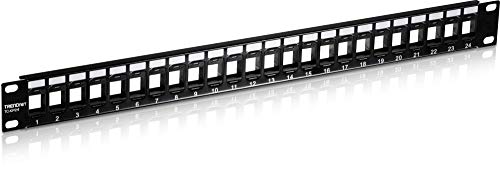
- 24 standard keystone openings
- SPCC steel 1U rackmount frame
- NDAA compliant with two-year warranty
Best For: Custom Cat6 and copper Ethernet builds
Best for 10G and PoE
Cable Matters 24-Port Cat6 Patch Panel

- Supports 10Gbps with compatible equipment
- Handles PoE, PoE+, and PoE++
- Includes labeling and cable-management hardware
Best For: High-speed Ethernet and PoE rack installations
Best No-Punchdown Pick
Sokqovt 24-Port Cat6 Coupler Panel

- Toolless RJ45 coupler installation
- 10Gbps Cat6 support
- Removable back bar and modular keystones
Best For: Fast, flexible rack and cabinet wiring
Best Shielded Option
Cable Matters 24-Port Cat6A Patch Panel

- 10Gbps Cat6A STP performance
- Individual EMI/RFI port shielding
- Supports PoE through PoE++
Best For: High-speed, interference-sensitive rack networks
Best Flexible Value
Rapink 24-Port Cat6 Inline Panel

- Toolless pass-through couplers
- 10Gbps support with gold-plated contacts
- Flexible, replaceable keystone options
Best For: Expandable home and small-office networks
High-Capacity Choice
48-Port Cat6 10Gbps Patch Panel

- 48 Cat6 ports with 10Gbps support
- Supports PoE, PoE+, and PoE++
- Includes rack hardware and cable-management accessories
Best For: Large networks needing high port density and PoE support
Compact Home-Network Pick

- 12 ports in a compact 1U, 10-inch format
- Supports Cat6, Cat5e, and Cat5 cabling
- Includes 568B labeling, screws, and zip ties
Best For: Small home networks using 10-inch wall-mount or rack equipment
Fast-Install Option
1U 48-Port Cat6A Keystone Panel

- 48 ports fit into one 19-inch rack unit
- Toolless couplers simplify installation
- Reusable cable management and flexible coupler support
Best For: High-density racks requiring quick setup and easy future changes
Most Flexible – Cable Matters 24-Port Keystone Patch Panel
For network patch panels that need to handle more than Ethernet, the Cable Matters 1U blank panel offers a versatile foundation. Its 24 keystone openings can accommodate compatible RJ45, coaxial, HDMI, USB, fiber, voice, and other keystone modules.
Best For: Structured cabling installations that may expand across network, audio, video, voice, and data connections.
Pros:
- Supports a broad range of standard-sized keystone jacks.
- Fits standard 19-inch racks, cabinets, and wall-mount brackets.
- Removable rear cable support bar includes numbered ports and zip-tie keyholes.
- Heavy-duty, flame-retardant powder-coated steel construction.
Cons:
- Keystone jacks are not included, so the panel requires separate modules.
- A blank design may involve more installation work than a preloaded panel.
This is a strong choice when flexibility matters more than an immediately ready Ethernet connection. You can populate the panel gradually and replace individual modules without changing the entire chassis.
Best Pass-Through Setup – Jadaol 24-Port Cat6 Patch Panel
The Jadaol is a practical choice among network patch panels when you want to connect pre-terminated Ethernet cables without punch-down termination. Its 24 installed Cat6 RJ45 couplers support a straightforward rack or wall-mount installation.
Best For: Offices, wiring closets, and server rooms using pre-terminated Cat5, Cat5e, or Cat6 Ethernet cables.
Pros:
- Pass-through design requires no punch-down tool or individual wire termination.
- Includes 24 Cat6 couplers plus one spare.
- Supports up to 10Gbps with compatible cabling and equipment.
- Removable rear cable management bar helps reduce connection strain.
Cons:
- Not a punch-down panel, limiting its suitability for unterminated bulk cable.
- Actual network speed depends on cabling, length, and connected equipment.
Choose this panel if installation speed and compatibility with existing RJ45-terminated cables are priorities. The pass-through layout keeps termination simple while preserving a standard 1U rack footprint.
Best Blank Rack Panel – TRENDnet TC-KP24 24-Port Blank Panel
The TRENDnet TC-KP24 is a straightforward blank option for network patch panels, providing 24 openings for standard keystone jacks. Its 1U SPCC steel frame is designed for 19-inch rack installation and supports custom Cat6-based Ethernet layouts.
Best For: Installers who want to select their own keystone jacks for a gigabit or 10G copper Ethernet solution.
Pros:
- Provides 24 standard-sized keystone openings.
- Sturdy 19-inch, 1U SPCC steel rackmount design.
- Sequential port numbering and supplementary labels simplify identification.
- NDAA compliant and backed by a two-year manufacturer warranty.
Cons:
- Keystone jacks are sold separately.
- The listed recommended Cat6 jacks are specific TRENDnet models.
This panel makes sense for a planned, component-based installation where you already have compatible keystone modules or want to choose them separately. It offers a clean rack presentation without locking the system to one connector type.
Best for 10G and PoE – Cable Matters 24-Port Cat6 Patch Panel
For network patch panels intended for a high-performance Ethernet rack, this Cable Matters 24-port Cat6 model combines RJ45 connectivity with a 10Gbps-ready design. It also supports PoE, PoE+, and PoE++, making it suitable for installations that power devices over Ethernet.
Best For: Cat6 network racks supporting high-speed switching, IP cameras, wireless access points, and other PoE devices.
Pros:
- Designed for Cat6 networks and supports up to 10Gbps with suitable equipment.
- Backwards compatible with Cat5e and Cat5 cabling.
- Supports PoE, PoE+, and PoE++ applications.
- UL listed, with numbered ports, T568A/T568B diagrams, D-rings, and cable ties.
Cons:
- It is an unshielded panel, which may not suit installations requiring shielding.
- Listed data-transfer details include a 1000Mbps specification despite the stated 10Gbps support.
This is a well-equipped option for organizing a modern Ethernet rack where PoE and future bandwidth matter. Its installation aids and included cable-management hardware help make a 24-port deployment easier to label and maintain.
Best No-Punchdown Pick – Sokqovt 24-Port Cat6 Coupler Panel
For installers who want a faster alternative to punchdown network patch panels, the Sokqovt 24-port Cat6 panel uses RJ45 female-to-female coupler keystones. It fits a standard 19-inch, 1U rack and supports data rates up to 10Gbps, making it practical for home or office wiring projects.
Best For: Rack or cabinet installations where toolless connections, flexible keystone options, and tidy cable management matter.
Pros:
- No punchdown tools are required; connect terminated RJ45 cables directly.
- Supports up to 10Gbps and accepts replaceable Ethernet, USB, HDMI, or blank keystones.
- Includes a sturdy steel chassis and removable back bar for cable support.
Cons:
- It uses couplers rather than traditional punchdown terminations, which may not suit every structured-cabling preference.
- The supplied notes identify it primarily as an indoor panel, despite listing indoor/outdoor usage.
The Sokqovt is a time-saving choice when you already have terminated cables and want a clean, serviceable rack layout. Its modular design also lets you replace an individual jack instead of the entire panel.
Best Shielded Option – Cable Matters 24-Port Cat6A Patch Panel
The Cable Matters 24-port Cat6A panel is one of the more feature-focused network patch panels in this roundup. Its shielded RJ45 couplers, individual port shielding, and 10Gbps capability are designed for installations where interference protection and organized cable routing are priorities.
Best For: High-speed rack networks using shielded Cat6A cabling, PoE equipment, and environments where EMI/RFI protection is important.
Pros:
- Supports data rates up to 10Gbps and PoE, PoE+, and PoE++.
- Individual port shielding helps protect against electromagnetic and radio-frequency interference.
- Includes a cable management bar, labels, cable ties, rack hardware, and a lifetime warranty.
Cons:
- Its Cat6A STP design may be more equipment than needed for a basic, unshielded home network.
- The panel weighs 1.9 pounds, so installation planning should account for its metal construction and cable load.
Choose this Cable Matters model when shielding, PoE support, and included mounting accessories are worth prioritizing. Standard keystone sockets also leave room to substitute compatible jacks for future network changes.
Best Flexible Value – Rapink 24-Port Cat6 Inline Panel
The Rapink 24-port Cat6 inline panel offers a straightforward way to build network patch panels without punchdown tools. Its preloaded couplers, removable back bar, and 19-inch 1U format make it suitable for organizing Cat5, Cat5e, or Cat6 cabling while leaving room for future connector changes.
Best For: Home and small-office installations that need quick coupler connections, repairable ports, and upgrade flexibility.
Pros:
- Toolless pass-through design simplifies installation and can reduce setup time.
- Gold-plated contacts support Ethernet connections up to 10Gbps.
- Replaceable couplers can be swapped for RJ45, fiber, coax, HDMI, VGA, or other compatible options.
Cons:
- The supplied notes do not specify a warranty.
- Its UTP design does not provide the individual shielding listed for the Cable Matters Cat6A panel.
Rapink is a practical pick for expandable wiring projects where easy repairs and connector flexibility matter. The removable back bar and included tie wraps help reduce cable strain and keep the installation more stable.
High-Capacity Choice – 48-Port Cat6 10Gbps Patch Panel
For demanding network patch panels installations, the Cable Matters 48-port model provides dense Cat6 connectivity in a sturdy 2U steel enclosure. It supports up to 10Gbps, works with Cat5 and Cat5e cabling, and includes features for organized rack installation.
Best For: Large home-office, business, or enterprise networks that need 48 ports, PoE support, and 2U rack compatibility.
Pros:
- Supports Cat6 networks up to 10Gbps and is backward compatible with Cat5e and Cat5.
- Compatible with PoE, PoE+, and PoE++ devices such as cameras and wireless access points.
- Includes numbered ports, T568A/T568B diagrams, D-rings, and cable ties.
- UL listed and designed for standard 19-inch racks, cabinets, or wall-mount brackets.
Cons:
- The 48-port, 2U design may be more capacity and rack space than smaller installations require.
- Its unshielded design may not suit environments requiring shielded cabling.
This is a practical high-density option when expansion capacity, PoE compatibility, and documented installation support matter more than conserving rack space.
Compact Home-Network Pick – 12-Port Cat6 10G Patch Panel
Among network patch panels for compact installations, the Rapink 12-port model is sized for 10-inch wall-mount or rack systems. Its punch-down layout supports Cat6, Cat5e, and Cat5 cabling while providing a straightforward way to centralize smaller Ethernet runs.
Best For: Home networks and small installations using a 10-inch rack, cabinet, or wall-mount enclosure.
Pros:
- Supports Ethernet connections up to 10Gbps.
- Works with Cat6, Cat5e, and Cat5 cabling.
- Gold-plated contacts and 568B labeling support consistent terminations.
- Includes mounting screws and zip ties for installation and cable support.
Cons:
- Its 12-port capacity is less suitable for larger or rapidly expanding networks.
- The 10-inch, 1U format is not intended for standard 19-inch rack installations without suitable compatibility.
- As a punch-down panel, installation requires terminating the cables rather than using a toolless coupler design.
With a compact footprint and clear 568B references, this panel is a sensible fit when a smaller home or office network needs organized Cat6 termination.
Fast-Install Option – 1U 48-Port Cat6A Keystone Panel
This 1U 48-port model takes a different approach to network patch panels by using included Cat6 keystone inline couplers instead of traditional punch-down termination. The toolless design, reusable cable management, and 19-inch rack compatibility make it suited to dense installations where quick setup and future changes are priorities.
Best For: Server rooms and data-center racks that need high port density, quick installation, and flexible port replacement.
Pros:
- Provides 48 ports in a compact 1U rack space.
- Includes 48 Cat6 keystone inline couplers for toolless termination.
- Supports Cat6A, Cat6, Cat5e, and Cat5 cables with 10Gbps performance.
- Reusable cable management does not require cable ties, and ports can be adapted with other couplers.
Cons:
- The supplied configuration uses inline couplers rather than a conventional punch-down block.
- It is designed for indoor, universal 19-inch rack, cabinet, or wall-mount installations.
- Its dense 48-port layout may be unnecessary for smaller networks.
The combination of 1U density, toolless installation, and replaceable couplers makes this a strong choice for installations where reducing termination time and simplifying future repairs are key concerns.
How We Picked These Network Patch Panels
We focused on practical differences that affect installation and long-term use: port capacity, Cat6 or Cat6A compatibility, advertised 10Gbps support, rack or wall-mount format, termination method, cable management, and safety or compliance listings where provided. The selection includes 12-, 24-, and 48-port options so you can match the panel to both your current cabling and expected growth.
We also considered whether a panel uses punch-down terminals, pass-through couplers, or interchangeable keystone modules. Each approach can be useful, but they serve different installation preferences and maintenance requirements.
Quick Comparison
- Best for flexible port layouts: Blank keystone panels let you install compatible RJ45, fiber, HDMI, or other modules as needed.
- Best for fast installations: Coupler and pass-through panels avoid traditional punch-down termination.
- Best for permanent structured cabling: Punch-down panels provide a conventional, secure termination for in-wall cable runs.
- Best for larger networks: A 48-port, 2U panel maximizes capacity while using more rack space.
- Best for compact installations: A 12-port wall-mount panel suits small offices, home labs, and locations without a full rack.
Key Buying Factors for Network Patch Panels
Port Count and Expansion
Count the cables you need to terminate today, then leave room for growth. A 24-port panel is a versatile choice for many small and medium installations, while 48 ports reduce the need to add another panel later. For a compact deployment, 12 ports may be easier to fit and manage.
Cat Rating and Bandwidth
Cat6 panels are generally suitable for standard Gigabit networks and can support higher speeds over appropriate cabling and distances. Cat6A is the safer choice when you are building for 10Gbps performance or want more headroom. The panel alone does not determine network speed; switches, cables, connectors, and installation quality must also be compatible.
Termination Style
Punch-down panels are designed for solid in-wall cable runs and require a punch-down tool. Coupler or pass-through models are quicker when cables already have RJ45 plugs, but they may be less suitable for permanent structured wiring. Blank keystone panels offer the most flexibility if you want to change module types later.
Rack Fit and Cable Management
Confirm the panel’s width and height before ordering. Most rack models are 19-inch wide, with 1U panels taking less vertical space than 2U designs. Integrated bars, rear supports, and labeling areas can reduce strain on connectors and make troubleshooting easier.
Who Should Buy Which Network Patch Panels?
Home-lab users and small offices should consider a 12- or 24-port panel with straightforward labeling and manageable installation. Installers building flexible racks may prefer blank keystone panels. Users prioritizing speed and simplicity should look at pass-through coupler designs. Businesses planning for expansion can benefit from a 48-port panel, provided the rack has enough space and the cable bundle can be managed cleanly. For new 10Gbps-focused builds, pair a Cat6A-capable panel with matching Cat6A cabling and compatible network hardware.