
Large file workflows demand more than sharp resolution. The right OLED reference monitor combines accurate color, useful screen space, fast connectivity, and a comfortable layout for reviewing video, photos, design files, and data-heavy projects.
These 10 displays range from professional 4K QD-OLED monitors to ultrawide and high-refresh gaming models. Use the guide below to match panel quality, workspace, ports, and ergonomics to the way you store, review, and manage large files.
Best 10 OLED Reference Monitors for Large File Storage Picks for 2026
Professional Color Workhorse

- 32-inch 4K QD-OLED at 120Hz
- Calman Verified, Delta E < 1.5
- USB-C 96W, Auto KVM, five-year warranty
Best For: Color-critical photo and video workflows
High-Speed 4K Alternative

- 32-inch 4K OLED display
- 4K 165Hz or Full HD 330Hz dual mode
- 0.03ms response with G-Sync and FreeSync
Best For: Mixed media work and high-refresh gaming
Compact Pro Reference

- 27-inch 4K QD-OLED at 120Hz
- Calman Verified with Delta E < 1.5
- USB-C 96W and Auto KVM
Best For: Compact color-critical creator workstations
Ultrawide Storage Command Center

- 49-inch Dual QHD QD-OLED display
- 32:9 layout for wide multitasking
- 144Hz, 0.03ms, and picture-in-picture
Best For: Wide file-management and multitasking setups
Color-Critical Pro Choice

- 4K 240Hz QD-OLED with 0.1ms response
- Delta E <1 and hardware calibration
- Thunderbolt 4 and five-year warranty
Best For: Professional photo and video editing with calibrated color
Comfort-Focused Creator Display

- 4K QD-OLED with 99% DCI-P3
- USB-C supports up to 90W power delivery
- Built-in spatial audio and adjustable stand
Best For: Hybrid editing, office work, and laptop connectivity
High-Speed OLED Specialist

- 4K 240Hz QD-OLED with 0.03ms response
- 99.5% DCI-P3 and Delta E <2 color
- DisplayPort 2.1, HDMI 2.1, and 90W USB-C
Best For: Editing and gaming with high refresh-rate performance
Best for Ultra-Wide Detail

- 45-inch 5K2K OLED workspace
- 125 PPI for sharper text
- USB-C 90W and DP 2.1
Best For: Large multitasking setups needing high resolution
Best for Burn-In Coverage

- 34-inch 3440 x 1440 ultrawide
- RGB stripe layout for text clarity
- Three-year burn-in panel coverage
Best For: Ultrawide storage work with added OLED protection
Best for 4K Productivity
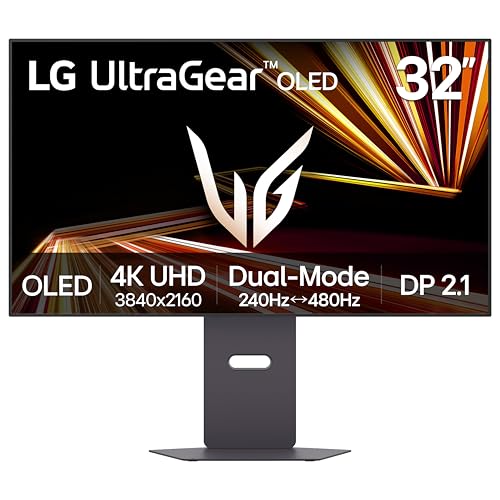
- 32-inch 4K UHD OLED display
- Switch app supports six sections
- USB-C and DisplayPort 2.1
Best For: Organized 4K file-management and multitasking
Professional Color Workhorse – ASUS ProArt PA329CDV
For shoppers seeking OLED reference monitors for large file storage workflows, the 32-inch ASUS ProArt PA329CDV combines 4K detail with professional color accuracy and extensive connectivity. Its QD-OLED panel, factory calibration, and USB-C hub make it well suited to reviewing, editing, and managing visually demanding projects.
Best For: Photo and video professionals who need a large, color-accurate 4K workspace with laptop-friendly connectivity.
Pros:
- 4K QD-OLED panel with 120Hz refresh rate, 0.1ms response time, and up to 1000-nit peak brightness
- Calman Verified calibration with Delta E < 1.5, 99% DCI-P3, and 100% sRGB coverage
- USB-C with 96W Power Delivery, Auto KVM, USB hub, and DisplayPort daisy chaining
- Fully adjustable stand and extended five-year warranty with registration
Cons:
- Its professional feature set may be more than needed for basic office storage tasks
- Only one HDMI port is listed
This is the strongest all-around choice here for color-critical work involving large media libraries. It offers the resolution, panel quality, and workflow connectivity expected from a professional reference display without giving up fast motion performance.
High-Speed 4K Alternative – Samsung Odyssey OLED G7
The Samsung Odyssey OLED G7 is a gaming-focused option for buyers comparing OLED reference monitors for large file storage setups that also need fast, fluid preview performance. Its 32-inch 4K OLED screen delivers strong contrast, accurate color, and a useful dual-mode refresh configuration.
Best For: Hybrid workstations where media review and large-file management share space with gaming.
Pros:
- 32-inch 4K OLED display with vivid contrast and true-black performance
- Dual mode supports 4K at 165Hz or Full HD at 330Hz
- Extremely fast listed 0.03ms response time with G-Sync compatibility and FreeSync Premium
- Pantone Validated color and HDR10+ Gaming support
Cons:
- Gaming is the stated primary use, rather than professional color production
- Connectivity is limited to listed DisplayPort and HDMI inputs
- Brightness is listed at 275 cd/m²
The G7 makes sense when responsiveness matters as much as image quality. It is less purpose-built for reference-grade creative work than the ProArt models, but its 4K OLED contrast and dual-mode speed make it a capable mixed-use display.
Compact Pro Reference – ASUS ProArt PA279CDV
The ASUS ProArt PA279CDV brings the key strengths of a professional OLED reference display to a more compact 27-inch footprint. For large file storage and media workflows, its 4K resolution, factory color calibration, USB-C power delivery, and Auto KVM support provide a streamlined desk setup.
Best For: Creators who want professional color performance and one-cable laptop connectivity without a 32-inch monitor.
Pros:
- 26.5-inch 4K QD-OLED panel with 120Hz refresh and 0.1ms response time
- Calman Verified, Delta E < 1.5, 100% sRGB, 99% DCI-P3, and BT.2020 gamut support
- USB-C with up to 96W Power Delivery, Auto KVM, USB hub, and daisy chaining
- Ergonomic height, tilt, swivel, and pivot adjustments
Cons:
- Smaller viewing area than the 32-inch ProArt option
- Three-year warranty is shorter than the larger ProArt model’s listed warranty
- Listed brightness is 240 cd/m², despite a 1000-nit peak-brightness claim in the features
This is a practical choice for a smaller creative desk or laptop-centered setup. It preserves the color-focused specifications and workflow tools of a professional display while taking up less space than a 32-inch model.
Ultrawide Storage Command Center – Samsung Odyssey OLED G9
The Samsung Odyssey OLED G9 is designed for users who want an expansive desktop for large file storage management, media timelines, and multitasking. Its 49-inch 32:9 QD-OLED screen effectively replaces a two-monitor layout with Dual QHD resolution and built-in picture-in-picture functionality.
Best For: Multitaskers who need wide access to folders, previews, timelines, or secondary windows on one curved display.
Pros:
- 49-inch 5120×1440 Dual QHD QD-OLED screen with 110 pixels per inch
- 32:9 aspect ratio provides extensive horizontal workspace
- Picture-in-picture supports simultaneous multitasking without a second monitor
- 144Hz refresh rate, 0.03ms response time, and G-Sync compatibility
Cons:
- Its 5120×1440 resolution is not 4K UHD
- Large 47.04-inch width requires substantial desk space
- Gaming-oriented features may be unnecessary for storage administration alone
The G9 is the most workspace-focused option in this group. Choose it when seeing many windows at once matters more than a conventional 16:9 4K format, and confirm your desk and graphics hardware can accommodate its size and resolution.
Color-Critical Pro Choice – ASUS ProArt PA32UCDM
For creators seeking OLED reference monitors for large file storage workflows, the ASUS ProArt PA32UCDM combines 4K resolution with highly accurate color reproduction. Its 31.5-inch QD-OLED panel, 10-bit color, wide gamut coverage, and Thunderbolt 4 connectivity suit demanding photo and video work.
Best For: Professional photo and video editors who prioritize calibrated color, HDR support, and fast connectivity.
Pros:
- 4K QD-OLED panel with 240Hz refresh rate and 0.1ms response time.
- True 10-bit color, 100% sRGB, 99% DCI-P3, and BT.2020 coverage.
- Delta E <1 accuracy, hardware calibration, and support for Dolby Vision, HLG, and HDR10.
- Thunderbolt 4 connectivity and an included five-year warranty with registration.
Cons:
- Its professional feature set may be excessive for general office use.
- Only one HDMI port is listed.
This is the strongest fit when visual accuracy matters more than convenience features. The high refresh rate is useful for smooth previews, while calibration tools and broad HDR support make it a serious reference display for content stored on large-capacity systems.
Comfort-Focused Creator Display – Dell 32 Plus S3225QC
The Dell 32 Plus S3225QC is a practical option among OLED reference monitors for large file storage setups, especially when one display must handle editing, business tasks, and everyday media. Its 4K QD-OLED panel delivers strong contrast and color, while USB-C connectivity helps reduce desk clutter.
Best For: Hybrid home-office users and creators who want 4K OLED visuals, built-in audio, and simple USB-C laptop connectivity.
Pros:
- 31.6-inch 4K QD-OLED display with 99% DCI-P3 coverage.
- Dolby Vision and DisplayHDR True Black 400 support.
- USB-C connection with up to 90W power delivery.
- Built-in spatial audio with five 5W speakers and adjustable stand.
Cons:
- Its 120Hz refresh rate is lower than the 240Hz ASUS models.
- Listed brightness is 250, which may be less suited to very bright HDR work.
- The warranty is one year, shorter than the ProArt option.
The S3225QC emphasizes convenience without giving up 4K QD-OLED image quality. It is a balanced choice for users managing large media libraries who also need a tidy workstation, integrated speakers, and a single-cable connection for a laptop.
High-Speed OLED Specialist – ASUS ROG PG32UCDM3
The ASUS ROG PG32UCDM3 brings a gaming-first feature set to OLED reference monitors for large file storage environments. Its 32-inch 4K QD-OLED panel pairs fast 240Hz performance with 10-bit color and wide-gamut coverage, making it suitable for editors who also want responsive gaming and modern high-bandwidth connections.
Best For: Creative professionals and gamers who need fast 4K performance, strong HDR, and flexible DisplayPort, HDMI, and USB-C connectivity.
Pros:
- 4K QD-OLED panel with 240Hz refresh rate and 0.03ms response time.
- True 10-bit color, 99.5% DCI-P3 coverage, and Delta E <2 color difference.
- DisplayPort 2.1 UHBR20, HDMI 2.1, and USB-C with 90W power delivery.
- OLED Care Pro proximity sensing plus a three-year warranty with burn-in coverage.
Cons:
- Gaming-oriented features may be unnecessary for strictly reference-focused workflows.
- The listed warranty is shorter than the ProArt monitor’s five-year coverage.
This model is compelling when speed and connectivity are as important as image quality. Its OLED care features add reassurance for long sessions, while DisplayPort 2.1 and HDMI 2.1 provide a more future-ready connection set for high-performance systems and consoles.
Best for Ultra-Wide Detail – LG 45GX950A-B 5K2K OLED
For buyers comparing OLED reference monitors for large file storage workflows, the LG 45GX950A-B offers exceptional workspace through its 45-inch 5K2K resolution. The 5120 x 2160 canvas and 125 PPI help keep text and detailed interfaces sharp while leaving room for file browsers, timelines, and multiple windows.
Best For: Professionals who want an expansive, high-resolution OLED display for multitasking, media work, and immersive gaming.
Pros:
- 5K2K resolution provides substantial horizontal workspace and detailed text.
- 45-inch curved OLED delivers deep blacks, vivid color, and up to 1300 nits peak brightness.
- USB-C supports up to 90W power delivery, alongside DisplayPort 2.1 and HDMI 2.1.
- Dual-mode operation switches between 5K2K at 165Hz and WFHD at 330Hz.
Cons:
- Its 800R curve and large 45-inch footprint may not suit every desk or workflow.
- It is designed primarily as a gaming monitor rather than a dedicated storage display.
- OLED care considerations still matter for interfaces with persistent static elements.
The LG stands out when screen area and resolution matter most. Its strong connectivity and sharp 125 PPI make it practical for managing large file libraries, while the OLED contrast and high refresh rates add versatility for visual work and entertainment.
Best for Burn-In Coverage – Alienware AW3426DW QD-OLED
When evaluating OLED reference monitors for large file storage, the Alienware AW3426DW combines a 34-inch ultrawide workspace with QD-OLED contrast and a text-focused RGB stripe subpixel layout. Its 3440 x 1440 resolution is well suited to side-by-side file management, while the included panel-exchange coverage adds reassurance for long-term ownership.
Best For: Users who want an ultrawide QD-OLED monitor with strong HDR performance and explicit OLED burn-in warranty coverage.
Pros:
- QD-OLED technology provides infinite contrast, vivid color, and up to 1300 nits peak brightness.
- RGB stripe subpixel layout is designed to improve text clarity.
- Three-year Advanced Exchange Service includes Premium Panel Exchange for OLED burn-in.
- 280Hz refresh rate, 0.03ms response time, and broad adaptive-sync support add smoothness.
Cons:
- 3440 x 1440 resolution offers less workspace than a 4K or 5K2K display.
- The 34-inch 21:9 format may be less spacious for extremely large file-management layouts.
- Its stated specific uses focus on desktop and gaming rather than professional reference work.
The AW3426DW is a balanced choice for users who value OLED contrast but want meaningful protection against panel concerns. It provides a practical ultrawide layout for file organization without giving up high-end gaming performance.
Best for 4K Productivity – LG 32GX870A-B 4K OLED
For OLED reference monitors for large file storage, the LG 32GX870A-B offers a familiar 32-inch 4K format that balances detailed viewing with a manageable desktop footprint. Its 3840 x 2160 resolution is useful for inspecting dense folder structures, previews, and productivity applications, while the Switch app can divide the display into up to six sections.
Best For: Users who need a sharp 4K OLED monitor for organized multitasking, file browsing, and mixed work-and-gaming use.
Pros:
- 4K UHD resolution provides detailed images and a practical 16:9 workspace.
- Micro Lens Array+ technology supports up to 1300 nits peak brightness.
- Switch app enables layouts with up to six screen sections.
- USB-C, DisplayPort 2.1, adaptive sync, and height, tilt, swivel, and pivot adjustments add flexibility.
Cons:
- Its 32-inch 16:9 layout offers less horizontal space than the ultrawide alternatives.
- The product is positioned as a gaming monitor, not a dedicated color-reference display.
- Its OLED warranty is listed as two years, shorter than the Alienware model’s stated coverage.
The 32GX870A-B is the most conventional productivity option in this group. It delivers 4K sharpness in a desk-friendly format and adds useful layout tools, making it a strong fit for storage-heavy workflows that also require gaming capability.
How We Picked the Best OLED Reference Monitors for Large File Storage
We focused on displays that can make large projects easier to inspect and manage, rather than treating storage capacity itself as a monitor feature. Selection criteria included resolution, OLED or QD-OLED image quality, color coverage, HDR support, refresh rate, screen size, connectivity, and workspace flexibility. Professional models received extra consideration for color accuracy, calibration features, USB-C connectivity, and suitability for photo, video, and design work.
Gaming-oriented models are included where their high resolution, ultrawide format, fast response, or large canvas can benefit multitasking and media-heavy workflows. Because OLED panels can be affected by static content over long periods, built-in pixel-shift, screen-care, and panel-maintenance features are also worth checking before purchase.
Quick Comparison
- Best professional 4K choices: ASUS ProArt PA329CDV, PA279CDV, and PA32UCDM.
- Best for a wide multitasking canvas: Samsung Odyssey OLED G9 or LG UltraGear 45GX950A-B.
- Best for high-refresh 4K performance: ASUS ROG PG32UCDM3 or LG UltraGear 32GX870A-B.
- Best curved 34-inch option: Alienware AW3426DW.
- Best everyday 4K QD-OLED balance: Dell S3225QC or Samsung Odyssey OLED G7.
Key Buying Factors for OLED Reference Monitors for Large File Storage
Resolution and Workspace
4K is a strong baseline for detailed images, timelines, spreadsheets, and large design files. Ultrawide models can place multiple windows side by side, while a 32-inch 4K screen offers sharper text and a more conventional desktop layout. Consider your desk depth and viewing distance before choosing a very large curved display.
Color Accuracy and HDR
For professional creative work, look for wide-gamut coverage, factory calibration, low Delta E claims, Calman verification, and HDR support. QD-OLED can deliver strong contrast and vibrant color, but confirm the monitor’s intended color modes and calibration controls if your files must meet a specific production standard.
Ports and File-Heavy Workflows
USB-C with power delivery can simplify laptop setups, while DisplayPort and HDMI support desktop systems, docks, and multiple sources. A built-in USB hub, KVM switch, or daisy-chain capability can reduce cable clutter when moving between computers and external storage systems. These features do not replace fast storage, but they can make large-file workflows easier to organize.
Burn-In Protection and Comfort
Static interfaces, browser panels, and file-management windows may remain onscreen for hours. Check for OLED care reminders, pixel refresh, warranty terms, and brightness-management features. Adjustable height, tilt, VESA compatibility, and an appropriate curve are equally important for long sessions.
Who Should Buy Which OLED Reference Monitors for Large File Storage?
Choose a ProArt model if color-managed creative work, USB-C convenience, and professional calibration matter most. Choose the Samsung OLED G9 or LG 45GX950A-B if you routinely compare files, timelines, and applications across one expansive desktop. Choose a 32-inch 4K gaming OLED if you want excellent detail alongside very high refresh rates for both work and play. Choose the Alienware 34-inch model for a more compact ultrawide experience. For balanced everyday use, the Dell S3225QC and Samsung Odyssey OLED G7 offer a practical mix of sharpness, contrast, and speed.