
Overhead footage can add valuable context to a documentary, from hands-on demonstrations and archival materials to maps, products, and detailed workspaces. The right rig keeps the camera stable while helping you frame repeatable shots without crowding the scene.
This roundup compares 10 overhead camera rigs across modular systems, tripods, desk mounts, clamps, and articulated arms. Consider camera weight, working height, available space, and how quickly you need to reposition the setup before choosing.
Best 10 Overhead Camera Rigs for Documentaries Picks for 2026
Best Modular Pick
PROAIM 12ft Overhead Modular Rig

- Configures to 4, 8, or 12 feet
- Includes ball head, riser, and accessory spacers
- Supports stand or ceiling mounting
Best For: Adaptable documentary overhead setups
Best Lightweight Rail
Glide Gear OH 75 Overhead Mount

- 15-pound maximum payload
- Lightweight 2.3-pound aluminum build
- Includes pole, clamps, posts, and camera sled
Best For: Portable top-down documentary shooting
Best Tripod Versatility
SmallRig CT200 Horizontal Overhead Tripod

- 33-pound maximum tripod load
- 180-degree tilt and 360-degree rotation
- Converts to a monopod
Best For: Multi-angle documentary camera support
Best Tabletop Platform
NEEWER ST100 Overhead Camera Mount

- 10-pound steel tabletop support
- Adjusts from 24 to 39 inches
- 12 crossbar mounting points
Best For: Desk-based demonstrations and flat-lay scenes
Best Travel-Ready Pick

- 90-degree rotating center column for top-down shots
- Fluid head with 360-degree pan and 147-degree tilt
- Folds to 22.8 inches and converts to a monopod
Best For: Portable documentary rigs needing overhead and conventional framing
Best Expandable Desk Rig

- 22.05-pound maximum load rating
- Segmented poles adjust height and length
- C-clamps fit desktops up to 3.54 inches
Best For: Studio and tabletop documentary demonstrations
Best Multi-Device C-Clamp Rig

- Adjustable height and width for tabletop setups
- 26.5-pound overall support rating
- Dual ball heads and included phone holder
Best For: Multi-device documentary demonstrations and studio scenes
Flexible Desk Rig
3-Section Detachable Overhead Mount
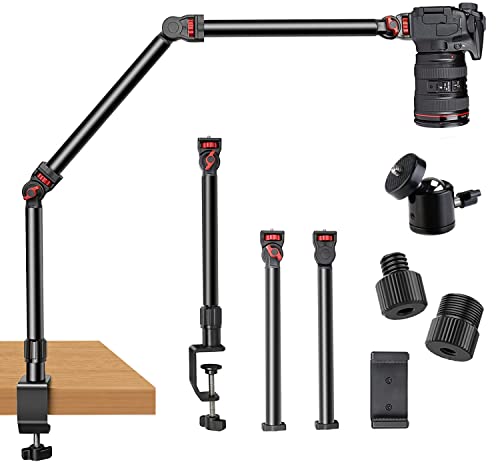
- Three adjustable sections with 360° base rotation
- Supports up to 4.5 lb horizontally
- Includes phone holder, ball head, and multiple screw sizes
Best For: Compact desktop documentary and tabletop filming
Stability-Focused Pick
SMALLRIG Triangle Camera Desk Mount

- Triangular structure adds reinforced support
- Supports up to 3 kg or 6.6 lb
- Fits desks up to 7 cm thick
Best For: Stable indoor overhead documentary scenes
Extended-Reach Option
ULANZI Flexible Arm Overhead Mount

- 29.53-inch arm with three-stage adjustment
- Center shaft reaches 27.56 inches
- Supports up to 2 kg and includes a 360° ball head
Best For: Longer-reach overhead desktop filming
Best Modular Pick – PROAIM 12ft Overhead Modular Rig
For filmmakers comparing overhead camera rigs for documentaries, the PROAIM Overhead 12ft Modular Rig stands out for its configurable rail length and multiple mounting points. Use it at 4, 8, or 12 feet, with payload capacity adjusted to match the selected length.
Best For: Documentary crews needing adaptable overhead, top-down, or bird’s-eye shots in studio or controlled production spaces.
Pros:
- Configures to 4, 8, or 12 feet for different spaces and shot types.
- Includes a ball head, quick-release plate, riser, and three accessory spacers.
- Can mount to C-stands, light stands, or directly to a ceiling.
- Supports cameras, lights, microphones, and other accessories.
Cons:
- Maximum payload drops to 11 pounds at the full 12-foot length.
- Stands are sold separately.
- Its modular setup is more involved than a compact tripod solution.
This is the most expandable option in the group, particularly when a documentary setup needs changing rail lengths or several accessories positioned along the overhead span. Plan carefully around payload and support requirements at longer configurations.
Best Lightweight Rail – Glide Gear OH 75 Overhead Mount
The Glide Gear OH 75 is a portable choice among overhead camera rigs for documentaries. Its six-foot aluminum pole supports up to 15 pounds and is designed for top-down work with DSLRs, smartphones, and other compatible cameras.
Best For: On-location documentary shoots that need a lightweight, quick-to-assemble overhead mount for tables, demonstrations, or large setups.
Pros:
- Supports a maximum payload of 15 pounds.
- Lightweight 2.3-pound aluminum construction is easy to transport.
- Includes a six-foot pole, two clamps, two baby pin posts, and a camera sled.
- Can accommodate rails or poles between 1 and 2 inches in diameter.
Cons:
- C-stands are required but not included.
- Offers less span than the 12-foot PROAIM system.
- It is not water resistant.
The OH 75 balances portability and capacity well, making it useful when a crew regularly moves between locations. Its dependence on separate C-stands should be included in the setup plan and budget.
Best Tripod Versatility – SmallRig CT200 Horizontal Overhead Tripod
The SmallRig CT200 takes a tripod-based approach to overhead camera rigs for documentaries. Its horizontal center column tilts 180 degrees and rotates 360 degrees, while the tripod converts to a monopod for additional shooting flexibility.
Best For: Documentary creators who want overhead, panoramic, low-angle, and mobile tripod shooting from one compact support system.
Pros:
- Supports up to 33 pounds, with a 22-pound limit for the tripod head.
- Horizontal column offers 180-degree tilt and 360-degree rotation.
- Converts from a tripod to a monopod.
- Includes a counterweight bag, carrying bag, quick-release plate, and smartphone holder.
Cons:
- Its overhead reach is governed by the tripod design rather than a long rail.
- A counterweight may be needed to optimize stability in extended positions.
- The broader feature set may be unnecessary for fixed tabletop overhead work.
The CT200 is a strong all-purpose option when overhead footage is only one part of a documentary kit. Its rotating column and monopod conversion add useful flexibility without requiring a dedicated rail system.
Best Tabletop Platform – NEEWER ST100 Overhead Camera Mount
The NEEWER ST100 is a dedicated tabletop platform for overhead camera rigs for documentaries. Its steel frame supports up to 10 pounds, with adjustable columns and numerous crossbar mounting points for flat-lay filming, tutorials, demonstrations, and related production work.
Best For: Desk-based documentary inserts such as cooking, drawing, crafts, unboxing, and instructional demonstrations.
Pros:
- Steel construction supports up to 10 pounds.
- Height adjusts from 24 to 39 inches using spring-loaded positioning points.
- Crossbar provides 12 mounting points for accessories.
- Includes a 1/4-inch camera mount and provisions for backdrop attachment.
Cons:
- Requires a flat desk at least 39.4 inches wide for tabletop use.
- Super clamps, phone clamp, backdrop, and other expansion accessories are sold separately.
- At 5.7 kilograms, it is heavier than the portable rail mount in this roundup.
The ST100 is best viewed as a stable workstation rather than a general-purpose field rig. Its fixed tabletop format and accessory-friendly crossbar make it practical for repeatable overhead sequences in a controlled documentary setup.
Best Travel-Ready Pick – COMAN 72-Inch Overhead Tripod
For filmmakers comparing overhead camera rigs for documentaries, the COMAN combines a 90-degree rotating center column with a fluid video head, making it practical for occasional top-down cutaways, interviews, product details, and travel work.
Best For: Documentary creators who need a portable tripod that can switch between conventional, vertical, and overhead framing.
Pros:
- 90-degree center-column rotation supports horizontal overhead shooting.
- Fluid head provides 360-degree panning and 147-degree tilt.
- Supports up to 11 pounds and includes a counterweight hook.
- Folds to 22.8 inches, weighs about 3.5–3.8 pounds, and converts to a monopod.
Cons:
- Overhead stability depends on properly balancing the extended column and using the counterweight hook.
- It is not water resistant.
The COMAN is a flexible choice when portability matters as much as overhead capability. Its tripod-to-monopod conversion and included phone clamp add utility, while the 11-pound limit suits many DSLR, camcorder, and smartphone setups.
Best Expandable Desk Rig – JUSMO LS15 Pro Overhead Mount
For fixed-location overhead camera rigs for documentaries, the JUSMO LS15 Pro offers a modular tabletop setup for recipe demonstrations, archival objects, crafts, studio segments, and other controlled scenes requiring a stable top-down view.
Best For: Desktop documentary production and studio demonstrations where the rig may need to hold a camera, lights, microphone, or other accessories.
Pros:
- Aluminum construction is rated for loads up to 22.05 pounds.
- Segmented poles allow flexible adjustment of height and length.
- Large C-clamps fit desktops up to 3.54 inches wide.
- Includes a super clamp and supports expansion with additional poles or compatible accessories.
Cons:
- Its tabletop C-clamp design is less suitable for location work than a folding tripod.
- The listed warranty is three months.
The LS15 Pro is best treated as a modular studio fixture rather than a quick-deploy field rig. Its high load rating and expansion options make it useful when a documentary setup needs several devices positioned around one overhead shooting area.
Best Multi-Device C-Clamp Rig – NEEWER NK002 Overhead Mount
For documentary teams building a compact tabletop setup, the NEEWER NK002 is one of the more adaptable overhead camera rigs for documentaries, with adjustable width and height, dual ball-head positioning, and mounting points for cameras, phones, microphones, and lights.
Best For: Tabletop interviews, demonstrations, unboxing-style documentary segments, and small studio setups that use multiple devices.
Pros:
- Adjusts from 27.2 to 48 inches in height and 25.2 to 47.2 inches in width.
- Heavy-duty C-clamp system supports up to 26.5 pounds overall.
- Dual ball heads provide flexible overhead camera angles.
- Includes a phone holder, super clamp, mini ball head, and 1/4-inch adapters.
Cons:
- The dual-ball-head mounting point is limited to 3.3 pounds.
- Optional crossarms for additional lighting and expansion are sold separately.
- Its desktop clamp format is intended for supported tabletop setups.
The NK002 stands out for crews that need to reposition a camera or add compact accessories without changing the whole rig. Check the individual 3.3-pound ball-head limit when pairing it with a heavier camera, lens, or accessory combination.
Flexible Desk Rig – 3-Section Detachable Overhead Mount
For documentary makers seeking overhead camera rigs for documentaries, this detachable aluminum desk stand offers several positioning options without taking up much workspace. Its three adjustable sections, 360° base rotation, and included ball head support top-down camera, lighting, phone, or microphone setups.
Best For: Desktop interviews, tabletop documentary scenes, demonstrations, and compact overhead filming setups.
Pros:
- Three-section arm with 180° adjustment points and 360° base rotation.
- Supports up to 4.5 lb horizontally and up to 6 lb maximum, according to the supplied specifications.
- Includes a phone holder, 360° ball head, and 1/4-inch, 3/8-inch, and 5/8-inch screw options.
- Padded clamp fits desks up to 2.4 inches thick and helps protect the tabletop.
Cons:
- The stated horizontal load capacity is lower than the maximum suspended rating.
- It requires a suitable desk or tabletop for the clamp.
- Devices such as cameras and lights are not listed as included components.
This is a versatile choice when your documentary work happens at a desk and you value compact packing and broad angle adjustment. The included mounting hardware also makes it useful for building a small multi-device setup.
Stability-Focused Pick – SMALLRIG Triangle Camera Desk Mount
Among overhead camera rigs for documentaries, the SMALLRIG Triangle Camera Desk Mount stands out for its reinforced triangular support structure. The auxiliary rod connects the horizontal and vertical sections to improve stability while retaining adjustable positioning for cameras, webcams, phones, and other compact devices.
Best For: Stable desktop documentary shots, product demonstrations, food scenes, interviews, and indoor overhead sequences.
Pros:
- Triangular support design is intended to improve shooting stability.
- Supports up to 3 kg, or 6.6 lb, according to the supplied specifications.
- Horizontal rod adjusts from 42 cm to 68.5 cm.
- Fits desks up to 7 cm thick and includes a phone holder and 1/4-inch-20 ball head.
Cons:
- The structure is less minimal than a basic single-arm desk mount.
- Its clamp requires a compatible desk up to 7 cm thick.
- The listing does not indicate that a camera or light is included.
The triangular support makes this a strong candidate when steadiness matters more than the smallest possible footprint. Multiple locking knobs and the auxiliary rod provide useful control for repeatable indoor documentary setups.
Extended-Reach Option – ULANZI Flexible Arm Overhead Mount
For documentary setups that need more reach, the ULANZI aluminum desk stand combines a 27.56-inch center shaft with a 29.53-inch extending arm. It is designed for overhead shooting and can hold cameras, lights, webcams, or other compatible equipment through its 360° ball head and 1/4-inch mounting points.
Best For: Longer-reach desktop filming, document displays, craft demonstrations, baking scenes, and overhead lighting arrangements.
Pros:
- Long 29.53-inch arm with three-stage adjustment.
- Center shaft reaches up to 27.56 inches for broader positioning options.
- Aluminum construction supports up to 2 kg, or 4.41 lb.
- 360° ball head and 1/4-inch screw points support cameras and additional equipment.
Cons:
- The desk clamp expands only to 1.96 inches, limiting tabletop compatibility.
- A phone clamp is needed for phone use and is not included.
- The camera, panel light, ring light, and other accessories are not included.
This model is appealing when a documentary scene requires extra distance or a higher overhead position. Its reach is substantial for a desk-mounted rig, though buyers should verify both clamp fit and the weight of the chosen setup.
How We Picked These Overhead Camera Rigs for Documentaries
We selected these models based on the practical demands of documentary production: load capacity, reach, mounting flexibility, stability, adjustability, and portability. The lineup includes large modular rigs for cameras, compact desk mounts for controlled tabletop scenes, and adjustable tripods for crews that need more working height.
Because documentary setups vary widely, specifications such as stated payload, arm length, pole height, included clamps, ball heads, and fluid heads matter as much as price. Always compare the manufacturer’s capacity with the fully assembled camera package, including the lens, battery, cage, monitor, microphone, and other accessories.
Quick Comparison
- Large production setups: The PROAIM modular rig is suited to wider overhead spaces, heavier packages, and more configurable builds.
- Frequent repositioning: Glide Gear, SmallRig, NEEWER ST100, and COMAN offer adjustable tripod-style approaches for changing shot locations.
- Desk-based filming: JUSMO, the articulating-arm mount, SMALLRIG Triangle, NEEWER NK002, and ULANZI are better suited to tabletop demonstrations and compact workspaces.
- Phone or lightweight camera work: Desk clamps and flexible arms can be convenient, but verify thread compatibility and payload before adding accessories.
Key Buying Factors for Overhead Camera Rigs for Documentaries
Payload and Safety
Choose a rig with meaningful capacity above your complete camera weight. A mount that is technically rated for the camera may still sag or vibrate when extended, especially with a long lens or side-mounted accessory. Use counterweights, safety cables, and secondary support where appropriate.
Reach, Height, and Clearance
Measure the table, set, or subject area before buying. Horizontal reach determines how much of the scene you can cover, while vertical clearance affects composition and whether talent can work comfortably beneath the camera. Longer arms usually require a sturdier base.
Stability and Vibration Control
Metal construction, broad bases, strong clamps, and secure locking mechanisms help reduce movement. A fluid head can make angle adjustments smoother, while a ball head may offer faster repositioning. Avoid relying on a lightweight desk clamp for a heavy cinema setup.
Mounting and Workflow
Check for standard camera threads, quick-release compatibility, phone holders, ball heads, and accessory mounting points. Cable management is also important: secure power, HDMI, and audio cables so they cannot pull the camera or enter the frame.
Who Should Buy Which Overhead Camera Rigs for Documentaries?
Choose a modular overhead rig if you film larger sets, heavier cameras, or repeatable documentary scenes that need maximum flexibility. Choose an adjustable tripod if you move between locations and want height and reach without permanently clamping to a desk. Choose a desk mount or articulating arm for tabletop interviews, craft demonstrations, document capture, and compact home or studio productions. Choose a lightweight clamp mount when portability and fast setup matter more than maximum payload.
For any of these Overhead Camera Rigs for Documentaries, test the fully loaded setup before recording. Lock every joint, inspect the support surface, confirm the camera remains balanced at the intended extension, and keep the rig outside areas where it could be bumped.