
The best professional podcast production consoles bring microphone inputs, headphone monitoring, mix-minus routing, effects, recording, and live-production controls into one focused workspace. That can simplify a multi-person studio while giving experienced creators more control than a basic USB interface.
This roundup compares 10 consoles and bundles for different production styles, from compact creator setups to larger digital mixers and complete multi-microphone packages. Focus on your guest count, routing needs, recording workflow, and included accessories before choosing.
Best 10 Professional Podcast Production Consoles Picks for 2026
Best All-in-One Pick

- Four XLR inputs and studio preamps
- APHEX processing and eight SMART pads
- Standalone multitrack recording
Best For: Creators seeking a complete podcast production console
Best for Guided Workflows
- Three touchscreen control modes
- AutoMix supports up to four mics
- USB-C and SD multitrack recording
Best For: Creators wanting adaptable controls and automated level management
Best Premium Connectivity

- Four combo inputs and 76dB preamp gain
- Dual USB-C interfaces
- Includes 32GB microSD card
Best For: Multi-device podcast studios and established creators
Best for Portable Panels

- Six mic inputs and six headphone outputs
- Up to 13-track SD recording
- Battery, AC, and USB power options
Best For: Mobile panel podcasts and multi-guest interviews
Studio-Live Command Center

- 40 inputs and 25 buses for complex routing
- 16 programmable MIDAS mic preamps
- 32 x 32 USB interface with motorized faders
Best For: Large studio, live, and podcast production setups
Four-Seat Podcast Hub
RODECaster Pro 2 Four-Person Bundle

- Complete four-host microphone and headphone package
- Remote calling via Wi-Fi, Ethernet, and Bluetooth
- Multitrack microSD recording up to 192 kHz
Best For: Four-person podcasts and streaming teams
Compact Creator Studio

- Two mic/line/instrument preamps
- Touchscreen, four faders, and six programmable pads
- Includes two mic packs and 128GB microSD card
Best For: Solo creators and two-person podcasts
Best All-in-One Four-Host Kit
RODECaster Pro II with 4 Zoom Mic Packs

- Complete four-host console and microphone setup
- Dual USB-C, Bluetooth, and onboard wireless
- APHEX processing with high-gain Revolution preamps
Best For: Four-host podcasts, panels, and roundtable production
Best Complete Studio Bundle
RODECaster Pro II 4-Mic Production Kit

- Four mic packs with headphones and tabletop stands
- Multitrack recording to microSD or USB
- Four headphone outputs and phone mix-minus
Best For: Four-person studios seeking an included recording card
Best Two-Person Premium Setup
RODECaster Pro II with Shure SM7B Mics

- Includes two Shure SM7B microphones
- ATH-M50x headphones and studio accessories included
- Dual USB-C and APHEX processing for flexible workflows
Best For: Two-host podcasts and interview-focused studios
Best All-in-One Pick – RØDECaster Pro II
The RØDECaster Pro II is a practical choice for professional podcast production consoles when you want recording, monitoring, sound effects, and voice processing in one desk unit. Its four XLR inputs, standalone recording, and APHEX presets reduce the need for additional equipment.
Best For: Podcasters who want a self-contained studio console with straightforward broadcast-style processing.
Pros:
- Four studio preamps with XLR, line, and instrument input support
- APHEX voice processing presets can make voices broadcast-ready with one tap
- Records multitrack audio to a computer, microSD card, or USB drive
- Eight customizable SMART pads support effects, music, and mix-minus calls
Cons:
- Microphones are not included
- Its broad feature set may be more than a basic solo setup needs
The RØDECaster Pro II balances hands-on show control with flexible standalone recording, making it a strong fit for creators who want to grow beyond a simple audio interface.
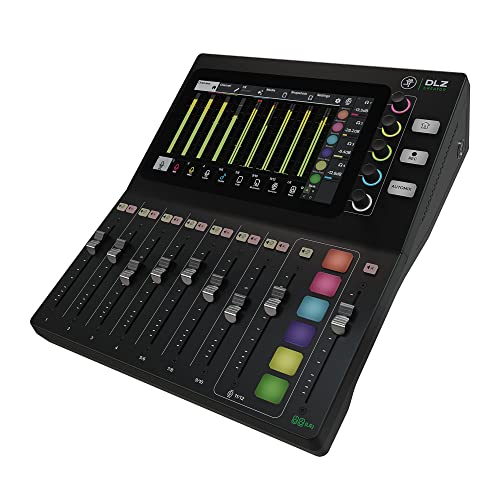
Best for Guided Workflows – Mackie DLZ Creator
The Mackie DLZ Creator is among the professional podcast production consoles designed to accommodate different experience levels. Its 10.1-inch touchscreen, three control modes, and AutoMix help simplify setup while retaining multitrack recording and custom monitoring options.
Best For: New and experienced creators who want adaptable controls for podcasts, livestreams, and video production.
Pros:
- Easy, Enhanced, and Pro modes adapt the touchscreen to your workflow
- AutoMix manages levels for up to four microphones
- Records or streams multitrack audio through USB-C or directly to an SD card
- Supports up to four customized headphone mixes
Cons:
- It is a relatively large, 9.1-pound console
- The supplied notes list only USB connectivity
With Mix Agent technology, Onyx80 preamps, and flexible operating modes, the DLZ Creator is especially appealing when multiple speakers and ease of operation matter.
Best Premium Connectivity – RODECaster Pro II Bundle
This RODECaster Pro II bundle suits professional podcast production consoles buyers who need premium preamps, flexible computer connections, and included recording media. The console combines four combo inputs, four headphone outputs, APHEX processing, and a 32GB microSD card.
Best For: Established podcasters and creators connecting multiple microphones, instruments, computers, or mobile devices.
Pros:
- Four Neutral combo inputs accept microphones and instruments
- Revolution Preamps provide up to 76dB of gain and low noise
- Dual USB-C interfaces support simultaneous computer or mobile connections
- Includes a 32GB microSD card and programmable SMART pads
Cons:
- The bundle’s extra accessories may be unnecessary if you already have recording supplies
- The supplied notes identify Windows as the operating system
Its dual USB-C connectivity, phone integration, and high-gain preamps make this package a compelling option for more involved studio and remote-production setups.
Best for Portable Panels – Zoom PodTrak P8
The Zoom PodTrak P8 is a portable alternative among professional podcast production consoles, supporting up to six microphones and two call-ins without requiring a computer. Battery, AC, and USB power options make it suitable for field recording as well as studio work.
Best For: Mobile podcasters, panel shows, and interview teams that need multiple headphones and self-contained editing.
Pros:
- Six high-gain mic inputs and six independent headphone outputs
- Records up to 13 tracks directly to an SD card
- Built-in editing tools include trimming, splitting, combining, and fading
- Supports wired and Bluetooth call-ins with mix-minus functionality
Cons:
- The bundle includes many accessories that may add to setup clutter
- Its USB interface is limited to 2-in/2-out operation
For creators who prioritize portability and guest management, the P8 combines substantial input capacity with onboard processing and editing, while the included bundle adds useful field-recording supplies.
Studio-Live Command Center – Behringer X32 Producer
For professional podcast production consoles that can also handle studio and live work, the Behringer X32 Producer emphasizes routing flexibility, hands-on control, and multitrack computer connectivity. Its 40-input, 25-bus design and rack-mountable chassis make it suited to complex audio setups.
Best For: Podcasters and production teams needing extensive inputs, buses, physical controls, and live/studio versatility.
Pros:
- 40 inputs and 25 buses provide substantial routing capacity.
- 16 programmable MIDAS-designed mic preamps support detailed input control.
- 32 x 32 USB audio interface supports computer recording and DAW control.
- Motorized faders and scene management help streamline repeatable productions.
Cons:
- Its 25.1-pound build and rack-mountable format may be excessive for a simple desktop podcast.
- The larger control surface can require more setup and learning than a dedicated compact podcast console.
The X32 Producer is a strong choice when podcasting is part of a broader production workflow. Choose it for expandable routing and physical mixing control rather than maximum simplicity.
Four-Seat Podcast Hub – RODECaster Pro 2 Four-Person Bundle
Among professional podcast production consoles, the RODECaster Pro 2 bundle stands out as a ready-to-use four-person package. It combines four XLR mic inputs with microphones, headphones, boom arms, remote-guest connectivity, programmable pads, and multitrack recording.
Best For: Four-person podcasts, streaming teams, and creators who want a complete multi-host setup with minimal additional shopping.
Pros:
- Includes four ZDM-1 dynamic microphones, headphones, XLR cables, and boom arms.
- Four combo XLR inputs accommodate the included microphones without phantom power.
- Wi-Fi, Ethernet, and Bluetooth support remote callers and connected workflows.
- Records multitrack audio to the included 32GB microSD card at up to 192 kHz.
Cons:
- The bundle is built around four seats, which may be more equipment than a solo creator needs.
- At 16 pounds, the complete setup is less travel-friendly than a minimal portable rig.
This is one of the most turnkey options here for a group podcast. Its included accessories and guest-oriented features reduce setup friction, while the dynamic microphones are designed to help limit untreated-room noise.
Compact Creator Studio – RODECaster Duo Podcast Bundle
The RODECaster Duo is a compact integrated option for professional podcast production consoles, combining two mic/line/instrument preamps, a touchscreen, wireless connectivity, onboard processing, and recording to microSD or USB. This bundle adds two podcast mic packs, a 128GB card, and a cleaning cloth.
Best For: Solo creators or two-person podcasts seeking a compact console with bundled microphones and flexible recording options.
Pros:
- Two high-end mic/line/instrument preamps suit solo and two-person productions.
- Color touchscreen, four faders, and six programmable pads provide direct control.
- Built-in Bluetooth, wireless receivers, dual USB ports, and microSD recording expand connectivity.
- Bundle includes two microphone packs with headphones, windscreens, XLR cables, and tabletop stands.
Cons:
- Two channels limit the number of directly connected microphone sources.
- It offers less input and bus capacity than a full-size production console.
The RODECaster Duo balances dedicated podcast controls with a smaller footprint. It is a practical fit when two inputs are sufficient and you value built-in processing, wireless features, and an all-in-one bundle.
Best All-in-One Four-Host Kit – RODECaster Pro II with 4 Zoom Mic Packs
If you need professional podcast production consoles for a roundtable or panel, this bundle is designed to get four hosts recording quickly. It combines the RODECaster Pro II with four matching dynamic microphones, headphones, tabletop tripods, windscreens, and XLR cables.
Best For: Four-host podcasts, panel shows, broadcast roundtables, and mobile production crews.
Pros:
- Complete four-host setup with console, microphones, headphones, stands, and cables.
- Four mic inputs, dual USB-C interfaces, Bluetooth calling, and onboard wireless support.
- 76 dB of gain and APHEX processing help drive the included dynamic microphones cleanly.
- Supports multitrack workflows across Mac, Windows, iOS, and Android.
Cons:
- The bundle is more equipment than a solo podcaster may need.
- Tabletop tripods are intended for desk setups rather than full-size floor stands.
This is a particularly practical choice when you want one purchase to cover a complete four-person table setup. Its strongest advantage is reducing compatibility and accessory decisions before the first recording.
Best Complete Studio Bundle – RODECaster Pro II 4-Mic Production Kit
For buyers comparing professional podcast production consoles, this package adds a four-microphone accessory set and recording media to the RODECaster Pro II. The console offers four mic/line/instrument preamps, multitrack recording to microSD or USB, and a touchscreen-based control layout.
Best For: Four-person podcast studios that want included monitoring, stands, cables, and a microSD card.
Pros:
- Includes four podcast mic packs with headphones, windscreens, XLR cables, and tabletop stands.
- Records multitrack audio to microSD or USB for flexible production workflows.
- Four headphone outputs, mix-minus phone interviews, Bluetooth, and two wireless mic receivers support varied sessions.
- Includes a 128GB microSD card and manufacturer-supplied accessories.
Cons:
- The listing’s channel details identify four channels, so buyers should verify their exact routing needs.
- The included one-year manufacturer warranty may be shorter than some buyers expect.
This bundle suits users who value a ready-to-record package and local recording capability. The included microSD card is a useful addition for sessions that do not depend entirely on a computer.
Best Two-Person Premium Setup – RODECaster Pro II with Shure SM7B Mics
This bundle is a focused option among professional podcast production consoles for two-person recording. It pairs the RODECaster Pro II with two Shure SM7B microphones, two Audio-Technica ATH-M50x headphones, stands, XLR cables, and a microSD card.
Best For: Two-host podcasts, interviews, and creators who want premium microphones and studio headphones included.
Pros:
- Includes two Shure SM7B microphones and two ATH-M50x headphones.
- Dual USB-C interfaces support simultaneous computer or mobile connections.
- Provides APHEX processing, a high-definition touchscreen, tactile controls, and onboard effects.
- Offers XLR, 1/4-inch, USB-C, and Bluetooth connectivity.
Cons:
- This package is built around two microphones rather than a four-host setup.
- The supplied notes contain differing microSD capacities, listing both 32GB and 64GB, so confirm the exact package contents.
- At 24.7 pounds, the bundle may be less convenient for frequent travel.
This is a strong fit when microphone quality and a polished two-person workflow matter more than maximum host capacity. The console’s dual USB-C connectivity also gives it flexibility for hybrid recording and streaming setups.
How We Picked These Professional Podcast Production Consoles
We selected models and bundles based on the features that matter most in professional podcast production: available microphone inputs, preamp quality, headphone outputs, mix-minus or remote-guest support, multitrack recording, onboard processing, physical controls, connectivity, and expansion potential. We also considered whether each option is better suited to a compact creator desk, a dedicated studio, live streaming, or a larger production environment.
Several listings are bundles built around the same core console. Compare the included microphones, headphones, storage, stands, and accessories carefully; a bundle can offer strong value, but its add-ons should not outweigh the console’s actual capabilities.
Quick Comparison
| Best for | What to prioritize | Typical fit |
|---|---|---|
| Solo creators | Simple controls, compact design, USB connectivity | One-person shows and mobile-friendly desks |
| Two- to four-person podcasts | Enough mic inputs, headphone outputs, and independent monitoring | Interview and co-host formats |
| Remote guests | Mix-minus routing, Bluetooth or USB calling, flexible buses | Hybrid local and remote production |
| Live shows and streaming | Fast mute controls, sound pads, effects, and reliable monitoring | Broadcast-style workflows |
| Larger studios | High channel counts, motorized faders, networking, and expansion | Multi-source productions and venues |
Key Buying Factors for Professional Podcast Production Consoles
Inputs, Outputs, and Guest Capacity
Count the microphones you will use today and the ones you may add later. Also check the number of headphone outputs and whether separate mixes can be created for hosts, guests, and callers. A console with sufficient inputs prevents the need for extra splitters or submixers.
Routing and Remote Recording
Mix-minus is important when bringing in phone or computer guests because it helps prevent echo and feedback. USB multitrack capability is valuable if you want to edit each voice independently, while stereo recording may be enough for a simple live-to-publish workflow.
Processing and Control
Onboard compression, gating, equalization, de-essing, and reverb can reduce dependence on computer software. Physical faders, mute buttons, programmable pads, and touchscreen or app control also affect how quickly you can manage a live conversation.
Recording, Connectivity, and Portability
Look for the recording format and storage options that match your workflow, including internal or removable storage, USB interfaces, and backup connectivity. If you record outside a studio, verify power requirements, size, and whether battery operation is supported.
Who Should Buy Which Professional Podcast Production Consoles?
Choose a compact all-in-one console if you want an approachable setup with minimal cabling and fast access to common podcast controls. A two- or four-person bundle makes sense when included microphones and headphones match your production needs and reduce setup costs.
Choose an adaptive digital mixer when you want guided workflows, flexible routing, and room to grow without immediately learning a traditional large-format console. A high-channel-count digital mixer is better for studios handling many sources, complex monitoring, live events, or broader audio-production duties.
Finally, prioritize the console rather than the accessories if you already own quality microphones, headphones, stands, or storage. The right professional podcast production console should fit your recording format, guest capacity, monitoring requirements, and editing workflow first; bundled extras are secondary.