
Choosing the right sound meter can make a big difference in compliance work, workplace safety checks, and environmental noise monitoring. The best professional sound level meters combine accuracy, ease of calibration, and dependable data logging.
Below, we focus on practical buying factors so you can match the right meter to your workflow, whether you need a simple handheld reader or a feature-rich model with software support.
Best 10 Professional Sound Level Meters Picks for 2026
Class 2 Logger
Integrating-Averaging Sound Meter

- Class 2 meter with 30 dBA to 130 dBZpk range
- Logs Leq, Lmax, Lmin, Lpeak, SEL, Ln%, octave bands, and FFT
- Includes software and stores up to 198,948 records
Best For: Data logging and noise analysis workflows
Industrial Classic

- Type 2 compliant with A and C weighting
- Backlit display with auto range and auto off
- Battery powered and includes AA battery
Best For: Simple industrial decibel checks
Bluetooth Logger

- Class 2 meter with ±1.4 dB accuracy
- Bluetooth, USB, and analog output support
- Stores up to 32,690 readings with timestamps
Best For: Connected logging and PC-based review
Field-Ready Class 2
CRY2831 IEC 61672-1 Sound Meter

- Class 2 meter with ±1.5 dB accuracy
- 29 dB to 138 dB range and 20 Hz to 12.5 kHz response
- IP54-rated with A, C, and Z weighting
Best For: Durable field checks and industrial monitoring
Bluetooth Smart Series
REED Instruments R1620-NIST Sound Level Meter

- Bluetooth Smart Series design
- Made in China
- Bluetooth-focused professional option
Best For: Buyers who want a Bluetooth-enabled sound level meter
Class 2 Accuracy
Extech SL510 Sound Level Meter

- ±1 dB accuracy meets Class 2 standards
- 35 to 130 dB range with A/C weighting
- Fast/Slow response with Data Hold and Min/Max
Best For: General-purpose buyers needing a dependable Class 2 meter
IEC Type 2 Pro Features

- IEC651 and ANSI S1.4 Type 2 design
- 30 to 130 dB range with A/C weighting
- Includes accessories and analog output
Best For: Commercial and residential users needing a versatile Type 2 meter
Data Logging Pick
Decibel Meter Data Logger with PC Export

- Stores up to 43,000 readings
- Exports data to Excel via PC
- 3-color alarm with A/C weighting
Best For: Long-term monitoring and report-ready noise tracking
Simple Field Pick
Portable LCD Sound Level Meter
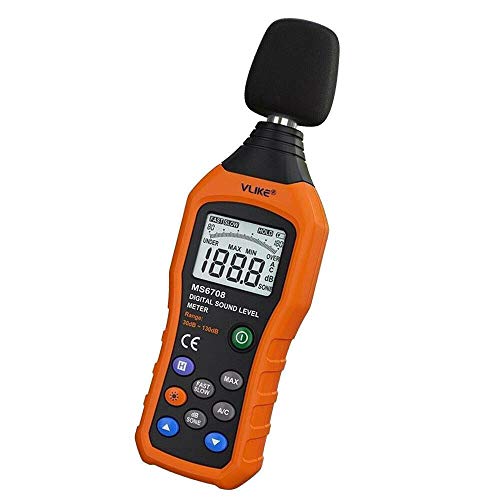
- 30 to 130 dB real-time measurement
- Backlight and anti-drop casing
- No onboard report generation
Best For: Basic handheld noise checks in everyday settings
Balanced Workhorse

- 30 to 130 dB range with 0.1 dB resolution
- A/C weighting plus fast and slow response
- MAX, hold, and under/over functions
Best For: Versatile noise testing across work and life environments
Class 2 Logger – Integrating-Averaging Sound Meter
If you need professional sound level meters for detailed noise logging and analysis, this Class 2 integrating-averaging model is built for data-heavy work. It covers A, C, and Z weightings, records key metrics like Leq, Lmax, Lmin, Lpeak, and SEL, and pairs measurement with included noise analysis software for deeper review.
Best For: Technicians and EHS users who want logged measurements, octave-band analysis, and software-based post-processing.
Pros:
- IEC 61672 / ANSI S1.4 Class 2 compliance with a 30 dBA to 130 dBZpk range.
- Logs Leq, Lmax, Lmin, Lpeak, SEL, Ln%, octave bands, and FFT data.
- Large storage capacity supports up to 198,948 records.
- Includes audio post-processing and spectrum analysis software.
Cons:
- More feature-rich than a basic handheld meter, so it may be more than casual users need.
- Detailed logging and analysis tools can take more setup than simple spot-check meters.
This is a strong choice when your workflow depends on both accurate readings and organized data analysis. It stands out most in applications where recording, comparing, and reviewing noise over time matters.
Industrial Classic – Fluke-945 Decibelmeter
For buyers comparing professional sound level meters for straightforward industrial use, the Fluke-945 keeps the focus on core decibel measurement. It offers A and C weighting, auto range, a backlit display, and IEC/ANSI Type 2 compliance, making it a practical pick for everyday level checks.
Best For: Industrial users who want a simple, battery-powered Type 2 decibel meter from a recognized brand.
Pros:
- IEC651 Type 2, ANSI S1.4 Type 2, and JISC1502 specification compliance.
- A and C weighting with auto range and auto off.
- Backlit display for easier reading in less-than-ideal lighting.
- Battery powered with included AA battery.
Cons:
- No data-logging or software features are listed.
- Less feature-dense than meters designed for advanced analysis.
This model makes sense if you want a dependable, no-fuss meter rather than a full analysis platform. It is best suited to users who value simplicity, portability, and standard compliance.
Bluetooth Logger – Triplett SLM420BT Sound Meter
Triplett SLM420BT Sound Level Meter and Datalogger | Bluetooth Connectivity, 30 to 130dB
Check Price On AmazonIf you want professional sound level meters with modern logging and connectivity, the Triplett SLM420BT blends Class 2 measurement with Bluetooth and USB transfer. It measures 30 to 130 dB, supports A and C weighting plus fast or slow response, and stores readings for later review.
Best For: Users who need a Class 2 meter with app connectivity, PC transfer, and built-in logging.
Pros:
- IEC 61672-1 Class 2 compliance with ±1.4 dB accuracy.
- Stores up to 32,690 readings with programmable sampling and date/time stamps.
- Bluetooth support for iOS and Android apps plus USB PC transfer.
- Includes AC and DC analog outputs, min/max, and data hold.
Cons:
- Only covers A and C weighting, not a broader set of weighting modes.
- Bulkier kit than a basic meter, since it includes software, case, and accessories.
This is a practical pick if you want a meter that can move easily from field checks to digital recordkeeping. The included accessories and connectivity make it especially useful for structured monitoring tasks.
Field-Ready Class 2 – CRY2831 IEC 61672-1 Sound Meter
Among professional sound level meters, the CRY2831 is aimed at users who need a rugged, standards-based tool for field checks and industrial monitoring. It measures from 29 dB to 138 dB, covers 20 Hz to 12.5 kHz, and supports A, C, and Z weighting with fast and slow response modes.
Best For: Field technicians and facility teams that need a durable Class 2 meter with a wider frequency range and strong environmental protection.
Pros:
- IEC 61672-1:2013 Class 2 compliance with ±1.5 dB accuracy.
- Wide 29 dB to 138 dB range and 20 Hz to 12.5 kHz frequency response.
- A, C, and Z weighting plus fast and slow time weighting.
- IP54-rated enclosure and AC/DC dual power supply for field use.
Cons:
- No built-in logging or app connectivity is listed in the supplied details.
- Advanced range and settings may be more than a basic spot-check user needs.
This model is a good fit when durability and measurement flexibility matter more than connected features. The included calibration certificate and wide operating temperature range add to its appeal for serious site work.
Bluetooth Smart Series – REED Instruments R1620-NIST Sound Level Meter
If you want professional sound level meters with smart connectivity, the REED Instruments R1620-NIST is built for Bluetooth-enabled use and is a straightforward option to add to a serious toolkit. The supplied notes only confirm Bluetooth Smart Series and that it is made in China, so it makes the most sense for buyers who specifically want connected measurement hardware.
Best For: Users looking for a Bluetooth-enabled sound level meter in a professional toolkit.
Pros:
- Bluetooth Smart Series design
- Suitable for buyers wanting connected sound level meter functionality
- Simple product positioning for professional use
Cons:
- Supplied notes do not list measurement range or accuracy
- No included feature details beyond Bluetooth Smart Series
- Country of origin is noted as made in China
With limited published specs in the provided notes, this model is best viewed as a Bluetooth-focused choice rather than a feature-heavy benchmark. If app-connected workflow matters more than detailed spec comparisons, it may still fit neatly into a professional sound monitoring setup.
Class 2 Accuracy – Extech SL510 Sound Level Meter
The Extech SL510 is a practical pick among professional sound level meters if you want a Class 2 unit with clearly stated performance details. It covers 35 to 130 dB, offers A and C weighting, and includes fast or slow response plus Data Hold and Min/Max functions, which makes it a versatile fit for routine field checks.
Best For: Buyers who want a Class 2 sound level meter with useful everyday measurement functions.
Pros:
- ±1 dB high accuracy meets Class 2 standards
- 35 to 130 dB range with A and C weighting
- Fast or Slow response time
- Data Hold and Min/Max functions
Cons:
- Only one sentence of supplied notes limits deeper feature context
- No included accessories were listed in the notes
- Best suited to standard decibel measurement rather than advanced logging
Overall, the SL510 stands out for the essentials that matter most in a professional sound level meter: accuracy, range, and practical measurement modes. If you need a dependable Class 2 meter for general use, this one is easy to understand and easy to recommend on specs alone.
IEC Type 2 Pro Features – Triplett 3550 SoniChek PRO
The Triplett 3550 SoniChek PRO is the most feature-rich of these professional sound level meters, with IEC651 Type 2 and ANSI S1.4 Type 2 design targets and a stated accuracy of +/-1.5 dB. It measures 30 to 130 dB, uses A/C weighting with fast or slow response, and adds AC/DC analog output, an analog bar graph, max hold, and a tripod mount.
Best For: Commercial and residential users who want a versatile Type 2 sound level meter with broad included accessories.
Pros:
- Designed to IEC651 Type 2 and ANSI S1.4 Type 2 standards
- 30 to 130 dB range with A/C weighting
- Includes AC/DC analog output and analog bar graph
- Comes with windscreen, output cables, USB cable, batteries, and case
Cons:
- Accuracy is listed at +/-1.5 dB, not the tightest in this group
- USB cable is for power only
- Analog output may be more than some buyers need
If you want the most complete package here, the Triplett 3550 is the strongest all-around choice from the supplied specs. Its combination of Type 2 design, wide measurement support, and included accessories makes it especially practical for HVAC, plant maintenance, home theater, and fire alarm work.
Data Logging Pick – Decibel Meter Data Logger with PC Export
If you need professional sound level meters for ongoing monitoring, this data-logging model is built around recording, review, and export. It stores up to 43,000 readings, shows live noise changes on a color screen, and can connect to a PC for Excel export and analysis.
Best For: Users who want long-term noise tracking, threshold alerts, and PC-based reporting.
Pros:
- Records up to 43,000 data points for later review
- Exports data to Excel when connected to a PC
- 3-color alarm makes low, medium, and high noise easy to spot
- Offers A/C weighting, FAST/SLOW response, and DC output
Cons:
- Requires PC connection for exporting and analysis
- Charging time is about 1.5 hours for the built-in battery
Overall, this is a strong fit when the job calls for more than simple spot checks. The combination of logging, adjustable alarms, and readable live graphs makes it practical for structured noise monitoring.
Simple Field Pick – Portable LCD Sound Level Meter
This is a straightforward option among professional sound level meters when you want real-time readings without extra reporting features. It measures from 30 to 130 dB, includes A/C mode, and adds a backlight for low-light checks around work areas, schools, offices, and other environments.
Best For: Basic handheld noise checking in everyday and industrial settings.
Pros:
- Measures real-time sound levels from 30 to 130 dB
- Backlight helps with night or low-light use
- Anti-drop casing and portable handheld design
- Power-saving design with auto backlight shutoff
Cons:
- Batteries are not included
- Does not keep or generate reports directly from the device
In practical terms, this meter focuses on the essentials: clear readings, basic A/C operation, and portability. It makes sense if you need a dependable check-tool rather than a logging instrument.
Balanced Workhorse – PT6708 Digital Decibel Reader
For buyers comparing professional sound level meters, this Protmex unit sits in the practical middle ground: it offers fast response, A/C weighting, and useful measurement functions without moving into data-logging complexity. It measures 30 to 130 dB with 0.1 dB resolution and a stated accuracy of +/-1.5 dB.
Best For: Users who want a versatile meter for environmental checks, equipment noise, and general sound testing.
Pros:
- Fast response and slow response modes for different noise changes
- A/C weighting supports ambient noise and machine analysis
- Includes MAX, data hold, and under/over functions
- Backlight and power-saving design help in field use
Cons:
- Does not keep or generate reports directly from the device
- Uses a simpler feature set than logging-focused meters
This is a solid choice if you need a readable, responsive meter for repeat checks across work and life environments. It emphasizes core measurement tools and dependable handling over advanced connectivity.
How We Picked the Best Professional Sound Level Meters
We prioritized meters that fit real professional use: stable Class 2 measurement where applicable, clear dB ranges, calibration support, data logging, and useful connectivity such as Bluetooth or PC software. We also favored models that make it easier to document readings over time instead of only showing a live number.
Quick Comparison
At a glance, the best options generally fall into three groups: basic field meters for fast spot checks, logging meters for audits and trend tracking, and advanced units with software or app connectivity for reporting. If you need documentation, look closely at memory capacity, export options, and whether the meter supports continuous logging.
Key Buying Factors for Professional Sound Level Meters
Accuracy and Standard Compliance
For professional work, look for IEC 61672 compliance or Class 2 performance when appropriate. That matters for consistency and credibility, especially in workplace, school, and community noise assessments.
Logging, Memory, and Export
If you need to track changes over a shift, project, or compliance period, choose a model with onboard memory and easy export. Larger data storage, software integration, and timestamps can save significant time when building reports.
Measurement Range and Weighting
A useful meter should cover common ambient and industrial noise levels without clipping. Also check weighting modes and response settings, since these affect how the meter interprets speech, machinery, and fluctuating sound sources.
Connectivity and Workflow
Bluetooth, USB, and companion software can streamline documentation, especially for consultants and safety teams. If you regularly share results, prioritize models that make data transfer simple and repeatable.
Calibration and Traceability
Calibration support is essential if your readings need to stand up to review. A calibration certificate or compatibility with external calibration tools is a major advantage for Professional Sound Level Meters used in formal assessments.
Who Should Buy Which Professional Sound Level Meters?
If you need fast field readings with minimal setup, a straightforward handheld meter is usually enough. If you handle inspections, audits, or ongoing monitoring, choose a data logger with export tools. For professionals who report to clients or regulators, a Class 2 meter with calibration support and software compatibility is typically the best all-around choice.
For the most demanding workflows, look for the strongest mix of accuracy, logging depth, and reporting convenience rather than focusing on price alone. That balance will matter more over time than a few extra features you rarely use.