
The right cart can make a podcast setup faster to move, easier to organize, and safer to transport between rooms or recording locations. This roundup compares 10 rolling equipment carts for podcasters, including mixer stands, folding hand trucks, utility carts, and all-terrain models.
We focused on load capacity, maneuverability, storage, adjustability, and portability so you can match a cart to your microphones, mixer, laptop, stands, cables, and other production gear.
Best 10 Rolling Equipment Carts for Podcasters Picks for 2026
Best Convertible Workhorse
Pyle Compact Folding Equipment Dolly

- Eight convertible cart configurations
- Folds and expands for different loads
- 200-pound alloy steel capacity
Best For: Flexible gear hauling and compact storage
Best Studio Setup Cart

- Height and angle adjustable
- Fits 14.5- to 22.5-inch gear
- Locking casters and 1U rack mount
Best For: Mixer and control-surface positioning
Best Tiered Storage Cart
VEVOR Stainless Steel Utility Cart

- Three shelves for organized storage
- 220-pound stainless steel capacity
- Locking silent swivel casters
Best For: Indoor studios needing shelf-based gear storage
Best Heavy-Duty Folding Cart

- Eight convertible hauling configurations
- 300-pound maximum load
- R-Trac wheels for varied terrain
Best For: Heavy mobile podcast and A/V equipment
Best Quiet Utility Cart

- Three shelves plus a drawer
- Quiet swivel casters
- 110-pound load capacity
Best For: Indoor studios needing organized, quiet-moving storage
Best Tall Studio Support

- Wheeled base for repositioning
- 14-foot maximum height
- 88.2-pound load capacity
Best For: Podcasters using elevated lighting or grip equipment
Best Heavy-Duty Gear Hauler
Gator Frameworks Folding Utility Cart

- 500-pound load capacity
- Eight configuration options
- All-terrain, no-flutter casters
Best For: Mobile crews transporting bulky podcast and production gear
Compact Studio Utility
Height-Adjustable Medical Trolley

- Height adjusts from 29.5 to 41.3 inches
- Tabletop rail helps secure equipment
- Basket storage and two locking casters
Best For: Lightweight podcast gear and compact indoor studios
Heavy-Duty Studio Support
Simpli-Magic Rolling Utility Cart
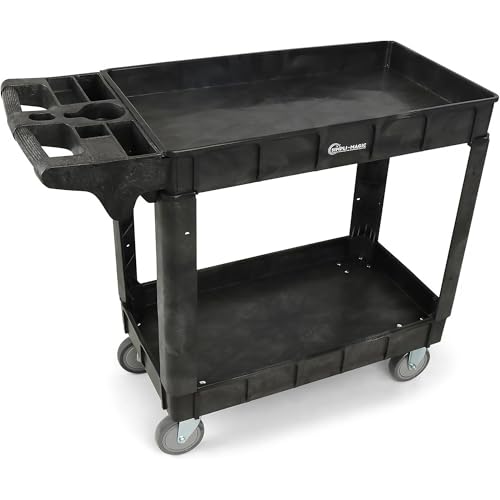
- Listed capacity reaches 600 pounds
- Two deep shelves hold production supplies
- Five-inch swivel casters and ergonomic handle
Best For: Large studios and teams moving bulky podcast gear
Load-In Specialist

- Carries up to 550 pounds
- Bed expands from 30 to 52 inches
- Treaded wheels suit rough surfaces
Best For: Mobile podcast load-ins and transporting large cases
Best Convertible Workhorse – Pyle Compact Folding Equipment Dolly
For podcasters who need to move microphones, stands, cases, and other gear between rooms, this Pyle model is a versatile option among rolling equipment carts for podcasters. Its convertible design, folding frame, and 200-pound capacity make it useful for both transport and storage.
Best For: Podcasters who want one cart that can handle varied equipment loads and fold away when not in use.
Pros:
- Transforms into eight cart configurations, including trolley, hand truck, and platform cart.
- Folds compactly and expands from 25.24 to 40.24 inches for larger equipment.
- Powder-coated alloy steel construction supports up to 200 pounds.
- Multi-directional wheels include brakes for controlled movement.
Cons:
- At 19.1 pounds, it is not the lightest portable cart.
- Its 14.25-inch width may limit how much gear can sit side by side.
This is a strong general-purpose choice when flexibility matters more than a dedicated studio layout. The eight-in-one design can adapt to changing production and hauling needs.
Best Studio Setup Cart – Gator Adjustable Mixer Stand
The Gator Frameworks stand is a studio-focused pick among rolling equipment carts for podcasters. Rather than serving as a general hauling dolly, it is designed to position mixers, controllers, drum machines, samplers, and 1U rack gear at a comfortable working height.
Best For: Home or professional podcast studios that need an adjustable rolling stand for a mixer or control surface.
Pros:
- Height and angle adjustments support seated or standing operation.
- Adjustable 14.5- to 22.5-inch width accommodates different equipment sizes.
- Includes a 1U gear rack mount for compatible rack equipment.
- Locking casters allow mobility with added stability when positioned.
Cons:
- Its single-level design offers less general storage than a tiered utility cart.
- It is intended primarily for mixers and studio equipment, not oversized loads.
Choose this model when ergonomic positioning and equipment access are more important than maximum storage volume. Its adjustable platform is especially practical for studios that alternate between sitting and standing workflows.
Best Tiered Storage Cart – VEVOR Stainless Steel Utility Cart
With three shelves and a 220-pound capacity, this VEVOR cart offers practical organization for microphones, cables, accessories, and production supplies. Its stainless steel construction and lockable swivel casters make it a sturdy choice among rolling equipment carts for podcasters working in a fixed indoor studio.
Best For: Indoor podcast studios that need tiered storage and an easy-to-clean rolling surface.
Pros:
- Three-tier layout provides dedicated storage for different gear categories.
- Supports up to 220 pounds and uses stainless steel throughout the frame and shelves.
- Silent 360-degree swivel casters glide smoothly, with two locking wheels.
- Removable and height-adjustable middle shelf adds storage flexibility.
Cons:
- Its 33.9-inch height and 29.1-inch width may take noticeable studio floor space.
- The cart is recommended for indoor use.
- Assembly is required, although the supplied notes indicate setup takes about 30 minutes.
This cart suits podcasters who prefer organized, shelf-based storage over a folding transport platform. The adjustable middle shelf is useful when equipment and accessory sizes vary.
Best Heavy-Duty Folding Cart – Pyle 300-Pound Multi-Cart
For podcasters who regularly transport heavier cases or larger production loads, this Pyle multi-cart brings a 300-pound capacity to the rolling equipment carts for podcasters category. It combines eight configurations with a telescoping frame, folding storage, and R-Trac wheels for varied hauling conditions.
Best For: Mobile podcasters, A/V technicians, and production teams moving substantial equipment over mixed terrain.
Pros:
- Eight-in-one design converts between hand truck, dolly, platform, and utility cart formats.
- Expands from 27.52 to 44.25 inches for larger equipment loads.
- 300-pound maximum capacity exceeds the other listed Pyle cart.
- R-Trac wheels and brakes are designed for smoother movement across uneven surfaces.
Cons:
- Its larger expanded range may be more cart than a small studio needs.
- At 27.52 inches long and 17 inches wide, it requires more storage space than a compact model.
- The supplied details do not specify a total item weight.
This is the strongest fit for demanding mobile setups where load capacity and terrain handling take priority. For lighter indoor workflows, its larger footprint may be unnecessary.
Best Quiet Utility Cart – VEVOR 3-Tier Medical Trolley
For podcasters who need compact rolling equipment carts for podcasters, the VEVOR Medical Trolley offers three shelves, a drawer, and quiet swivel casters. Its polypropylene construction is easy to clean, while the 110-pound capacity provides useful support for microphones, cables, accessories, and other studio supplies.
Best For: Indoor podcast rooms, studios, and creators who want organized storage with quiet movement.
Pros:
- Three shelves and a drawer keep podcast accessories organized.
- Quiet swivel casters help reduce disruption when repositioning the cart.
- Supports up to 110 pounds and includes three-sided shelf guardrails.
- Easy-clean polypropylene construction is suited to frequent use.
Cons:
- The 13.4-by-23.6-inch footprint may limit larger equipment layouts.
- Its medical-cart styling may be less polished for a finished studio set.
This is a practical choice when quiet rolling, divided storage, and a relatively compact footprint matter more than specialized audio features.
Best Tall Studio Support – Kupo High Roller Stand
Although it is a stand rather than a shelf cart, the Kupo High Roller is a mobile option for rolling equipment carts for podcasters when the priority is supporting elevated lighting or studio hardware. Its wheeled base, 14-foot maximum height, and universal combo head make it useful for flexible production setups.
Best For: Podcasters who also use elevated lights, grip equipment, or larger studio fixtures.
Pros:
- Wheeled base makes heavy lighting setups easier to reposition.
- Supports loads up to 88.2 pounds.
- Universal combo head accepts junior and baby mounting configurations.
- Spring-cushioned risers help control adjustments and reduce sudden drops.
Cons:
- It does not provide shelves or enclosed storage for podcast accessories.
- At 25.1 pounds and nearly 60 inches long, it is less compact than a utility cart.
- The 14-foot height is more capability than many tabletop podcast setups require.
Choose this Kupo when your podcast workflow includes lighting and grip equipment that needs height and mobility; for cable and accessory organization, a shelf-based cart will be more appropriate.
Best Heavy-Duty Gear Hauler – Gator Frameworks Folding Utility Cart
The Gator Frameworks All-Terrain Folding Multi-Utility Cart is the strongest match for heavy rolling equipment carts for podcasters who transport amps, instruments, lighting, DJ equipment, or bulky cable cases. It supports up to 500 pounds, folds for flexibility, and converts into eight configurations.
Best For: Mobile podcasters and production crews moving substantial gear across indoor or outdoor locations.
Pros:
- 500-pound capacity handles heavy professional equipment.
- Eight configurations accommodate different gear arrangements.
- All-terrain casters feature no-flutter design and durable tread.
- Welded steel construction and a non-skid surface support secure transport.
Cons:
- At 46 pounds, it is considerably heavier than a compact studio cart.
- The single-platform design offers less divided storage than a shelf cart.
- Its 36-inch depth may require substantial storage space.
This is the most capable option for transporting a full podcast or production load, especially when rugged wheels and adaptable configurations matter more than lightweight storage.
Compact Studio Utility – Height-Adjustable Medical Trolley
For podcasters who need compact rolling equipment carts for podcasters, this height-adjustable trolley offers a manageable tabletop for a laptop, monitor, or recording accessories. Its protective rail, storage basket, and lockable casters make it suited to organized indoor studio setups.
Best For: Podcasters who want a compact, height-adjustable cart for a laptop, monitor, or smaller recording setup.
Pros:
- Height adjusts from 29.5 to 41.3 inches.
- Large tabletop with a protective rail to help keep equipment in place.
- Includes a metal storage basket and five 360-degree wheels, with two foot brakes.
Cons:
- Maximum listed weight capacity is 21 pounds.
- Only one shelf is listed, so storage space is limited.
- The medical-cart design may be less suitable for large production gear.
This is a practical choice for a lightweight podcast workstation, especially when adjustable height and a small footprint matter more than heavy-duty capacity.
Heavy-Duty Studio Support – Simpli-Magic Rolling Utility Cart
This Simpli-Magic cart is one of the more robust rolling equipment carts for podcasters, with deep two-shelf storage and a listed 600-pound capacity. Its ergonomic handle, large swivel casters, and durable polypropylene construction make it useful for moving heavier equipment or organizing a busy studio, workshop, or production area.
Best For: Podcasters, filmmakers, and production teams transporting bulky gear and supplies between work areas.
Pros:
- Listed 600-pound maximum capacity supports heavy loads.
- Two deep shelves provide substantial storage for equipment and accessories.
- Five-inch swivel casters and an ergonomic push handle support maneuverability.
- Resists chips, dents, rust, water, and corrosion according to the supplied notes.
Cons:
- Its large utility-cart format may be excessive for a small podcast desk.
- The supplied details list a 28-inch depth, which may require considerable floor space.
- It is not described as height adjustable.
Choose this cart when load capacity and storage outweigh portability concerns. It is especially well suited to studios that regularly move cameras, cases, cables, and other production supplies.
Load-In Specialist – On-Stage UTC5500 Utility Cart
The On-Stage UTC5500 is a transport-focused option among rolling equipment carts for podcasters. Its adjustable bed expands from 30 to 52 inches, while treaded wheels and locking casters are designed for moving equipment across rough surfaces during load-in and load-out.
Best For: Mobile podcasters and production crews hauling cases or large equipment over varied surfaces.
Pros:
- Hauls up to 550 pounds in a single trip.
- Adjustable bed length accommodates loads from 30 to 52 inches.
- Treaded wheels and 360-degree front casters help with uneven or rough surfaces.
- Handles at both ends support pushing, pulling, and steering.
Cons:
- It is a low-profile dolly rather than a shelf-style workstation.
- The supplied details list no tabletop or built-in storage compartments.
- Its outdoor/load-in focus may be unnecessary for a stationary studio.
This cart makes the most sense for event-based podcasting and equipment transport. Its expandable bed and high capacity are useful when cases vary in size, but it is not intended to replace a studio equipment shelf.
How We Picked These Rolling Equipment Carts for Podcasters
We selected carts that can support common podcast workflows, from a compact home studio to mobile recording and live event production. The comparison considers stated weight capacity, shelf or platform design, wheel type, folding capability, height adjustment, locking features, and how easily each cart can be stored or transported.
Because podcast equipment varies widely, the list includes several cart styles rather than treating one design as universally best. Mixer stands prioritize access and working height, while utility carts offer shelves for microphones, interfaces, headphones, cables, and accessories. Folding dollies and all-terrain carts are better suited to load-in and load-out work.
Quick Comparison
- Best for compact mobile setups: Folding Pyle carts with multiple configurations.
- Best for a dedicated mixer position: The adjustable Gator Frameworks mixer stand.
- Best for shelves and organized storage: VEVOR three-tier utility carts.
- Best for heavy or oversized loads: Gator Frameworks, Simpli-Magic, and On-Stage all-terrain carts.
- Best for stand-based production gear: The Kupo High Roller Stand.
Key Buying Factors for Rolling Equipment Carts for Podcasters
Load Capacity and Platform Size
Add the weight of your mixer, computer, interfaces, stands, cases, and cables before choosing. A higher capacity is useful, but the platform must also be wide and stable enough for your largest item. Avoid relying on maximum capacity alone if your gear is tall or top-heavy.
Wheel Design and Maneuverability
Locking casters help keep a cart stationary while recording, while larger all-terrain wheels are valuable for thresholds, pavement, and venue floors. For home studios, compact swivel wheels may be easier to turn in tight spaces. Check whether the wheels and frame can handle the surfaces you use most.
Portability and Storage
Folding carts are easier to place in a vehicle or closet, but fixed shelving can provide better organization during a session. Look for folding handles, adjustable platforms, and a manageable folded size if you frequently record away from home.
Organization and Working Height
Multiple shelves can separate recording hardware from accessories, while an adjustable mixer stand may provide a more comfortable control position. Consider cable clearance, shelf depth, edge lips, and whether the design leaves enough room to operate controls without reaching awkwardly.
Who Should Buy Which Rolling Equipment Carts for Podcasters?
Home podcasters will usually benefit from a compact rolling mixer stand or three-tier cart that keeps the interface, laptop, and accessories within reach. Mobile podcasters should prioritize folding Pyle models or a lighter utility cart that fits the vehicle and can be carried between locations. Event and field-production teams should look at the high-capacity Gator, Simpli-Magic, or On-Stage carts, especially when equipment must cross uneven ground. Creators who also use lighting or support stands may prefer the Kupo model, while those needing a height-adjustable work surface should consider the VEVOR gas-lift trolley.
Before buying, measure doorways, storage space, vehicle clearance, and the footprint of your largest piece of equipment. A cart that fits your workflow—and remains stable when fully loaded—will be more useful than one chosen solely for its advertised capacity.