
The best wide-angle camera lenses for filmmaking help you capture expansive landscapes, tight interiors, dynamic establishing shots, and immersive handheld footage. The right choice depends on more than focal length: sensor format, aperture, autofocus, distortion control, and focusing style all affect your results.
This roundup compares 10 options across Sony E, Canon EF-S, Canon EF, and compact-camera systems, including dedicated cine lenses, still-photo lenses, and budget-friendly conversion attachments.
Best 10 Wide-Angle Camera Lenses for Filmmaking Picks for 2026
Best Canon DSLR Zoom

- Flexible 10-22mm range
- USM AF with full-time manual focus
- 9.5-inch close focus
Best For: Canon EOS DSLR landscapes, interiors, and establishing shots
Best Low-Light Cine Prime

- Fast T1.2 aperture
- 270° manual focus rotation
- 0.3 m close focus
Best For: Sony APS-C/S35 low-light and controlled cinematic shoots
Best Budget Zoom

- 10-18mm ultra-wide zoom range
- Optical image stabilization
- Quiet stepping-motor autofocus
Best For: Canon EF-S users shooting stabilized wide-angle video
Best Sony APS-C Prime

- 113.8-degree ultra-wide view
- Fast f/2.8 aperture
- Lightweight 175g design
Best For: Sony E-mount vlogging and immersive wide-angle video
Best Manual-Focus Low-Light Prime
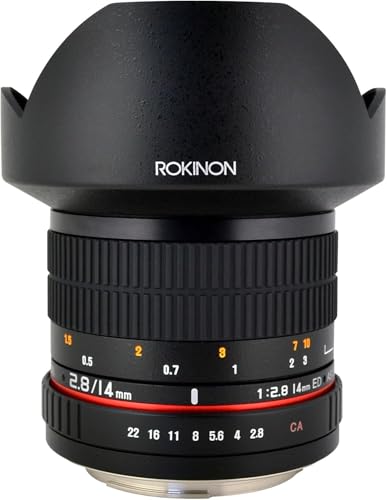
- 115.7-degree ultra-wide view
- Fast f/2.8 aperture
- Manual focus with built-in hood
Best For: Canon EF filmmakers using controlled low-light setups
Sony ZV-1 Vlogging Pick
ULANZI WL-1 Wide-Angle/Macro Lens

- 18mm-equivalent wide-angle effect
- 10X HD macro capability
- Purpose-built for Sony ZV-1
Best For: Sony ZV-1 vlogging and close-up filmmaking
Mirrorless Starter Pick

- 0.43x wide-angle conversion
- Detachable macro portion
- Fits compatible 49mm threads
Best For: Mirrorless users seeking an affordable screw-on wide-angle accessory
DSLR Versatility Pick
Tectra 58mm 0.43x Wide-Angle Lens

- 0.43x wider field of view
- Detachable macro capability
- Designed for 58mm lens threads
Best For: DSLR filmmakers wanting one wide-angle and macro add-on
Best Lightweight Zoom – Sigma 10-18mm F2.8 DC DN
For filmmakers seeking wide-angle camera lenses for filmmaking on Sony APS-C cameras, the Sigma 10-18mm F2.8 DC DN combines an ultra-wide zoom range with a constant, bright aperture. Its compact 260 g design, autofocus, image stabilization, and weather-resistant construction make it practical for travel, vlogging, and mobile video production.
Best For: Sony APS-C E-mount filmmakers who need a lightweight, versatile zoom for travel, landscapes, vlogging, and online content.
Pros:
- 10-18mm ultra-wide zoom covers varied framing needs.
- Constant F2.8 aperture supports low-light shooting and consistent exposure while zooming.
- Lightweight 260 g body with autofocus, stabilization, and weather resistance.
Cons:
- Compatible with Sony APS-C E-mount cameras rather than full-frame systems.
- Its 1.8x zoom range is less extensive than some wider-range zooms.
The Sigma is a strong all-rounder when portability and flexibility matter more than a dedicated cinema design. It is especially well suited to handheld and run-and-gun work where autofocus and stabilization are useful.
Best Compact Prime – Sony E 11mm F1.8 APS-C
The Sony E 11mm F1.8 is a compact prime for creators who want a very wide perspective without carrying a bulky lens. Among wide-angle camera lenses for filmmaking, it stands out with its bright F1.8 aperture, quiet autofocus, internal focusing, and features designed to reduce focus breathing during movie recording.
Best For: APS-C and Super35 Sony E-mount filmmakers, vloggers, and content creators who prioritize a lightweight 11mm prime.
Pros:
- Bright F1.8 aperture helps in low light and supports background separation.
- Compact, lightweight design suits APS-C and Super35 cameras.
- Fast, quiet autofocus with reduced focus breathing for video.
Cons:
- Fixed 11mm focal length offers no zoom flexibility.
- Designed for APS-C and Super35 cameras, limiting compatibility with other formats.
This lens is a convenient choice for handheld pieces to camera, vlogging, and compact cinema setups. Choose it when a bright, consistent ultra-wide view is more valuable than interchangeable focal lengths.
Best Canon DSLR Zoom – Canon EF-S 10-22mm
The Canon EF-S 10-22mm f/3.5-4.5 USM provides a flexible ultra-wide zoom for Canon EOS digital SLR cameras. For filmmakers comparing wide-angle camera lenses for filmmaking, its 10-22mm range, close-focusing ability, fast autofocus, and full-time manual focus make it useful for landscapes, interiors, and immersive establishing shots.
Best For: Canon EOS DSLR users who need an ultra-wide zoom with close focusing and hands-on focus control.
Pros:
- 10-22mm range offers flexible ultra-wide framing.
- USM autofocus includes full-time manual focus adjustment.
- Close focuses to 9.5 inches for detailed foreground shots.
- Circular aperture design produces natural-looking highlights.
Cons:
- Maximum aperture varies from f/3.5 to f/4.5 and is less bright than the other options here.
- No listed optical image stabilization; the supplied details identify stabilization as digital.
- Not water resistant.
The Canon is a capable choice for DSLR-based productions that need an adaptable wide zoom and close focus. Its slower aperture makes it better suited to well-lit scenes or setups where additional lighting is available.
Best Low-Light Cine Prime – SIRUI Night Walker 16mm T1.2
The SIRUI Night Walker 16mm T1.2 is built for filmmakers who prefer deliberate manual focus and cinematic control. Its fast T1.2 aperture, 270-degree focus rotation, 13-blade aperture, 0.3 m close-focus distance, and Sony E mount make it a compelling option among wide-angle camera lenses for filmmaking on APS-C and Super35 cameras.
Best For: Sony FX30 and other APS-C/S35 E-mount productions requiring low-light performance, manual focus control, and cinematic operation.
Pros:
- Very bright T1.2 aperture supports low-light shooting and depth-of-field control.
- 270-degree focus-ring rotation enables precise manual pulls.
- 0.3 m minimum focus distance supports close, immersive compositions.
- 13-blade aperture is intended to create smooth-looking bokeh.
Cons:
- Manual focus only, with no autofocus assistance.
- No image stabilization.
- At 592 g, it is heavier than the compact alternatives.
The Night Walker is the most cinema-focused option in this group. It makes the most sense for controlled shoots, low-light scenes, and operators who value a geared-style manual workflow over convenience features.
Best Budget Zoom – Canon EF-S 10-18mm IS STM
If you need wide-angle camera lenses for filmmaking on a Canon EOS camera, the Canon EF-S 10-18mm offers flexible framing in a compact zoom. Its 10-18mm range, optical stabilization, and stepping-motor autofocus make it a practical option for handheld video, landscapes, and changing compositions.
Best For: Canon EF-S users who want an affordable ultra-wide zoom for stabilized video, landscapes, and general wide-angle shooting.
Pros:
- 10-18mm zoom range supports both expansive and moderately wide compositions.
- Optical image stabilization can help with handheld shooting.
- Stepping-motor autofocus is designed for noise-free video shooting.
- Close focusing distance is approximately 0.22 meters.
Cons:
- Maximum aperture is relatively slow at f/4.5-5.6.
- Designed for Canon EF-S compatibility rather than a universal mount.
- It is not water resistant.
The variable aperture limits low-light flexibility, but the stabilization and quiet autofocus make this Canon zoom a sensible filmmaking choice when convenience and coverage matter more than a fast aperture.
Best Sony APS-C Prime – VILTROX 9mm f/2.8 AF E
For Sony E-mount creators seeking wide-angle camera lenses for filmmaking, the VILTROX 9mm f/2.8 provides an expansive 113.8-degree field of view in a lightweight prime. Its fast aperture, close focusing, and autofocus suit vlogging, interiors, landscapes, and immersive handheld shots.
Best For: Sony E-mount users who want a lightweight ultra-wide prime for vlogging, close perspectives, and low-light-capable video.
Pros:
- Very wide 9mm focal length with a 113.8-degree angle of view.
- f/2.8 maximum aperture offers more low-light flexibility than slower zooms.
- 175g design is easy to carry for travel and handheld filming.
- STM autofocus and a 0.13-meter minimum focusing distance add versatility.
Cons:
- No image stabilization is specified.
- It is a fixed-focal-length lens, so framing requires moving the camera.
- Compatibility is listed for Sony E-mount cameras.
The VILTROX is a strong fit when a small, fast, and extremely wide lens matters more than zoom flexibility. Its USB-C upgrade port also provides a convenient way to update firmware.
Best Manual-Focus Low-Light Prime – Rokinon 14mm f/2.8 EF
The Rokinon 14mm f/2.8 is a manual-focus option for Canon EF users comparing wide-angle camera lenses for filmmaking. Its fast f/2.8 aperture and 115.7-degree angle of view are suited to expansive scenes, interiors, landscapes, and astrophotography-style low-light work.
Best For: Canon EF filmmakers who prioritize a fast ultra-wide prime and precise manual focus over autofocus or image stabilization.
Pros:
- 14mm focal length provides a broad 115.7-degree angle of view.
- f/2.8 maximum aperture supports low-light shooting.
- Optical design uses 14 elements in 10 groups with aspherical elements.
- Built-in petal lens hood is included.
Cons:
- Manual focus may be less convenient for fast-moving subjects.
- No image stabilization is specified.
- The lens weighs 900g according to the supplied product notes.
This Rokinon is best for controlled filmmaking where manual focus is acceptable and a fast, dramatic ultra-wide perspective is the priority. Its substantial weight makes it better suited to supported or deliberate setups than lightweight run-and-gun work.
Sony ZV-1 Vlogging Pick – ULANZI WL-1 Wide-Angle/Macro Lens
For Sony ZV-1 owners seeking wide-angle camera lenses for filmmaking, the ULANZI WL-1 adds an 18mm-equivalent wide-angle effect while also providing a 10X HD macro option. Its adhesive-backed adapter ring is designed specifically for the ZV-1.
Best For: Sony ZV-1 vloggers who want a compact wide-angle and macro accessory for selfie video and close-up shots.
Pros:
- Combines an 18mm-equivalent wide-angle lens with a 10X HD macro lens.
- Designed specifically for the Sony ZV-1 and does not interfere with lens shrinkage.
- Includes an adhesive-backed ring and 52mm bayonet-style attachment system.
- Macro lens can be removed when a close-up view is needed.
Cons:
- Compatible only with the Sony ZV-1.
- The wide-angle lens must be used with the macro lens attached and cannot be used by itself.
- No image stabilization is included.
The WL-1 is a specialized, convenient choice for ZV-1 filmmaking and vlogging, particularly when switching between wider talking-head framing and macro detail. Confirm the camera compatibility before ordering.
Mirrorless Starter Pick – Altura Photo 49mm 0.43x Lens
The Altura Photo 49mm 0.43x add-on is a practical option among wide-angle camera lenses for filmmaking when your existing lens has a compatible 49mm front thread. It widens the view and includes a detachable macro portion for detailed close-ups.
Best For: Canon M-series and compatible mirrorless users who want a screw-on wide-angle accessory with added macro functionality.
Pros:
- Converts a compatible lens to a wider 0.43x viewing angle.
- Detachable macro section supports close-up shots of small subjects.
- Listed as compatible with several Canon, Sony, Fujifilm, and Sigma lenses.
- Uses a straightforward screw-on design for 49mm front filter threads.
Cons:
- Only fits lenses with a 49mm front thread.
- Manual focus is listed in the product details.
- Compatibility must be checked by lens thread size rather than camera model alone.
This add-on offers flexibility for filmmakers who already own a compatible 49mm lens and want a wider composition without replacing the primary lens. Verify the diameter symbol and thread size on your lens before purchase.
DSLR Versatility Pick – Tectra 58mm 0.43x Wide-Angle Lens
The Tectra 58mm 0.43x lens is a versatile add-on for filmmakers using lenses with 58mm front threads. It expands the field of view and includes a detachable macro portion, while the supplied notes describe multicoated optics and continued autofocus, auto exposure, and zoom capability.
Best For: Canon DSLR and other compatible camera users who need a 58mm screw-on wide-angle and macro accessory.
Pros:
- 0.43x conversion broadens the view of a compatible lens.
- Detachable macro portion supports high-resolution close-up work.
- Compatible with a broad selection of listed Canon, Nikon, Olympus, Panasonic, and Fujifilm lenses.
- Supplied notes describe multicoated glass optics and retained autofocus, auto exposure, and zoom functions.
Cons:
- Requires a lens with a 58mm front thread.
- Does not provide image stabilization.
- Compatibility should be confirmed by the lens thread size, not the camera body alone.
The Tectra is a useful two-in-one accessory for DSLR filmmaking setups that already include a compatible 58mm lens. Its broad listed compatibility is helpful, but checking the exact front-thread diameter remains essential.
How We Picked These Wide-Angle Camera Lenses for Filmmaking
We selected lenses and lens attachments that cover common filmmaking needs, from ultra-wide establishing shots to practical zoom ranges for run-and-gun work. The list considers focal length, maximum aperture, manual or autofocus operation, sensor compatibility, mounting system, and the type of camera each product is designed to serve.
Because these options are not interchangeable, verify your camera mount and sensor format before buying. A lens designed for APS-C or Super 35 may not provide full coverage on a full-frame camera, while a full-frame lens can be larger or less affordable than necessary on a crop-sensor body.
Quick Comparison
| Best For | Look For | Potential Trade-Off |
|---|---|---|
| Low-light filmmaking | Fast apertures such as f/1.8, f/2.8, or T1.2 | Higher cost, larger size, or shallower focus |
| Flexible framing | Wide zoom range | Slower maximum aperture or more distortion |
| Controlled cine work | Manual focus, geared rings, consistent handling | Slower focus changes and less convenience |
| Compact cameras | Dedicated or compatible attachment lenses | Lower optical correction and limited versatility |
Key Buying Factors for Wide-Angle Camera Lenses for Filmmaking
Focal Length and Sensor Coverage
Ultra-wide lenses around 9mm to 14mm can exaggerate perspective and work well for interiors, action, and dramatic foregrounds. Lenses from roughly 16mm to 22mm usually offer a more natural wide view. On APS-C and Super 35 cameras, remember that the effective field of view is narrower than the stated focal length.
Aperture and Exposure
A fast aperture helps when filming indoors, at night, or with available light. It can also provide subject separation, although wide lenses naturally make background blur harder to achieve. Slower zooms may still be a better choice when you need flexible framing and daylight stability.
Focus, Stabilization, and Distortion
Autofocus is useful for vlogging, moving subjects, and fast production schedules. Manual-focus cine lenses are often preferable for repeatable pulls and rigged setups. Also check distortion, corner sharpness, focus breathing, and whether your camera can correct lens profiles. Optical stabilization is uncommon on many wide primes, so confirm whether your camera or rig supplies stabilization.
Who Should Buy Which Wide-Angle Camera Lenses for Filmmaking?
Choose a fast prime if you prioritize low-light performance, compactness, or a consistent cinematic look. A wide zoom is the more practical option for events, travel, documentary work, and solo shooting where changing lenses is inconvenient. A manual cine lens suits controlled productions with follow-focus equipment and planned marks.
For Sony APS-C and Super 35 users, the Sony 11mm, Viltrox 9mm, Sigma 10-18mm, and SIRUI 16mm represent different balances of autofocus, speed, range, and cinematic control. Canon crop-sensor users should compare the Canon 10-22mm and 10-18mm zooms with the listed third-party options. Finally, compact-camera attachments such as the ULANZI ZV-1 accessory or 0.43x adapters are best for inexpensive experimentation rather than demanding professional production.