
When it comes to capturing sound, you need the right tools to guarantee clarity and fidelity. Zoom field recorders offer a range of options suitable for various needs, whether you’re a musician, podcaster, or content creator. Each model brings its own unique features, making it essential to understand what fits your recording style best. Let’s explore the top choices that can elevate your audio experience in any setting.
Zoom H1essential Stereo Handy Recorder for Musicians and Content Creators

The Zoom H1essential Stereo Handy Recorder is the perfect companion for musicians and content creators who value high-quality audio without the hassle of complex settings. Its compact design fits easily in your pocket, making it a breeze to carry. With stereo 32-bit float recording and high-quality X/Y microphones, you’ll capture crisp sound up to 120 dB SPL. Plus, it records at a sample rate of 96kHz to an SD card. Operating on just two AAA batteries, you’ll enjoy long sessions without worrying about power. Whether you’re recording interviews or live music, this handy recorder is your go-to solution.
Best For: Musicians, podcasters, filmmakers, and content creators seeking an affordable, high-quality audio recording solution.
Pros:
- Compact and portable design makes it easy to carry and use on-the-go.
- Exceptional audio fidelity with low noise floor suitable for various recording needs.
- User-friendly setup with intuitive controls, ideal for beginners and enthusiasts.
Cons:
- Requires micro SD card and batteries that are not included in the package.
- Menu interface may be challenging for some users to navigate.
- Lacks phantom power for connecting external microphones, limiting versatility.
Zoom H4essential 4-Track Handy Recorder

For musicians, podcasters, and filmmakers seeking high-quality sound without breaking the bank, the Zoom H4essential 4-Track Handy Recorder stands out with its impressive 32-bit float recording feature. This eliminates gain adjustments and prevents clipping, ensuring a wide dynamic range. With built-in X/Y stereo microphones and dual level converters, you’ll capture audio that surpasses most portable recorders. The intuitive interface on the 2.0 full-color LCD makes navigation easy, while versatile connectivity options let you connect various mics. Lightweight and compact, it offers up to 20 hours of battery life, making it perfect for on-the-go recording.
Best For: Musicians, podcasters, and filmmakers seeking high-quality sound without pro-level prices.
Pros:
- Superior 32-bit float recording eliminates clipping and allows for a wide dynamic range.
- Intuitive user interface with a full-color LCD for easy navigation and real-time monitoring.
- Lightweight and portable design with up to 20 hours of battery life, ideal for on-the-go recording.
Cons:
- Some users may need to perform post-processing of audio levels, requiring additional work.
- The compact design may limit the size of additional accessories that can be used simultaneously.
- The price point, while affordable, may still be considered high for casual users or beginners.
Zoom H1 XLR Handy Recorder with 32-Bit Float

With its innovative 32-bit float recording capability, the Zoom H1 XLR Handy Recorder stands out as a top choice for musicians, podcasters, and filmmakers seeking professional-grade audio without the hassle of constant gain adjustments. Weighing just 6.4 ounces, it’s compact and easily portable. The dual XLR/TRS combo inputs and versatile connectivity options make it perfect for various setups. Users appreciate its clean, clip-free audio and impressive battery life of up to 10 hours. While the user interface could be improved, the H1 remains a budget-friendly option that delivers excellent sound quality for any on-the-go recording needs.
Best For: Musicians, podcasters, and filmmakers looking for high-quality portable audio recording without the need for constant gain adjustments.
Pros:
- Superior 32-bit float recording ensures clip-free audio and eliminates gain adjustments.
- Lightweight and compact design makes it highly portable for on-the-go recording.
- Versatile connectivity options with dual XLR/TRS combo inputs and USB-C functionality.
Cons:
- User interface can be clunky and may require some time to get used to.
- Small display may be difficult to read in certain lighting conditions.
- Some users have concerns about the durability of the plastic construction.
Zoom F8n Pro 8-Channel Multi-Track Field Recorder
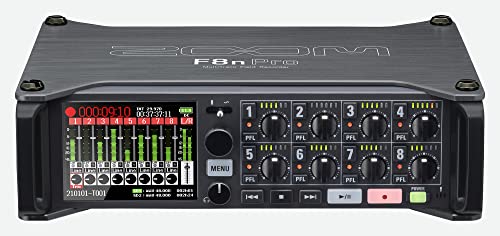
Designed for professional sound engineers and filmmakers, the Zoom F8n Pro 8-Channel Multi-Track Field Recorder delivers superior sound quality that elevates your recordings. With advanced preamps and an incredibly low noise floor, you can expect crystal-clear audio every time. The user-friendly 2.4-inch full-color LCD guarantees you have clear visual feedback for streamlined control. Weighing only 2.64 lbs, it’s compact and perfect for on-the-go recording. Plus, its extended battery life means you can record up to 12 hours on lithium batteries. With versatile connectivity options, you can easily integrate microphones and monitors into your setup for any environment.
Best For: Professional sound engineers and filmmakers seeking high-quality audio recording in portable settings.
Pros:
- Superior sound quality with advanced preamps and a low noise floor for crystal-clear recordings.
- Extended battery life allowing for up to 12 hours of recording time with lithium batteries.
- Versatile connectivity options, including XLR/TRS combo jacks and TA3 outputs for flexible integration.
Cons:
- Weight at 2.64 lbs may not be suitable for those seeking ultra-lightweight options.
- Learning curve may be present for users unfamiliar with multi-track field recorders.
- Price point could be a barrier for hobbyists or casual users.
Zoom F3 Professional Field Recorder

The Zoom F3 Professional Field Recorder stands out as an ideal choice for audio professionals seeking high-quality recordings in demanding environments. With its 32-bit float technology and dual A/D converters, you’ll capture every nuance from soft whispers to loud sounds without distortion. The two locking XLR/TRS inputs allow for versatile mic options, while the USB Type-C port simplifies file transfers and functions as a USB audio interface. Battery-powered and compact, it’s perfect for on-the-go recording. When you choose the F3, you’re investing in reliability and exceptional audio clarity, making it an essential tool for any sound engineer.
Best For: Audio professionals and sound engineers looking for a portable, high-quality field recorder that captures pristine sound in various environments.
Pros:
- Exceptional audio quality with 32-bit float recording technology and dual A/D converters, ensuring clarity without distortion.
- Versatile connectivity with dual locking XLR/TRS inputs and USB Type-C port for easy file transfers and audio interface capabilities.
- Portable and battery-powered, making it ideal for on-the-go recordings in diverse settings.
Cons:
- Limited to 2 channels, which may not meet the needs of users requiring multi-track recording.
- Relatively heavier compared to other compact recorders, potentially affecting portability for some users.
- Higher price point compared to entry-level recorders, which may not be suitable for budget-conscious buyers.
Zoom F2 Field Recorder with Lavalier Microphone and Bluetooth Control

For videographers and content creators seeking high-quality audio without the bulk, the Zoom F2 Field Recorder with Lavalier Microphone and Bluetooth Control stands out as an ideal choice. Weighing only 8 ounces, this compact device features automatic gain adjustment and a 2.4-inch standing screen display for easy monitoring. With 32-bit float recording capabilities, you can capture clear sound in various environments, from weddings to interviews. The Bluetooth control lets you operate remotely, enhancing your workflow. Plus, its compatibility with smartphones and laptops simplifies file management, making the F2-BT a solid option for anyone serious about audio quality.
Best For: Videographers and content creators looking for a lightweight and high-quality audio recording solution.
Pros:
- Automatic gain adjustment for optimal recording levels in various environments.
- Compact design (only 8 ounces) and Bluetooth control for convenient remote operation.
- 32-bit float recording capability allows for extensive post-processing without clipping.
Cons:
- Some users report concerns about the device feeling cheap and flimsy.
- Occasional issues with the battery door and SD card slot, leading to usability frustrations.
- Instances of freezing during recordings have been noted by certain users.
Zoom PodTrak P4 Podcast Recorder

If you’re a podcaster looking for a portable and versatile solution, the Zoom PodTrak P4 Podcast Recorder is your go-to device. This battery-powered recorder features four high-quality microphone inputs with phantom power support, allowing you to capture pristine audio. With four headphone outputs and individual volume control, everyone can monitor their sound comfortably. The PodTrak P4 also includes four programmable sound pads and multi-track recording, ensuring you have all the tools you need for professional-quality production. Plus, it operates up to 3.5 hours on just two AA batteries—perfect for on-the-go recording sessions.
Best For: Podcasters seeking a portable and versatile recording solution that delivers high-quality audio in various settings.
Pros:
- High-quality microphone inputs with phantom power support for excellent audio capture.
- Multiple headphone outputs with individual volume control for comfortable monitoring.
- Programmable sound pads and multi-track recording capabilities for professional production.
Cons:
- Limited battery life of 3.5 hours may require frequent battery replacements during extended sessions.
- Requires SD cards for storage, which are not included with the device.
- Some users may find the interface and features complex if they are new to podcasting equipment.
Zoom H6 Portable Recorder

Featuring advanced 32-bit float recording technology, the Zoom H6 Portable Recorder is perfect for musicians and podcasters who demand superior audio quality without the risk of clipping. Weighing just one pound, its compact design makes it easy to carry. You’ll appreciate the intuitive interface and full-color LCD, which simplifies adjustments. With four XLR/TRS inputs and the ability to record up to six tracks, it adapts well to various recording scenarios. Plus, the extended battery life guarantees you won’t miss a moment. Whether you’re in the studio or on the go, the H6 delivers clarity and versatility.
Best For: Musicians, podcasters, and audio professionals who require high-quality, portable recording solutions without the risk of clipping.
Pros:
- Superior sound quality with 32-bit float recording technology, capturing details clearly.
- Compact and lightweight design, making it highly portable for on-the-go recording.
- Intuitive user interface with a full-color LCD for easy adjustments and navigation.
Cons:
- Some users experience a learning curve with the menu system and file navigation.
- Issues with file management, including redundant file creation.
- Lack of a limiter on the line-out, which may be a concern for some users.
Zoom H2essential Multi-Mic Handy Recorder

The Zoom H2essential Multi-Mic Handy Recorder stands out as an ideal choice for musicians, podcasters, and field recorders seeking high-quality audio without the hassle of complicated settings. It captures pristine 32-bit float recordings, eliminating gain adjustments and clipping. You can record in mono, stereo, or surround sound directly to an SD card. Weighing just 6 oz and offering up to 20.5 hours of battery life, it’s perfect for long sessions on the go. The 1.3-inch full-color LCD makes navigation easy, while the USB Type-C port guarantees seamless file transfers and versatile connectivity for various applications.
Best For: Musicians, podcasters, and field recorders looking for high-quality audio recording with ease of use.
Pros:
- 32-bit float recording ensures professional-grade audio quality without the need for gain adjustments.
- Lightweight and portable design allows for easy transport and up to 20.5 hours of continuous recording.
- User-friendly interface with a 1.3-inch full-color LCD simplifies navigation for both beginners and experienced users.
Cons:
- Limited internal storage; requires an SD card for recording.
- Battery-powered, which may necessitate frequent battery changes for extended use.
- May lack advanced features found in higher-end models for professional users.
Zoom H1n Handy Recorder Bundle

For musicians, podcasters, and filmmakers seeking high-quality audio without the hassle of complex setups, the Zoom H1n Handy Recorder Bundle stands out with its 32-bit float recording. This bundle includes everything you need: the Zoom H1n recorder, a 32GB microSDHC card, a lavalier condenser microphone, a furry windscreen, and batteries. With onboard X/Y microphones capturing clean audio up to 120 dB SPL, you’ll enjoy advanced features like overdubbing and auto record. Users praise its ease of use for various applications, making it perfect for sit-down interviews or on-the-go recordings. It’s a versatile tool for any content creator.
Best For: Musicians, podcasters, and filmmakers seeking high-quality audio recording without the complexity of advanced setups.
Pros:
- Easy to use with a user-friendly interface, suitable for various recording scenarios.
- High-quality audio capture with 32-bit float recording and onboard X/Y microphones.
- Comes with essential accessories, including a lavalier microphone and windscreen, providing great value.
Cons:
- Some users report compatibility issues with the lavalier microphone.
- Customer support experiences have received mixed feedback.
- The recorder is battery-powered, which may require frequent battery replacements for extended use.
Factors to Consider When Choosing a Zoom Field Recorder
When you’re choosing a Zoom field recorder, you need to contemplate several key factors. Think about audio quality standards, battery life, portability, connectivity options, and user interface design. Each of these elements can greatly impact your recording experience and the final outcome of your project.
Audio Quality Standards
Choosing the right Zoom field recorder hinges on understanding audio quality standards, as these can greatly impact your recordings. Look for features like 32-bit float recording technology, which captures a wide dynamic range without clipping. High sample rates, reaching up to 96 kHz, are vital for professional audio fidelity. Built-in X/Y stereo microphones enhance your sound capture, creating a more immersive experience. A low noise floor is essential, as it minimizes unwanted background noise and improves clarity. Additionally, the ability to connect external microphones and utilize phantom power allows you to use specialized mics tailored for specific environments, further elevating your audio quality. Keep these factors in mind to make the best choice for your needs.
Battery Life Considerations
Understanding battery life is essential for maximizing your recording sessions with a Zoom field recorder, especially if you plan to be in remote locations. Battery life varies greatly by model; some can last up to 20 hours on lithium batteries, while others may only give you around 3.5 hours with standard AA batteries. It’s wise to choose a recorder that supports multiple battery types to enhance longevity and performance. Look for models with power-saving modes that extend recording time and smart battery gauges that provide accurate battery life readings. Additionally, the ability to power your recorder via USB can be a game-changer for long sessions, allowing you to use external power sources or battery packs when needed.
Portability and Size
Maximizing your recording experience goes beyond battery life; portability and size play a significant role in usability. When choosing a Zoom field recorder, you’ll want to take into account the weight and dimensions. Models like the Zoom H1essential weigh just 3.2 ounces and fit easily in your pocket, making transport a breeze. Compact designs, such as the Zoom F2, measuring only 0.72 x 2.26 x 0.72 inches, are perfect for on-the-go recordings. Also, think about build quality; lightweight models often feature rubberized bodies for shock resistance. Finally, look for compatibility with accessories like tripod mounts or carrying cases to enhance your setup versatility. A portable recorder guarantees you’re ready for any recording scenario without hassle.
Connectivity Options Available
When selecting a Zoom field recorder, connectivity options can make a significant difference in your recording experience. Look for models with XLR/TRS combo inputs, which let you connect various microphones and line-level sources, enhancing versatility. USB Type-C ports are also essential, enabling easy file transfers and allowing your recorder to function as a USB audio interface for seamless compatibility with computers and digital audio workstations. Additionally, Bluetooth functionality in some models allows remote operation and monitoring via dedicated smartphone apps. Don’t forget about headphone outputs with individual volume controls, which guarantee real-time audio monitoring during recordings. By considering these connectivity features, you’ll better capture high-quality sound in any environment.
User Interface Design
The user interface design of a Zoom field recorder is vital for a smooth recording experience. Intuitive controls let you navigate and adjust settings quickly during sessions, which is important in the field. Models with full-color LCD screens enhance usability by providing clear visual feedback, helping you monitor recording levels effortlessly. If you’re visually impaired, look for accessibility options like audio guidance, as they broaden usability. Compact designs with straightforward button layouts guarantee you can access functions rapidly when you need them most. User feedback often points out the learning curves associated with complex menus, so opting for simpler interfaces can be a wise choice, especially if you’re new to field recording.
Recording Features Offered
An intuitive user interface enhances your experience, but the recording features of a Zoom field recorder are what truly define its performance. Look for models that support 32-bit float recording technology, which eliminates the need for gain adjustments and prevents clipping, ensuring you capture a wide dynamic range. Consider the maximum sample rates, typically ranging from 44.1 kHz to 192 kHz, to enhance audio fidelity. Evaluate built-in microphones, especially those with X/Y stereo configurations for high-quality sound in various environments. Multiple input options, including XLR/TRS combo inputs, offer versatility in connecting different audio sources. Finally, check the battery life; extended performance is essential for long recording sessions, with some recorders providing up to 20 hours of operation.
Target Audience Needs
Choosing the right Zoom field recorder depends on your specific needs and use cases, as different users prioritize various features. If you’re a musician, look for models with 32-bit float technology to capture every detail during live performances without clipping. Podcasters should consider recorders with multiple microphone inputs and sound pads, ensuring clear audio during interviews. Filmmakers will want portable recorders that deliver superior audio fidelity and versatile connectivity for seamless integration with cameras. Content creators often seek lightweight, user-friendly devices with built-in microphones for quick setup during vlogs or interviews. Casual users may opt for budget-friendly options that still offer decent quality for everyday recording needs. Tailoring your choice to your requirements will enhance your recording experience.