
Vinyl Record Player review is a fit for buyers who want a simple, all-in-one turntable with a retro look.
It aims at casual listening, light room-filling sound, and easy setup rather than audiophile-level performance.
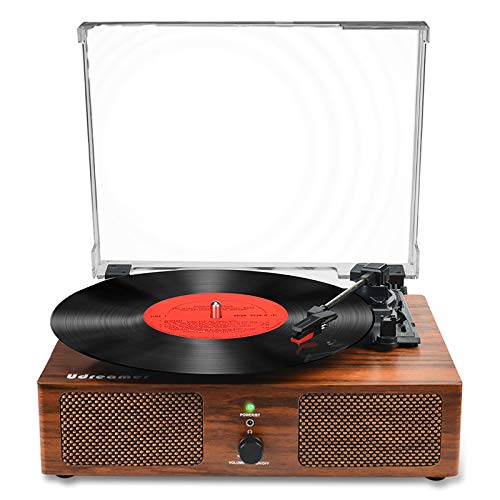
Vinyl Turntable Review Summary
The Vinyl Record Player makes sense if you want a straightforward way to play records without building a separate stereo system.
Its built-in speakers, Bluetooth input, USB playback, AUX input, and RCA output give it unusually broad flexibility for a compact all-in-one unit, which is useful for beginners, gift buyers, and anyone setting up a low-commitment record corner.
Verdict: best for casual vinyl listening, small rooms, and gift use, not for buyers chasing the most detailed sound or upgrade-heavy hi-fi paths.
Review Scorecard
| Category | Score | Why it scores that way |
|---|---|---|
| Ease of setup | 9/10 | Built-in speakers and multiple inputs reduce the need for extra gear. |
| Playback flexibility | 9/10 | Supports 33 1/3, 45, and 78 RPM plus 7, 10, and 12 inch records. |
| Everyday convenience | 8/10 | Bluetooth, USB, AUX, headphone jack, and auto stop cover multiple use cases. |
| Sound potential | 6/10 | Internal speakers are convenient, while RCA output is there if you want more volume. |
| Build and record care | 7/10 | Belt drive, tonearm lifter, and dust cover are good practical touches. |
| Gift appeal | 9/10 | Vintage wood-look styling and simple operation suit decorative and present-buying use. |
The core buying question is simple: is Vinyl Record Player worth it if you do not want to assemble a separate audio stack?
In many casual setups, yes.
The product is clearly designed around convenience first, with enough playback options to handle a wide range of listening habits while still staying approachable.
Key Features and Specifications of Vinyl Turntable
This record player is built as a self-contained unit with 2 stereo speakers inside the chassis.
That matters because it lets a new buyer start listening without buying amplifier, receiver, or external speakers on day one.
It also supports several input and playback modes:
- Bluetooth input for wireless phone pairing
- USB input for direct music playback
- AUX input for 3.5 mm devices such as an iPad or CD player
- RCA output for external speakers
- Headphone jack for private listening
On the vinyl side, the table is broad enough for most common collections.
It supports 33 1/3 RPM, 45 RPM, and 78 RPM, along with 7-inch, 10-inch, and 12-inch records.
That makes it suitable for standard LPs, singles, and older discs, provided the rest of your collection is compatible.
The deck uses a belt-driven system, which the listing positions as a way to reduce vibration.
It also includes an auto stop switch, a tonearm lifter, a detachable dust cover, and a 45 RPM adapter if needed.
The styling is part of the appeal too.
The listing describes a vintage wooden look, which makes the unit feel as much like a decor object as a playback device.
That is relevant if you want the player visible on a shelf, sideboard, or desk instead of hidden in a media cabinet.
Pros and Cons of Vinyl Turntable
Pros
- All-in-one format keeps setup simple.
- Built-in stereo speakers make it usable right away.
- Bluetooth, USB, and AUX increase everyday flexibility.
- RCA output gives you an upgrade path to external speakers.
- Supports three speeds and three common record sizes.
- Auto stop, tonearm lifter, and dust cover add practical protection.
- Vintage styling works well as a gift or room accent.
Cons
- Built-in speakers usually mean convenience over depth and separation.
- Buyers focused on better fidelity will likely want external speakers.
- It is better suited to casual listening than critical audio use.
- The feature set is broad, but not specialized for advanced vinyl hobbyists.
The biggest tradeoff is obvious: this is a convenience-first turntable.
That is a strength if you are new to records or want something easy to live with, but it limits the appeal for buyers who already know they want a more upgradeable hi-fi path.
Who Should Buy Vinyl Turntable?
This player is a good fit for beginners who want to hear records without learning a lot of audio plumbing first.
It is also a strong match for gift buyers, college rooms, home offices, and small apartments where a compact, self-contained player matters more than maximum output.
It should also appeal to buyers who want a versatile media hub.
The Bluetooth, USB, and AUX inputs mean it can pull double duty as a casual music player even when a person is not spinning vinyl.
You should probably skip it if your priorities are more serious.
If you already own external amplification and care about extracting the most detail from your records, an entry-level hi-fi turntable with separate speakers or a more upgrade-friendly cartridge path will make more sense.
This is also not the best choice if your primary concern is long-term system building.
The listed strengths are convenience, compatibility, and style, not a path toward a more demanding audiophile setup.
How Vinyl Turntable Handles Everyday Use
Bluetooth and Digital Inputs
Bluetooth input is one of the most useful extras here because it lets the player act like a general-purpose speaker system when you are not using records.
The USB and AUX inputs add more flexibility, so the unit is not limited to vinyl-only sessions.
Record Playback Flexibility
Support for 33 1/3, 45, and 78 RPM is a real practical benefit.
Combined with the ability to play 7-inch, 10-inch, and 12-inch records, the player covers the standard mix most casual collectors will own.
Protection and Convenience
The tonearm lifter, auto stop switch, and dust cover show that the design is trying to reduce small annoyances.
These are not dramatic audiophile features, but they are exactly the kind of details that make a beginner-friendly turntable easier to live with.
Sound and Expansion Path
The internal stereo speakers are the simplest way to start, but the RCA output matters because it gives you a cleaner path to louder or fuller sound later.
That makes the player more flexible than a totally closed all-in-one unit.
Alternatives to Vinyl Turntable
If you want a similar beginner-friendly path with a more established record-player brand, look at the Crosley turntable line.
Crosley has a broad range of entry-level players, so it is a natural comparison for buyers shopping on style and convenience.
If you prefer a more mainstream audio brand, the Audio-Technica turntable line is worth a look.
Those models often make more sense for buyers who are already thinking about a longer-term vinyl setup.
If your goal is a compact, all-in-one design with a familiar lifestyle-brand feel, the Victrola record player line is another credible alternative.
It tends to overlap with this product category on features like built-in speakers and gift-friendly styling.
Is Vinyl Turntable Worth It?
Yes, if your goal is convenience. Vinyl Record Player is worth considering when you want a compact turntable that can play records immediately, handle several input sources, and look good in a room without demanding extra components.
It is less compelling for serious sound quality seekers, because the built-in-speaker approach is optimized for simplicity rather than maximum fidelity.
Still, the RCA output, belt drive, auto stop, and multi-speed support make it a practical pick for casual vinyl use.
If you want a simple record player for a bedroom, office, dorm, or gift, this is an easy model to justify.
If you want to build a more serious audio chain, keep shopping.