
Professional studio headphone splitters make it easier for performers, engineers, producers, and instructors to monitor the same source without sacrificing control or clarity. The right choice depends on how many listeners you need to support, which connectors your equipment uses, and whether each user needs independent volume adjustment.
This roundup covers compact passive splitters, portable headphone amplifiers, and larger powered distribution hubs for recording, rehearsal, live sound, and studio collaboration.
Best 10 Headphone Splitters for Professional Studios Picks for 2026
Best Powered Pick

- Four headphone outputs
- Independent volume controls
- Compact metal enclosure
Best For: Tracking sessions and rehearsals with up to four listeners
Best Passive Hub

- Five 1/4-inch outputs
- Independent output switches
- Supports TS or TRS cables
Best For: Studios and live setups needing five switchable destinations
Best Value Amplifier
- Four independently controlled outputs
- Includes 12V power adapter
- Compact metal construction
Best For: Small studios sharing one stereo mix with four listeners
Best Simple Cable Split

- Splits one stereo signal into two
- Shielded 1.6-foot cable
- Gold-plated TRS connectors
Best For: Simple two-device stereo splits in compact setups
Best Multi-User Amp
STABCL 8-Channel Headphone Amplifier

- Eight stereo outputs with individual volume controls
- Mono/stereo switch and audio distribution function
- Includes adapters for 1/4-inch and 1/8-inch plugs
Best For: Recording studios and stage setups with multiple headphone users
Best Simple Cable Splitter

- Splits one 1/4-inch stereo signal into two outputs
- Shielded oxygen-free copper cable supports clear transmission
- Two 30cm cables included in the package
Best For: Two-person monitoring with compatible 1/4-inch equipment
Best Compact 8-Way Distributor
Bairutong 9-Jack Headphone Amp

- Distributes audio to up to eight headphones
- Nine AUX ports support 3.5mm devices
- Compact powered design includes cable and adapter
Best For: Small studios and events using multiple 3.5mm headphones
Best Multi-Input Pick
4-Channel Studio Headphone Amplifier
- Eight headphone outputs across 1/4-inch and 1/8-inch jacks
- Independent volume control for all four channels
- RCA, 3.5mm, and 6.35mm inputs with mono/stereo switching
Best For: Studios and podcasts with multiple listeners and audio sources
Best Compact Choice
Pyle PHA40 4-Channel Headphone Amp

- Supports four headphones at once
- Independent volume knob for every channel
- Compact design for studio or on-stage use
Best For: Small sessions and portable monitoring
Best High-Capacity Pick
Arklove HP10 Headphone Amplifier
- Provides up to ten independent volume controls
- Compact metal unit for studio and stage use
- Includes a power switch and 3.5mm headphone output
Best For: Larger sessions needing many individual monitoring levels
Best Powered Pick – Mackie HM-4
The Mackie HM-4 is a practical choice for headphone splitters for professional studios when several people need to monitor one source. Its four independent outputs provide a separate level control for each listener, while the compact metal enclosure suits tracking sessions, rehearsals, and small control-room setups.
Best For: Recording sessions and rehearsals with up to four listeners who need individual volume control.
Pros:
- Drives four headphones from a 1/4-inch or 1/8-inch source output.
- Independent volume controls let each listener set a comfortable level.
- Compact metal design can be secured to a desk, rack, or stand.
Cons:
- It is a four-output unit, so larger sessions require additional distribution hardware.
- The supplied notes do not specify compatible device types beyond its input/output connections.
Choose the HM-4 if dependable powered distribution and per-listener control matter more than adding extra outputs. Its plug-and-play design keeps a monitoring setup straightforward.
Best Passive Hub – Cubilux 5-Way Splitter
The Cubilux 5-Way 6.35mm splitter is a flexible option for headphone splitters for professional studios when you need to distribute one mono or stereo feed to as many as five destinations. Its independent switches make it easy to enable or mute connected outputs without repeatedly unplugging cables.
Best For: Studios, podcast setups, and live applications using compatible 1/4-inch TS or TRS connections.
Pros:
- Offers five 1/4-inch output jacks for speakers, monitors, amplifiers, or headphones.
- Independent switches provide convenient output control.
- Gold-plated jacks and an aluminum-alloy case support durability and low-noise operation.
Cons:
- Its passive design may require turning up the source volume when multiple outputs are connected.
- It does not provide individual volume controls for listeners.
- TS and TRS cables should not be mixed in the same setup.
This is best viewed as a connection hub rather than a powered headphone amplifier. It makes sense when your connected equipment can supply the necessary level and you value five switchable outputs.
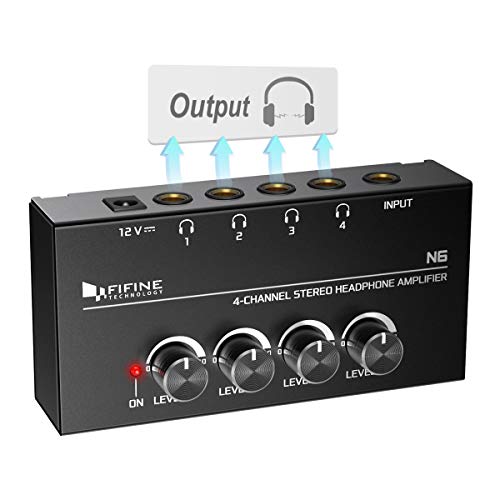
Best Value Amplifier – FIFINE N6 Headphone Amplifier
The FIFINE N6 is a compact powered solution among headphone splitters for professional studios, sharing one stereo source across four headphone outputs. Separate volume knobs, a metal build, and an included 12V adapter make it suitable for tracking, stage monitoring, and other setups requiring multiple listeners.
Best For: Small studios and performers monitoring one stereo mix through up to four quarter-inch headphones.
Pros:
- Provides four outputs with separate volume controls.
- Designed to maintain low noise and minimal distortion with all four headphones connected.
- Includes a 12V DC power adapter and power indicator light.
- Compact metal construction suits studio and stage use.
Cons:
- It has one input and four outputs; it is not a mixer.
- All input and output ports are 6.35mm, and cables are not included.
- Stereo operation requires 1/4-inch TRS cables, while mono operation uses TS cables.
The N6 is a strong fit when four-person monitoring and individual level control are priorities. Confirm your cable types and connector requirements before choosing it for a studio rack or interface.
Best Simple Cable Split – HOSONGIN 1/4-inch Y Splitter
The HOSONGIN 1/4-inch Y cable is the simplest option among headphone splitters for professional studios, splitting one stereo signal into two outputs without adding an amplifier. Its shielded construction and gold-plated TRS connectors make it useful for straightforward mixer, interface, headphone, or monitor connections.
Best For: Two-device stereo splits where the source can drive both connected outputs without separate volume control.
Pros:
- Splits one 1/4-inch TRS stereo signal into two female 1/4-inch stereo jacks.
- Shielding helps protect against EMI/RFI interference.
- Gold-plated connectors and tinned copper wire support clear signal transmission.
- Flexible 1.6-foot molded cable is suited to compact setups.
Cons:
- It provides only two outputs and has no amplification or individual volume controls.
- It cannot combine two outputs into one input.
- The short cable length may not suit widely spaced equipment.
Use the HOSONGIN when you need a basic two-way stereo connection and want minimal hardware. For multiple listeners, longer cable runs, or level control, a powered headphone amplifier is the more capable approach.
Best Multi-User Amp – STABCL 8-Channel Headphone Amplifier
For professional studios needing multiple independent headphone feeds, the STABCL 8-channel amplifier is a more capable option than a basic splitter. It provides eight stereo output channels, individual volume controls, and support for both 1/4-inch and 1/8-inch connections with the included adapters.
Best For: Recording studios, rehearsals, and stage setups where several listeners need separate volume control.
Pros:
- Eight high-power stereo amplifier channels with independent volume knobs.
- Functions as an audio distributor with one input and eight outputs.
- Offers mono/stereo switching and a metal CNC unibody design.
- Includes nine 6.35mm-to-3.5mm jack adapters.
Cons:
- Requires the included 12V AC adapter for power.
- The product notes specify that 1/8-inch devices require a conversion plug.
This is a strong choice when a professional studio needs several headphone stations rather than simply duplicating one jack. Its individual controls and robust metal construction add practical flexibility for group monitoring.
Best Simple Cable Splitter – 1/4-Inch Dual Stereo Y Cable
This 1/4-inch Y cable is a straightforward choice for headphone splitters for professional studios when you need to send one stereo signal to two headphones or other compatible devices. Its compact 30cm length keeps short connections manageable, and the package includes two cables.
Best For: Studio, DJ, amplifier, karaoke, and live-sound setups that need two 1/4-inch stereo outputs from one source.
Pros:
- Splits one 6.35mm stereo signal into two 6.35mm female stereo jacks.
- Uses gold-plated connectors and oxygen-free copper conductors.
- Multiple shielding layers are designed to resist EMI/RFI interference.
- Nylon braiding helps protect against wear, pulling, and tangling.
Cons:
- It does not combine two outputs into one input.
- It is a passive cable splitter, so it does not provide separate amplification or volume controls.
- Both the source and connected headphones need compatible 1/4-inch connections, unless additional adapters are used.
Choose this cable when the source already has enough output power and you only need a simple two-way connection. It is less suitable for larger monitoring groups or applications requiring independent level adjustment.
Best Compact 8-Way Distributor – Bairutong 9-Jack Headphone Amp
The Bairutong 9-jack unit is a compact headphone amplifier and distributor for setups using 3.5mm auxiliary connections. It accepts one input and sends the signal to up to eight headphones or audio systems, making it useful when a small studio or event needs many simultaneous listening points.
Best For: Studios, schools, events, and stage applications using multiple 3.5mm headphones or auxiliary-equipped audio devices.
Pros:
- Nine AUX ports support one input and up to eight connected outputs.
- Built-in gain chip is designed to transmit the input signal without attenuation.
- Compact 4.8-by-2-by-1-inch unit is easy to place or transport.
- Includes a 1-meter audio cable and 12V adapter.
Cons:
- Uses 3.5mm auxiliary connections rather than 1/4-inch studio jacks.
- The notes describe shared signal distribution, not individual volume controls for each output.
- Requires a 12V, 1A power supply.
This model makes sense for high-count listening setups where compact size and 3.5mm compatibility matter most. For professional rack-style monitoring with different levels per musician, an amplifier with individual channel controls may be a better fit.
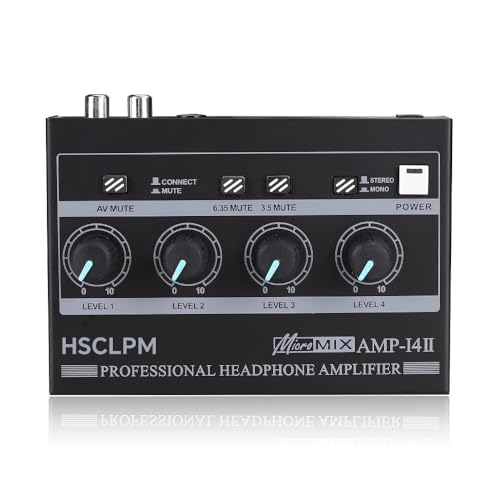
Best Multi-Input Pick – 4-Channel Studio Headphone Amplifier
For professional studios needing flexible headphone splitters for professional studios, this four-channel amplifier offers eight total output jacks, individual volume controls, and several input options. It is suited to shared monitoring setups where listeners need separate level control.
Best For: Studios, podcasts, and collaborative monitoring with multiple audio sources.
Pros:
- Provides four 1/4-inch and four 1/8-inch stereo outputs for up to eight headphones.
- Gives each channel its own volume control.
- Supports RCA, 3.5mm, and 6.35mm inputs with mute-based signal mixing.
- Includes mono/stereo switching and a dedicated power switch.
Cons:
- Requires external power through the included adapter.
- Its multiple controls and inputs may be more than needed for a simple one-source setup.
This is the most versatile option of the three for studios that need both high output capacity and flexible signal routing. Its combination of mixed inputs, independent levels, and multiple connector sizes makes it practical for varied recording and listening workflows.
Best Compact Choice – Pyle PHA40 4-Channel Headphone Amp
The Pyle PHA40 is a straightforward choice among headphone splitters for professional studios when four people need to monitor the same mix. Its compact housing, four 1/4-inch outputs, and individual level controls keep the setup simple and portable.
Best For: Small studio sessions, on-stage monitoring, and mobile recording setups.
Pros:
- Can power up to four pairs of headphones simultaneously.
- Offers an independent rotary volume control for each output.
- Uses 1/4-inch TRS input and output connections.
- Compact dimensions make it easy to carry and use on the road.
Cons:
- Provides fewer outputs than the other listed amplifiers.
- Its listed connections are limited to 1/4-inch TRS, so adapters may be needed for other headphone plugs.
- The enclosure is plastic.
Choose the PHA40 when portability and uncomplicated four-person monitoring matter more than extra routing features. It is a practical, focused solution for distributing one main mix with separate listener volume adjustments.
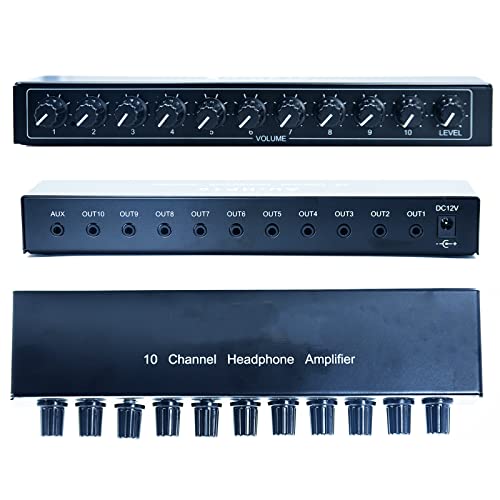
Best High-Capacity Pick – Arklove HP10 Headphone Amplifier
The Arklove HP10 stands out among headphone splitters for professional studios with its high-capacity monitoring design and up to ten independent volume controls. Its compact metal enclosure is intended for studio and stage use, with a 3.5mm input and headphone output plus compatibility with 6.35mm headphones through an adapter.
Best For: Larger recording sessions where many people need individual monitoring levels.
Pros:
- Offers up to ten independent volume controls for shared monitoring.
- Designed to power multiple headphones during recording or playback.
- Includes a power switch and 3.5mm headphone output.
- Compact metal design is suitable for studio and stage applications.
Cons:
- The notes describe four high-power stereo amplifiers despite the ten-channel positioning, so buyers should verify the exact output layout.
- 6.35mm headphones require a 3.5mm-to-6.35mm adapter.
- Uses a 12V DC power adapter rather than battery power.
The HP10 is the strongest fit when a session needs many separately adjusted listening levels in a small footprint. Confirm the channel and output configuration before purchase, especially if your setup depends on native 1/4-inch headphone connections.
How We Picked These Headphone Splitters for Professional Studios
We grouped the selected models by their intended studio role: simple signal splitting, compact multi-output monitoring, and powered headphone distribution. Key considerations included output count, connector compatibility, individual volume controls, input options, portability, construction, and suitability for stereo monitoring. Passive cables and hubs can be convenient for basic setups, while powered amplifiers are generally better when several headphones must be driven at a consistent level.
Because studio systems vary, check the product’s exact input and output specifications before buying. A 1/4-inch TRS splitter is not interchangeable with a 3.5mm-only unit without the appropriate adapter, and balanced connections should not be assumed simply because a plug uses three conductors.
Quick Comparison
| Best For | Recommended Type | Why It Fits |
|---|---|---|
| One source, two listeners | TRS Y-splitter cable | Low-cost, compact, and easy to pack |
| Small recording sessions | Four-channel headphone amplifier | Multiple outputs with practical studio monitoring |
| Large tracking groups | Eight- or nine-output powered amp | Supports more listeners from one source |
| Mobile or compact rigs | Portable mini amplifier | Uses less desk space and travels easily |
| Mixed studio equipment | Multi-input distribution amp | Accommodates RCA, 3.5mm, and 1/4-inch sources |
Key Buying Factors for Headphone Splitters for Professional Studios
Output Count and Volume Control
Count the headphones you need to connect now, then allow some room for future sessions. Individual volume knobs are especially useful when musicians have different hearing preferences or headphone sensitivities. Shared-volume designs are simpler but less flexible.
Power and Signal Performance
Passive splitters are suitable for short, uncomplicated connections, but adding multiple headphones can reduce available drive and may affect listening level. A powered amplifier is the safer choice for several listeners, long sessions, or demanding headphones. Look for clean stereo operation, low noise, and enough output power for your headphones’ impedance.
Connectors and Compatibility
Confirm whether your source uses 3.5mm, 1/4-inch, RCA, or another connection. For professional studio equipment, 1/4-inch TRS is common, while consumer devices often use 3.5mm. Adapters can solve size differences, but they do not replace proper signal routing or balanced equipment.
Build and Convenience
Metal housings, sturdy jacks, clear labeling, and strain relief matter when equipment is frequently moved. Also check whether the unit includes a power adapter and whether its layout leaves enough room for bulky headphone plugs.
Who Should Buy Which Headphone Splitters for Professional Studios?
Choose a passive Y-cable if you only need to share one stereo source with one additional listener and want the smallest, least expensive solution. Select a four-channel amplifier for home studios, podcast rooms, teaching spaces, and typical tracking sessions. For bands, rehearsal rooms, or larger production teams, an eight- or nine-output powered distributor is more practical. If your setup changes often, prioritize a unit with multiple input types and independent controls. Portable creators should favor compact amplifiers that match their source connector and can fit comfortably beside the rest of the recording rig.