
When it comes to achieving high-quality audio, the right audio interface for your XLR microphone can make a significant difference. You might be surprised by the variety of options available, each offering unique features to enhance your sound. From compact designs suited for travel to robust setups ideal for studio environments, there’s something for everyone. Let’s explore some of the best choices to elevate your audio experience and find the perfect fit for your needs.
Focusrite Scarlett Solo 3rd Gen USB Audio Interface

The Focusrite Scarlett Solo 3rd Gen USB Audio Interface is an ideal choice for musicians, podcasters, and vocalists seeking professional-quality recordings without the hassle. With high-performing mic pre-amps and a switchable Air mode, you’ll achieve crystal-clear sound. It features two high-headroom instrument inputs, ensuring excellent guitar and bass recordings without distortion, thanks to the Gain Halos. The interface supports up to 24-bit/192kHz, capturing the nuances of your music or podcast perfectly. Plus, its low-noise balanced outputs provide clean audio playback, making it perfect for streaming. Included software like Pro Tools Intro+ enhances your recording experience, backed by a three-year warranty.
Best For: Musicians, podcasters, and vocalists seeking professional-quality recordings with ease and convenience.
Pros:
- High-performing mic pre-amps with switchable Air mode for enhanced clarity.
- Supports studio-quality recordings up to 24-bit/192kHz, capturing detailed sound.
- Includes valuable software tools like Pro Tools Intro+ and a three-year warranty.
Cons:
- Limited to two inputs, which may not be sufficient for larger setups.
- Lacks advanced features found in higher-end audio interfaces, such as MIDI connectivity.
- May require additional equipment for optimal performance, like microphones and cables.
FIFINE Gaming Audio Mixer with XLR Microphone Interface

If you’re a gamer or streamer looking to elevate your audio quality, the FIFINE Gaming Audio Mixer with XLR Microphone Interface is an excellent choice. Its single XLR input with 48V phantom power guarantees your condenser mic shines, enhancing your audio clarity. You’ll appreciate the four independent channels for precise volume control and the front mute button for eliminating background noise. Plus, the customizable sound effects and voice modulation options elevate your streaming experience. With user-friendly plug-and-play compatibility and vibrant RGB lighting, it’s designed to keep your audience engaged while providing stellar sound quality.
Best For: Gamers and streamers seeking to enhance their audio quality with professional-grade equipment.
Pros:
- High-quality audio input: The XLR microphone input with 48V phantom power improves clarity for condenser microphones.
- Customizable features: Offers sound effects and voice modulation options to enhance the streaming experience.
- User-friendly setup: Plug-and-play compatibility with dual PC settings makes it easy to connect and use.
Cons:
- Limited microphone compatibility: Not compatible with USB microphones, which may limit options for some users.
- Missing XLR cable: The required shielded XLR cable is not included, potentially adding extra costs for users.
- Complexity for beginners: The multiple features and channels may be overwhelming for users new to audio mixing.
MAONO USB Audio Interface for PC (PS22 Lite Black)

For podcasters and voice actors looking to elevate their sound quality, the MAONO USB Audio Interface PS22 Lite Black stands out with its high-resolution recording capabilities of 24-bit/192kHz. Its compact design fits comfortably in your hand, while the dynamic light ring helps you monitor sound input easily. You’ll appreciate the support for both condenser and dynamic microphones, with up to 56 dB preamp and 48V phantom power. Plus, the included ProStudio Routing Software guarantees smooth live streaming. Plug-and-play functionality and user-friendly modes make setup a breeze, letting you focus on creating stunning audio without the hassle.
Best For: Podcasters and voice actors seeking high-quality audio recording with a user-friendly interface.
Pros:
- Supports high-resolution recording at 24-bit/192kHz for superior sound quality.
- Compact design with an intuitive light ring for easy monitoring of sound input.
- Plug-and-play functionality and dedicated software make setup simple for beginners.
Cons:
- Limited to XLR input, which may not suit users with USB microphones.
- 48V phantom power may not be compatible with all microphones.
- Some users may find the dynamic range of 106dB less impressive compared to higher-end models.
Shure MVX2U XLR-to-USB Digital Audio Interface

Designed for content creators and musicians who demand high-quality sound without the hassle, the Shure MVX2U XLR-to-USB digital audio interface streamlines your audio experience. With 60dB gain and 48V phantom power, it transforms any XLR microphone into a professional tool. Its plug-and-stream functionality makes broadcasting a breeze, while universal compatibility guarantees it works with both dynamic and sensitive condenser mics. You’ll appreciate the built-in 3.5mm headphone jack for zero-latency monitoring, allowing you to hear exactly what your audience hears. Plus, its compact design keeps your workspace tidy, making setup flexible and straightforward.
Best For: Content creators and musicians seeking high-quality sound with a user-friendly audio interface.
Pros:
- Universal compatibility with both dynamic and condenser microphones.
- Zero-latency monitoring through the built-in headphone jack for real-time audio feedback.
- Compact design that minimizes workspace clutter while maintaining performance.
Cons:
- Limited to XLR microphones, which may not appeal to users with USB mics.
- Requires additional equipment (XLR microphone and cable) for use.
- Potentially higher learning curve for those unfamiliar with audio interfaces.
Audio Interface, 2X2 24-bit/192kHz for Studio Quality Recording

The 2X2 24-bit/192kHz audio interface is perfect for musicians and content creators who demand studio-quality recordings. With plug-and-play USB C connectivity, you’ll enjoy seamless integration without the hassle of drivers. Its high-performance converters deliver crystal-clear, low-noise audio, ensuring every nuance is captured. You’ll benefit from integrated 48V phantom power for condenser mics and zero-latency monitoring for silent tracking. The elegant design features illuminated control knobs for easy use in low light, while the built-in 3.5mm headphone jack enhances compatibility. This versatile interface is ideal for home recording, music production, or on-the-go creativity.
Best For: Musicians and content creators seeking high-quality audio solutions for home recording and mobile use.
Pros:
- Plug-and-play USB C connectivity allows for effortless setup without the need for drivers.
- Studio-grade audio fidelity at 24-bit/192kHz captures intricate details with a wide dynamic range.
- Integrated 48V phantom power supports the use of demanding condenser microphones.
Cons:
- Limited to two channels, which may not be sufficient for larger recording setups.
- The elegant design may not be ideal for more rugged, on-the-go environments.
- Built-in headphone jack may not support all headphone types, potentially limiting compatibility.
M-AUDIO M-Track Solo USB Audio Interface

If you’re looking for an affordable yet powerful option to enhance your recording, streaming, or podcasting setup, the M-AUDIO M-Track Solo USB Audio Interface stands out. It’s compatible with both Mac and PC, delivering 48kHz audio resolution for high-quality recordings. With one combo XLR/Line input featuring phantom power, you can easily connect your microphone. There’s also a Line/Instrument input for guitars. Monitor your sound through the 1/8 headphone output or stereo RCA outputs, and enjoy zero latency with the USB/Direct switch. Plus, it includes MPC Beats Software to kickstart your music production journey.
Best For: The M-AUDIO M-Track Solo USB Audio Interface is best for beginner musicians, podcasters, and streamers seeking an affordable yet reliable audio recording solution.
Pros:
- High-quality 48kHz audio resolution ensures professional sound quality for recordings.
- Versatile input options with combo XLR/Line input and Line/Instrument input accommodate various devices.
- Included MPC Beats Software provides essential tools for music production, enhancing creative possibilities.
Cons:
- Limited input options with only one XLR/Line input may not suffice for multi-mic setups.
- Basic monitoring capabilities might not meet the needs of advanced users requiring more detailed sound analysis.
- No MIDI input/output, limiting connectivity with other musical equipment.
M-AUDIO M-Track Duo USB Audio Interface for Recording and Podcasting
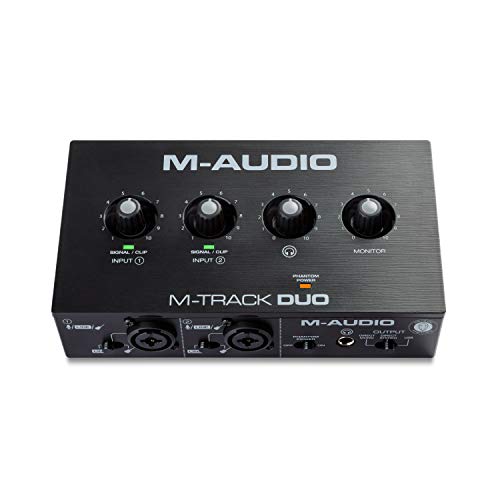
For those seeking an affordable yet high-quality audio interface for recording, streaming, or podcasting, the M-AUDIO M-Track Duo USB Audio Interface stands out. It’s compatible with both Mac and PC, delivering crisp 48kHz audio resolution. With two combo XLR/Line/Instrument inputs and phantom power, you can easily record guitars and vocals. Enjoy zero latency monitoring via the USB/Direct switch, along with a 1/4 headphone output and stereo outputs for flexible monitoring. Plus, its transparent Crystal Preamps guarantee ideal sound quality for all microphones, including condensers. The included MPC Beats Software enhances your music production experience considerably.
Best For: Musicians, podcasters, and streamers looking for an affordable, high-quality audio interface to enhance their recording experience.
Pros:
- Versatile Inputs: Two combo XLR/Line/Instrument inputs with phantom power for a variety of recording options.
- Zero Latency Monitoring: USB/Direct switch allows for real-time audio feedback, improving performance during recordings.
- High-Quality Sound: Transparent Crystal Preamps ensure optimal sound quality for all types of microphones.
Cons:
- Limited Inputs: Only two inputs may not be sufficient for larger recording setups.
- Basic Software: While MPC Beats is included, some users may prefer more advanced software options.
- No MIDI Connectivity: Lacks MIDI input/output, which may limit integration with MIDI devices.
Elgato Wave XLR MK.2 USB Audio Interface and DSP Mixer for XLR Microphones

Designed for streamers and content creators, the Elgato Wave XLR MK.2 USB Audio Interface and DSP Mixer delivers exceptional audio quality with its 80dB gain, ensuring that any XLR microphone sounds loud and clear. You’ll enjoy a loud, clear headphone output with ultra-low latency, letting you hear exactly what your audience hears. The onboard effects, including Voice Tune and Compressor, enhance your sound effortlessly. With touch mute functionality and LED feedback, you can control your audio with ease. Plus, it’s compatible with Stream Deck, PC, and Mac, making it a versatile choice for any setup.
Best For: Streamers and content creators looking for high-quality audio performance and advanced mixing capabilities in a compact interface.
Pros:
- Exceptional audio quality with 80dB gain, ensuring clarity for any XLR microphone.
- User-friendly features like touch mute functionality and LED feedback for easy audio control.
- Onboard effects such as Voice Tune and Compressor allow for professional sound enhancement.
Cons:
- Limited to XLR microphones, which may not suit users with USB mics.
- Compatibility restricted to Stream Deck, PC, and Mac, potentially excluding some users.
- Higher price point compared to basic audio interfaces, which may deter budget-conscious buyers.
Shure MVX2U Gen 2 XLR-to-USB-C Digital Audio Interface
The Shure MVX2U Gen 2 XLR-to-USB-C Digital Audio Interface is perfect for content creators seeking high-quality sound in a portable format. It offers seamless audio processing with features like Auto Level Mode, Real-Time Denoiser, and Digital Popper Stopper, ensuring zero-latency recording. Plug-and-play convenience lets you connect any XLR microphone effortlessly, providing up to +60 dB clean gain and 48V phantom power. With compatibility across devices and MOTIV apps, you can customize your audio with ease. Whether you’re podcasting, streaming, or recording, this interface delivers professional results wherever you go. Enhance your sound quality with the Shure MVX2U today!
Best For: Content creators, podcasters, and streamers seeking high-quality audio in a portable format.
Pros:
- High-performance digital audio processing with features like Auto Level Mode and Real-Time Denoiser for professional sound quality.
- Plug-and-play convenience with compatibility across various devices, enabling easy connection of any XLR microphone.
- Customizable audio settings through MOTIV apps, allowing users to adjust tone, EQ, compression, and limiting for tailored sound.
Cons:
- Limited to XLR microphones, which may not suit users with other microphone types.
- Requires a compatible device (desktop, tablet, or smartphone) for full functionality, potentially limiting use in some scenarios.
- Depending on the microphone used, users may still need to manage audio levels manually in certain situations despite the Auto Level Mode.
XTUGA USB Audio Interface for PC

Ideal for students and beginners, the XTUGA USB Audio Interface Q-12 offers a straightforward solution for those looking to set up a 2-channel home studio. This interface connects easily via USB, requiring no external adapter, making it perfect for mobile karaoke or on-the-go music creation. With professional 16-bit/48kHz resolution and 48V phantom power, you’ll enjoy crystal-clear sound and seamless vocal tracking. Its durable build guarantees longevity, while compatibility with popular software like Audacity and Pro Tools keeps your workflow smooth. Plus, it’s budget-friendly, making it an excellent choice for entry-level users aiming to enhance their sound quality.
Best For: Students and beginners looking to create a budget-friendly 2-channel home studio setup.
Pros:
- Plug-and-play functionality allows for easy setup without the need for external power adapters.
- Professional audio quality with 16-bit/48kHz resolution ensures crystal-clear recordings.
- Durable build designed for longevity, making it ideal for home karaoke and music creation on the go.
Cons:
- Limited to 2 channels, which may not be sufficient for more advanced users or larger projects.
- Basic features might not meet the needs of professional musicians or sound engineers.
- Lower customer ratings (4.0 out of 5 stars) suggest some users may experience issues or have concerns.
Factors to Consider When Choosing an Audio Interface for XLR Microphones
When choosing an audio interface for your XLR microphone, you’ll want to take into account several key factors. Think about the connectivity options available, whether you need phantom power, and the sound quality specs that fit your needs. Additionally, don’t forget to check the monitoring features and software compatibility to guarantee a seamless setup.
Connectivity Options Available
Choosing the right connectivity options for your audio interface can greatly enhance your recording experience with XLR microphones. XLR microphones connect via XLR cables, providing a balanced connection that minimizes noise and interference. Look for audio interfaces with USB-C or USB-A connectivity for easy plug-and-play setup with computers and devices, eliminating the need for extra drivers. Some interfaces even offer dual connectivity options, allowing you to switch between XLR and line inputs, which adds versatility to your recording setup. Additionally, zero-latency monitoring is a key feature in many interfaces, enabling you to hear your input signal in real-time without any delay. These factors will help you achieve the best sound quality when using your XLR microphone.
Phantom Power Requirements
Phantom power is essential for getting the best performance out of condenser microphones, which generally need 48V to function properly. When choosing an audio interface, look for one that includes a phantom power switch, allowing you to enable or disable this feature as needed. Verify the interface can supply sufficient phantom power for all connected microphones; some may have limitations on how many channels can receive power simultaneously. An audio interface with built-in phantom power simplifies your setup, eliminating the need for external power supplies or separate preamps. Always check the specifications of both your microphone and audio interface to guarantee compatibility with phantom power requirements, so you can achieve the best audio quality possible.
Sound Quality Specifications
Selecting the right audio interface for your XLR microphone hinges on understanding sound quality specifications. Aim for an interface that supports at least 24-bit/192kHz resolution to capture every detail of your sound. A dynamic range of at least 106 dB is essential for achieving clarity and depth, minimizing noise and distortion in your recordings. Make sure the interface includes integrated phantom power, typically 48V, to properly power your condenser microphones. Look for zero-latency monitoring, which lets you hear your input in real-time without delays—this can greatly enhance your performance. Finally, prioritize high-performance preamps; transparent preamps maintain your microphone’s natural tone and markedly improve overall audio fidelity. Choose wisely, and you’ll elevate your sound quality.
Monitoring Features Included
When it comes to recording with an XLR microphone, monitoring features can greatly enhance your experience and output quality. Look for audio interfaces that include built-in headphone outputs for real-time audio monitoring, allowing you to hear exactly what’s being recorded without latency. Zero-latency monitoring is essential for live performances and recordings, as it guarantees there’s no delay between input and output signals. Many interfaces offer direct monitoring switches, letting you choose between listening to the input directly or through software playback. Visual feedback like LED indicators helps you keep track of levels, ensuring peak performance. High-quality interfaces may also provide adjustable monitoring levels and additional outputs for flexible monitoring setups in different recording environments.
Software Compatibility Support
Understanding software compatibility is essential for maximizing the potential of your XLR microphone setup. Confirm your audio interface works seamlessly with popular digital audio workstations (DAWs) like Pro Tools, Ableton Live, and Cubase. This compatibility can greatly enhance your recording and editing experience. Look for interfaces that come with bundled software, which can provide valuable effects, instruments, and mastering tools, benefiting both beginners and seasoned producers. It’s also important to choose interfaces supporting ASIO drivers, as they reduce latency during recordings or streaming. Verify that your interface offers plug-and-play functionality for Mac or Windows to simplify setup and minimize technical issues. If you plan to record on the go, check for mobile device compatibility and dedicated apps for added convenience.
Portability and Design
Choosing the right audio interface for your XLR microphone setup involves considering both portability and design. Look for a compact and lightweight model that’s easy to transport for mobile recording or live streaming. A rugged build quality is essential, ensuring it withstands travel and frequent use for long-lasting durability. Many portable interfaces offer plug-and-play functionality, allowing for quick setup without extra drivers or power sources. Ergonomic designs can help reduce cable clutter, keeping your workspace tidy during sessions. Additionally, features like dynamic light rings or illuminated control knobs enhance usability in low-light environments, making your recording experience smoother and more efficient. Prioritize these aspects to get the best out of your audio interface.