
When you’re in the market for a condenser microphone, low self-noise is essential for achieving pristine audio quality. Whether you’re recording vocals, instruments, or podcasts, the right mic can make a significant difference in your sound. In this guide, you’ll discover top contenders that excel in clarity and noise handling. From professional studio options to budget-friendly choices, there’s something for every need. Let’s explore these standout microphones further.
RØDE NT1 5th Gen Studio Condenser Microphone

If you’re looking for a versatile microphone that excels in both studio and home settings, the RØDE NT1 5th Gen is an excellent choice. This large-diaphragm condenser mic features XLR and USB outputs, making it perfect for music production, vocal recording, and podcasting. You’ll appreciate its warm, silky sound and ultra-low self-noise, ideal for capturing everything from voiceovers to instruments. With RØDE’s high-gain Revolution Preamp and 192kHz conversion, your recordings will be crystal clear. Plus, its durable aluminum body guarantees it’s built to last, making it a reliable companion for your audio projects.
Best For: The RØDE NT1 5th Gen is best for musicians, podcasters, and content creators seeking high-quality audio capture in both studio and home environments.
Pros:
- Versatile Connectivity: Supports both XLR and USB outputs, making it suitable for various recording setups.
- Exceptional Sound Quality: Offers a warm, silky character with extremely low self-noise and high SPL handling.
- Durable Build: Crafted from high-grade aluminum with military-grade coating, ensuring longevity and reliability.
Cons:
- Price Point: May be considered expensive for those on a tight budget.
- Requires Interface for XLR: XLR output requires an additional audio interface or mixer for use, which could add to the overall cost.
- Limited Built-in Features: Lacks advanced features like onboard effects or EQ that some users may expect from high-end microphones.
Audio-Technica AT2020 Cardioid Condenser Studio XLR Microphone
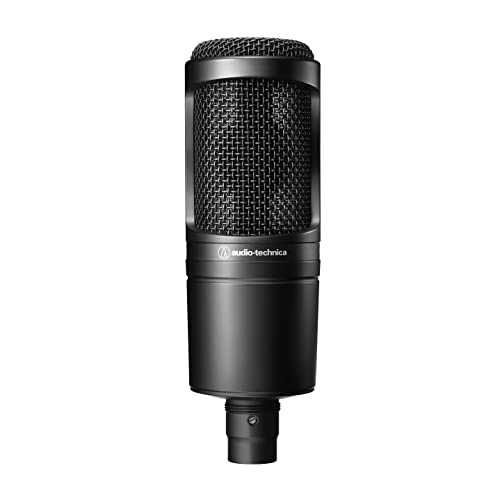
The Audio-Technica AT2020 Cardioid Condenser Studio XLR Microphone stands out as an exceptional choice for aspiring musicians and podcasters seeking professional audio quality in their recordings. With its custom-engineered low mass diaphragm, you’ll enjoy an extended frequency response and superior transient response. This microphone excels in project and home studio applications, offering high SPL handling and a wide dynamic range for unmatched versatility. Its cardioid polar pattern effectively isolates your desired sound source while minimizing background noise. Plus, the integral 3-pin XLRM connector guarantees a reliable connection. You won’t be disappointed with the AT2020’s performance!
Best For: The Audio-Technica AT2020 is best for aspiring musicians and podcasters looking for professional-grade audio quality in home or project studio settings.
Pros:
- High SPL handling allows for versatility in capturing loud sound sources without distortion.
- Cardioid polar pattern effectively isolates the desired sound while reducing background noise.
- Durable design and reliable XLR connector ensure longevity and stable connections for various applications.
Cons:
- Requires phantom power, which may necessitate additional equipment if not already available.
- Limited built-in features compared to more expensive models, such as onboard controls or effects.
- Sensitive to plosives, requiring the use of a pop filter for optimal vocal recordings.
FIFINE USB Microphone for MAC OS and Windows (K669B)

Looking for a reliable microphone that seamlessly works with both MAC OS and Windows? The FIFINE USB Microphone (K669B) is your go-to choice. This metal condenser mic features a plug-and-play setup with a 5.9-foot USB cable, making it easy to connect directly to your USB-A port. Its durable design guarantees stability during recordings, while the cardioid pattern effectively captures your voice, minimizing background noise. With an adjustable volume knob, you can control sensitivity for clear audio during gaming, streaming, or voiceovers. Plus, it’s compatible with popular applications like Discord, Zoom, and OBS. Enjoy exceptional sound quality with this versatile microphone!
Best For: Those who need a versatile and reliable microphone for recording vocals, streaming, and voiceovers on both MAC OS and Windows.
Pros:
- Plug-and-play setup with a 5.9-foot USB cable allows for easy connection and use.
- Durable metal design and stable tripod stand provide excellent support during recordings.
- Adjustable volume knob enables sensitivity control for clear sound capture in various applications.
Cons:
- Not compatible with Xbox and phones, limiting its versatility for some users.
- Requires a USB-A port for connection, potentially necessitating an adapter for some devices.
- The weight of 0.35 pounds may not be ideal for users seeking ultra-lightweight options.
Logitech Blue Yeti USB Microphone for PC and Gaming

Designed for creators and gamers alike, the Logitech Blue Yeti USB Microphone delivers broadcast-quality sound that enhances your audio experience. With its custom three-capsule array, you’ll capture every nuance of your voice, whether you’re streaming on Twitch or recording a podcast. The microphone features four pickup patterns, allowing you to choose the best setting for your needs. Plus, onboard controls make it easy to adjust volume, mute, and select patterns. Its plug-and-play functionality means you can set it up quickly on both Mac and PC, making it a perfect choice for any audio project. Enjoy pristine sound with the Yeti!
Best For: Creators, gamers, and podcasters looking for a high-quality USB microphone to enhance their audio experience.
Pros:
- Custom three-capsule array ensures clear and powerful sound capture.
- Versatile pickup patterns allow for tailored audio settings for different recording scenarios.
- Plug-and-play functionality makes setup quick and easy on both Mac and PC.
Cons:
- Bulky design may require additional space on a desk.
- Requires Logitech G HUB for full feature access, which may not be ideal for all users.
- Price point may be higher compared to basic USB microphones.
ZealSound Podcast Microphone for PC

For podcasters and streamers seeking high-quality audio, the ZealSound Podcast Microphone for PC stands out with its studio-quality sound and intelligent noise reduction features. Its cardioid pickup pattern hones in on your voice while minimizing background noise, making it ideal for various environments. The plug-and-play USB design guarantees easy setup across devices, including PCs and mobile platforms. With real-time monitoring and adjustable controls, you’ll have complete audio oversight. Plus, the durable build and accessory package assure a professional recording experience. Enjoy crisp, clear sound with the ZealSound, perfect for all your content creation needs.
Best For: Podcasters and streamers who need high-quality audio with noise reduction capabilities in a user-friendly design.
Pros:
- Studio-quality sound with intelligent noise reduction for clear recordings.
- Plug-and-play functionality compatible with various devices and platforms.
- Durable construction and complete accessory package for a professional experience.
Cons:
- Limited to USB connectivity, which may not suit all users.
- May require additional adjustment for optimal sound in noisy environments.
- Some users might find the monitoring volume control less intuitive.
FIFINE Studio Condenser USB Microphone Kit (T669)
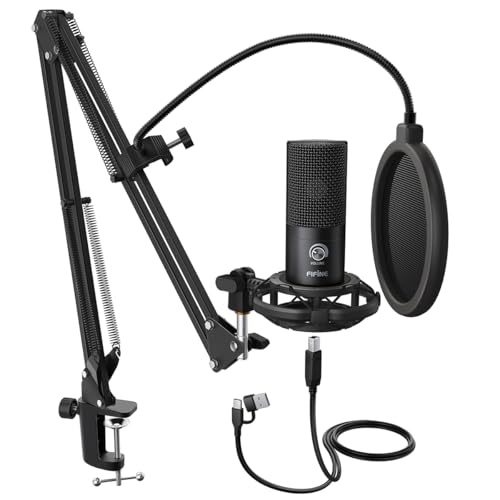
The FIFINE Studio Condenser USB Microphone Kit (T669) stands out as an excellent choice for content creators who want high-quality audio without complicated setups. With its USB output, you can easily plug and play on your PC or laptop. Its cardioid condenser capsule captures clear audio while minimizing background noise, offering a robust signal-to-noise ratio of 78 dB. The included adjustable boom arm and double pop filter enhance your recording experience by allowing ideal positioning and reducing unwanted sounds. Plus, it comes with a one-year warranty and solid customer support, making it a reliable option for all your audio needs.
Best For: Content creators, podcasters, and gamers seeking a user-friendly microphone that delivers high-quality audio.
Pros:
- High-quality sound: Offers a wide frequency response and clear audio capture with minimal background noise.
- User-friendly setup: USB plug-and-play design makes it easy to connect to PCs and laptops.
- Versatile accessories: Includes an adjustable boom arm and double pop filter for enhanced recording flexibility.
Cons:
- Limited to USB connection: Not suitable for devices without USB ports.
- Requires external power: May need a powered USB hub for optimal performance.
- Boom arm stability: Some users may find the boom arm less stable under heavy use.
Superlux CMH8AMKII True Condenser Microphone Kit

With a true condenser microphone featuring a 1” cardioid capsule, the Superlux CMH8AMKII True Condenser Microphone Kit stands out as an excellent choice for musicians and podcasters seeking high-quality audio. Its impressive frequency response of 30 Hz–20 kHz and low self-noise of just 5 dB(A) guarantee pristine sound. The 3μm gold-plated diaphragm captures rich lows, present mids, and clear highs, making it ideal for vocals and nuanced instruments. Included accessories like the HM7 shock mount and pop filter enhance your recording experience while minimizing background noise. This mic delivers an open soundstage and strong dynamics, perfect for any audio project.
Best For: Musicians, podcasters, and audio professionals seeking high-quality recording with a versatile microphone.
Pros:
- Exceptional frequency response (30 Hz–20 kHz) for capturing a wide range of sounds.
- Low self-noise (5 dB(A)) ensures clear recordings without background hiss.
- Includes useful accessories like a shock mount and pop filter for improved recording quality.
Cons:
- Requires phantom power to operate, which may limit compatibility with some devices.
- Cardioid pickup pattern may not be ideal for capturing sound from multiple sources simultaneously.
- Slightly heavier design may be less convenient for portable setups.
Shure SM4 Studio Recording Microphone Kit (SM4-K-KIT)

Offering exceptional audio quality, the Shure SM4 Studio Recording Microphone Kit (SM4-K-KIT) stands out as an ideal choice for musicians and content creators seeking professional-grade sound. Its brass 1-inch dual-diaphragm capsule captures both rich lows and detailed highs, while the uniform cardioid polar pattern guarantees clarity by minimizing unwanted noise. With a capacity to handle sounds up to 140dB, you won’t worry about distortion during loud recordings. The rugged, all-metal design assures durability, and the included accessories, like the magnetic pop filter and shock mount, make setup easy. You’ll appreciate its sleek look, perfect for video shoots and live streams.
Best For: Musicians and content creators seeking professional-grade sound quality for studio recordings and live performances.
Pros:
- Superior audio quality with a brass 1-inch dual-diaphragm capsule for rich lows and detailed highs.
- Durable all-metal construction designed to withstand both stage and studio environments.
- Includes essential accessories like a detachable pop filter and shock mount for easy setup and mix-ready audio.
Cons:
- May be more expensive than entry-level microphones, making it less accessible for beginners on a budget.
- The cardioid polar pattern may not be ideal for capturing sound from multiple sources simultaneously.
- Slightly heavier than some other microphones, which could affect portability for some users.
MAONO USB Gaming Microphone with Noise Cancellation

Gamers and streamers seeking crystal-clear audio will appreciate the MAONO USB Gaming Microphone with noise cancellation technology. This mic effectively eliminates background noise, thanks to its cardioid pickup pattern that captures sound from the front. You’ll love the one-click mute button for quick audio control and the mic gain knob to adjust your voice levels. Plus, with controllable RGB lighting featuring nine modes, it enhances your gaming setup. Its plug-and-play design guarantees easy compatibility with Windows, Mac, and PS4/PS5. The sturdy metal boom arm and shock mount further improve your audio experience, making it a solid choice for any gamer.
Best For: Gamers and streamers looking for a high-quality microphone that delivers clear audio and eliminates background noise.
Pros:
- Noise Cancellation: Effectively reduces background noise for clearer audio during gaming and streaming.
- Easy Setup: Plug-and-play design with no drivers required, making it compatible with Windows, Mac, and PS4/PS5.
- Adjustable Features: Includes a mic gain knob and one-click mute button for convenient audio control.
Cons:
- Limited Compatibility: Not compatible with Xbox consoles.
- Size and Portability: The sturdy boom arm may not be suitable for small or cluttered setups.
- RGB Lighting Dependency: The aesthetic RGB lighting may be unnecessary for users who prefer a minimalist look.
MAONO XLR/USB Condenser Microphone (A04 Gen2)

The MAONO XLR/USB Condenser Microphone (A04 Gen2) stands out as an excellent choice for podcasters and content creators seeking exceptional audio quality. With a sampling rate of 192kHz/24bit and a cardioid polar pattern, it captures studio-quality sound, perfect for your voiceovers and singing. Its dual connectivity allows seamless use with laptops, PCs, and even gaming consoles like PS4/PS5. Plus, the included accessories, such as the adjustable scissor arm and pop filter, enhance your setup. Enjoy customizable audio settings through MAONO Link software, ensuring your recordings are crisp and clear every time.
Best For: Content creators, podcasters, and musicians seeking high-quality audio recording and versatile connectivity options.
Pros:
- Studio-quality sound with a high sampling rate of 192kHz/24bit, ideal for professional recordings.
- Dual connectivity options (XLR & USB) provide flexibility for various devices, including PCs and gaming consoles.
- Included accessories such as a scissor arm stand and pop filter enhance the recording experience and setup ease.
Cons:
- Not compatible with Xbox, limiting its use for some gamers.
- XLR cable not included, requiring an additional purchase for XLR connectivity.
- Customization features (like MAONO Link software) are only available in USB mode, limiting options for XLR users.
Factors to Consider When Choosing a Condenser Microphone With Low Self Noise
When choosing a condenser microphone with low self noise, you’ll want to take into account several key factors. Think about the type of microphone you need, its frequency response range, and the self-noise specification. Additionally, pay attention to the polar pattern and connectivity options to make certain it fits your recording setup perfectly.
Microphone Type Selection
Choosing the right condenser microphone requires careful consideration of several key factors, especially if you want low self-noise for pristine audio recordings. First, look at the diaphragm type; larger diaphragms typically offer a warmer sound and improved low-frequency response. Next, evaluate the polar pattern—cardioid or omni—since this affects how the mic captures sound from various angles, impacting isolation. Pay close attention to the self-noise level, measured in dB; lower values mean cleaner recordings with less unwanted hiss. Also, consider microphones with high SPL handling to capture loud sounds without distortion. Finally, additional features like built-in pop filters or shock mounts can enhance sound quality by reducing plosive sounds and vibrations, making your recordings even better.
Frequency Response Range
Understanding frequency response range is essential for selecting a condenser microphone that delivers low self-noise and high-quality recordings. This range, measured in Hertz (Hz), determines the variety of sound frequencies the microphone can effectively capture. A wider frequency response lets you pick up more detail, which is vital for recording both vocals and musical instruments. Most studio condenser microphones cover a standard range from 20Hz to 20kHz, encompassing the full spectrum of human hearing. If you need to capture high-frequency sounds, like cymbals or vocal sibilance, look for microphones with an extended frequency response. Additionally, consider the frequency response curve, as it influences how different frequencies are amplified or attenuated, shaping the tonal balance of your recordings.
Self-Noise Specification
Although self-noise might seem like a minor detail, it can greatly affect your recording quality. Self-noise refers to the inherent noise produced by the microphone itself, measured in decibels (dB). A lower self-noise rating indicates better sound quality, allowing for clearer recordings without distracting background noise. If you’re aiming for sensitive applications like studio recording or capturing quiet vocals, look for microphones with self-noise levels below 10 dB, as they’re typically considered excellent. Remember, self-noise has a considerable impact on the overall dynamic range of your recordings. The design of the microphone, including the quality of its components and diaphragm type, plays an essential role in its self-noise performance, so choose wisely to guarantee pristine audio quality.
Polar Pattern Consideration
When selecting a condenser microphone with low self-noise, considering the polar pattern is essential for capturing the best audio quality. The polar pattern determines how sensitive the microphone is to sound from different directions. A cardioid pattern is ideal for most recording environments, as it focuses on sound from the front while rejecting noise from the sides and rear. This feature minimizes background interference, making it perfect for vocals and instruments in live or studio settings. On the other hand, omnidirectional microphones capture sound equally from all directions, which can be useful for recording multiple sources but may also pick up unwanted ambient noise. Understanding these patterns helps you choose the right microphone for your specific audio needs.
Connectivity Options Available
Choosing the right polar pattern helps narrow down your options, but the connectivity of the condenser microphone can greatly impact your recording experience. Typically, you’ll find XLR and USB connections. XLR is preferred in professional settings because it carries balanced audio signals, minimizing interference and allowing for longer cable runs without losing quality. On the other hand, USB microphones offer plug-and-play convenience, making them perfect for home studios or casual recording. Some models even feature dual connectivity, giving you the flexibility to switch between studio setups and direct digital recording. Verify your microphone is compatible with your devices, like computers or audio interfaces, to guarantee seamless integration into your existing setup.